Recently, there has been some news that is quite eye-catching.On November 19, 2025, ADC Biotechnology Company Lifordi Immunotherapeutics announced the completion of a new round of strategic financing of $42 million. The funds are mainly used for ADC beyond tumors— LFD-200, which targets VISTA, one of the most competitive emerging targets (for both cancer and autoimmunity).
Earlier, ABBV-773 also gained significant attention; domestically, one of the leaders in ADC, Ying’en Bio, is working hard to develop DB-2304, which is also an ADC drug for autoimmunity.
The author believes that under these circumstances, ADC drug therapy may be a very important potential trend in the future, and we must pay attention to it. Today, the author mainly uses ABBV-773’s development journey to write this article, hoping to provide some help to future researchers.
01
Pioneer ABBV-773’s Birth
Born from the autoimmunity drug king Humira, MNC AbbVie became a pioneer in this era of competition, and ABBV-773 is also the first anti-inflammatory ADC to enter clinical trials. The specific preparation and screening process of this drug can be referenced in the article published in the ACS journal titled “Discovery of ABBV-3373, an Anti-TNF Glucocorticoid Receptor Modulator Immunology Antibody Drug Conjugate,” which details the screening process very thoroughly.
Here, we will not elaborate on the screening process of the payload, but will mention one point about the linker: the hydrolysis of the maleimide ring can stabilize the drug conjugate’s binding to the antibody, preventing it from easily undergoing decoupling through reverse Michael reactions. This mechanism, combined with direct action, attaches the dipeptide linker to the aniline of the drug molecule via an amide bond, forming a stable ADC. This stability has been validated in a crab-eating macaque model, and no changes in DAR were observed within two weeks.
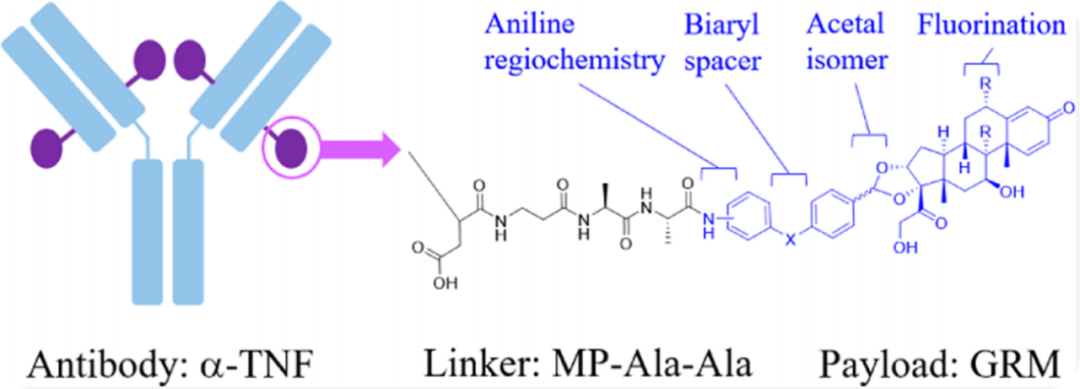
Here, we will focus on the screening of the in vivo model: the mouse abdomen was sensitized with fluorescein isothiocyanate (FITC), and after 6 days, FITC was administered in the ear, leading to increased swelling in the ear. Before sensitization with FITC, a single treatment with 10 mg/kg or 3 mg/kg of the candidate ADC drug was given to assess the impact of the ADC drug on ear swelling. All candidate ADC molecules inhibited ear swelling. Moreover, no significant differences in efficacy were observed between the two tested doses.
In addition, the safety of the ADC must also be evaluated, specifically its impact on hormones in the body. To assess the effects of the ADC on corticosterone and P1NP, mice were stimulated with adrenocorticotropic hormone (ACTH) 72 hours after ADC administration, and plasma was collected 30 minutes later to measure corticosterone, testosterone, and P1NP levels. Unlike the effects on inflammation (where small differences were observed among the ADC molecules), some candidate molecules showed weak effects on corticosteroids, while others showed stronger effects, as seen in the following figures. No P1NP was detected at the tested doses—this indicates that these ADCs may have a wider therapeutic window.
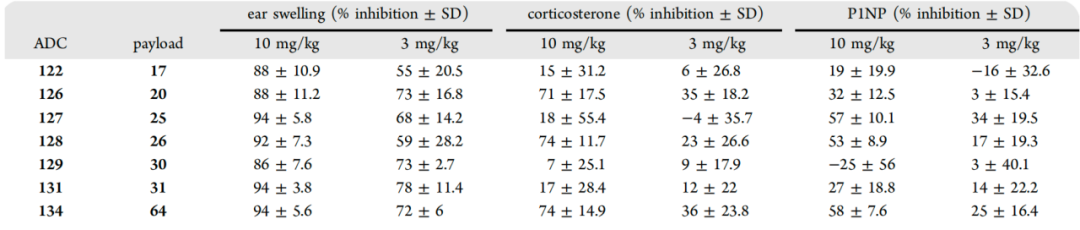
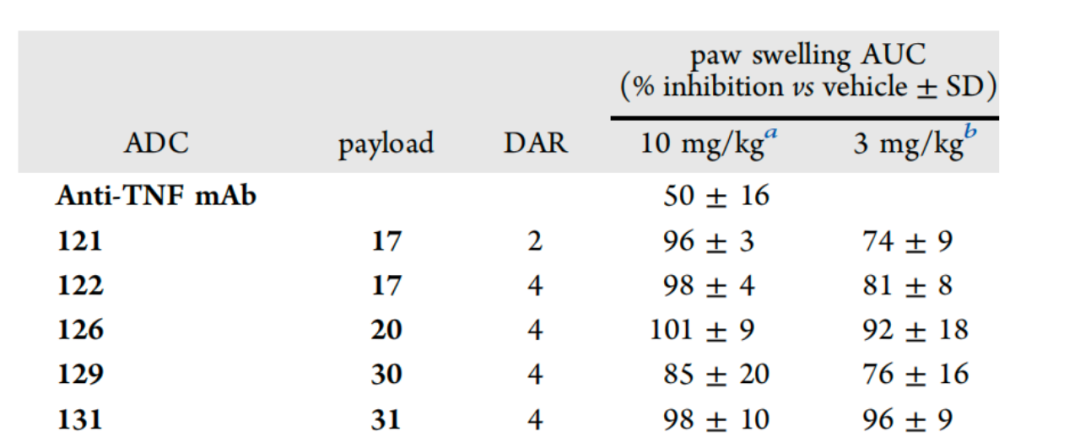
Subsequently, the trial was advanced to evaluate the anti-inflammatory effects of the ADC candidate molecules in a chronic inflammatory environment, leading to multiple ADCs being advanced to a mouse collagen-induced arthritis (mCIA) model, which essentially replicates many pathological features of human RA (rheumatoid arthritis) indications. The selected candidates were 122, 129, and 131, along with 126, where the first three drugs showed good anti-inflammatory effects with minimal hormonal impact, but 126 exhibited some inhibitory effects on hormones—moderate impact on P1NP, but still significantly inhibited corticosterone.
Finally, in terms of efficacy, 122 and 129 showed a dose-dependent decrease in efficacy, while 126 and 131 displayed similar effects in foot swelling suppression at both doses.
In the mCIA model, the reduction in foot swelling effects of all four ADCs lasted for more than 30 days after a single administration. Moreover, all ADCs showed significantly better efficacy than the parent monoclonal antibody (Adalimumab).
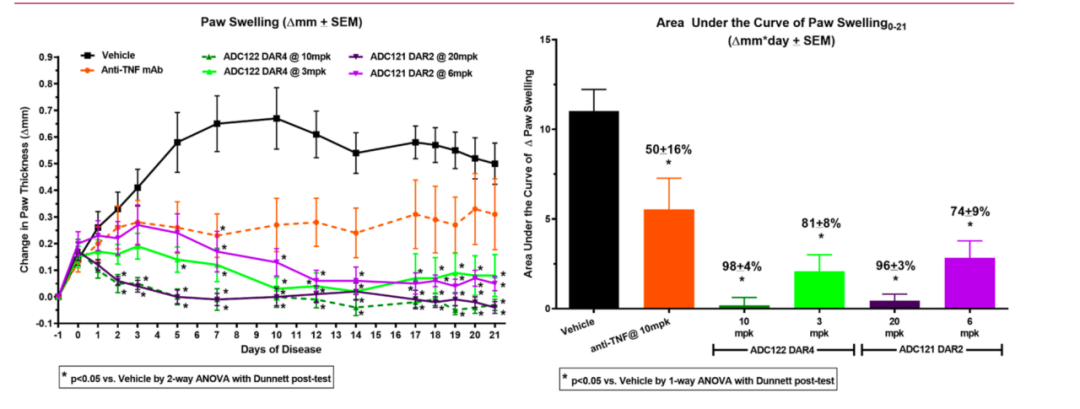
We can see that the final selections were 122 and 121, both of which showed similar efficacy at high doses, but considering the impact on hormones, 122 had a smaller hormonal impact, thus it was chosen. This molecule was used to prepare human antibodies, which is the well-known— ABBV-3373.
02
Clinical Trials of ABBV-3373
Finally, we have arrived at the clinical trial stage. First is the Phase I trial, assessing safety and tolerability in adults.
Overall, ABBV-3373’s pharmacokinetic characteristics for subcutaneous and intravenous administration are similar to those of antibodies, with Cmax and AUC increasing with dose, and a longer duration of drug exposure. ABBV-3373 and TAb have similar pharmacokinetic characteristics, reaching Tmax about 3 days after subcutaneous administration, followed by a clear single exponential decline, with a half-life of about 2 to 8 days. After intravenous administration, ABBV-3373’s serum concentration decreases rapidly in the initial phase, consistent with typical intravenous administration characteristics, and then enters a slower elimination phase similar to that of the 300 mg subcutaneous administration group, with a half-life of about 4 to 12 days.
The concentration of unbound effective payload is several orders of magnitude lower than that of ABBV-3373. Notably, the exposure of the effective payload after subcutaneous injection appears to be dose-dependent, while after intravenous injection, it deviates from the dose proportionality. Unlike ABBV-3373, at the same dose level, the exposure of the effective payload after subcutaneous injection is higher than that after intravenous injection.
Overall, ABBV-3373’s pharmacokinetics compared to the naked antibody Adalimumab shows that, compared to Adalimumab, ABBV-3373 has a faster systemic clearance rate and a shorter average half-life. After a single subcutaneous injection, ABBV-3373’s average clearance rate and half-life are as high as 79.3 mL/h and 7.4 days, while Adalimumab’s average clearance rate and half-life after a single subcutaneous injection are 20.0 mL/h and 20 days, respectively. The differences can be attributed to the impact of drug conjugation on the antibody scaffold (e.g., reduced hydrophilicity), and are consistent with observations from other ADC drugs.
In terms of safety, except for a transient decrease in serum cortisol levels at the 900 mg intravenous dose, there was no significant impact on serum cortisol levels.
Then, the Phase IIa trial commenced. Adult patients with moderate to severe rheumatoid arthritis (RA) receiving methotrexate background therapy were treated with either intravenous ABBV-3373 100 mg every week for 12 weeks, followed by placebo treatment for 12 weeks; or subcutaneous Adalimumab 80 mg every week for 24 weeks. The primary endpoint was the change in the 28-joint disease activity score (DAS28-CRP) from baseline at week 12.
As shown in the figure, although ABBV-3373 (-2.65) significantly outperformed placebo and was significantly better than historical data for Adalimumab (-2.13), p=0.022. However, it can be seen that under this trial, the difference between ABBV-3373 and the data for Adalimumab in the trial was not very large. Moreover, in terms of secondary endpoints, the drug and Adalimumab showed similar efficacy for most indicators.
(Image Source:https://acrjournals.onlinelibrary.wiley.com/doi/10.1002/art.42415)
In terms of safety, overall, ABBV-3373 data appears to be much better, with a lower overall incidence of treatment-emergent adverse events (TEAEs) during the active control phase (weeks 0-12) in the ABBV-3373 treatment group (35.5%) compared to the Adalimumab group in the trial (70.6%). Four patients treated with ABBV-3373 reported serious adverse events (SAEs) (non-cardiac chest pain, pneumonia, upper respiratory infection, and anaphylactic shock). Among them, two cases of serious infection were moderate and were considered not reasonably related to the study drug, resolving within 9-12 days.
However, at week 24, 40.0% (n = 12) and 17.6% (n = 3) of patients were found to have anti-drug antibodies during treatment. Among patients treated with ABBV-3373, one patient developed anti-drug antibodies during treatment at week 12, with a high titer (>100), and experienced anaphylactic shock after the fourth week of administration, leading to permanent discontinuation of the drug.
Looking back, it is speculated that this adverse reaction event led to the termination of the therapy in 2020, which is indeed regrettable.
03
The Future of Autoimmunity ADCs
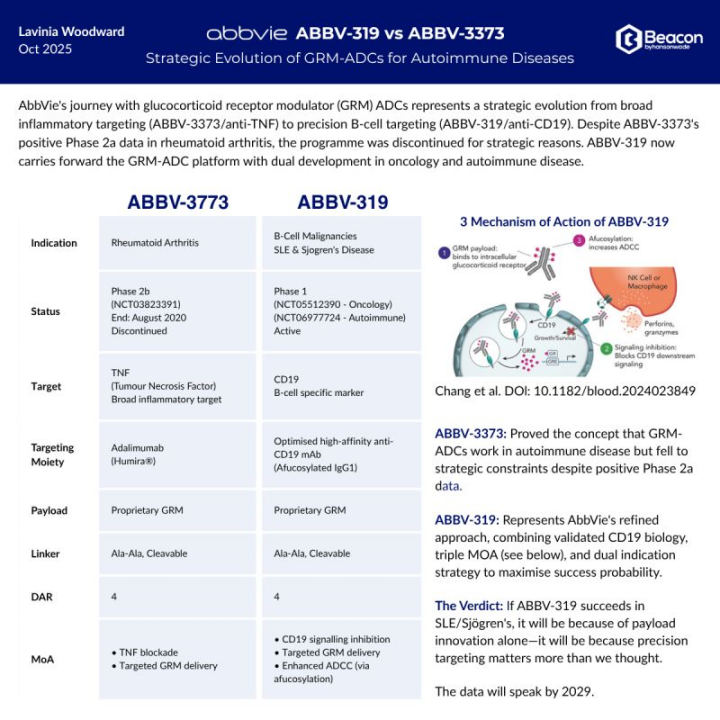
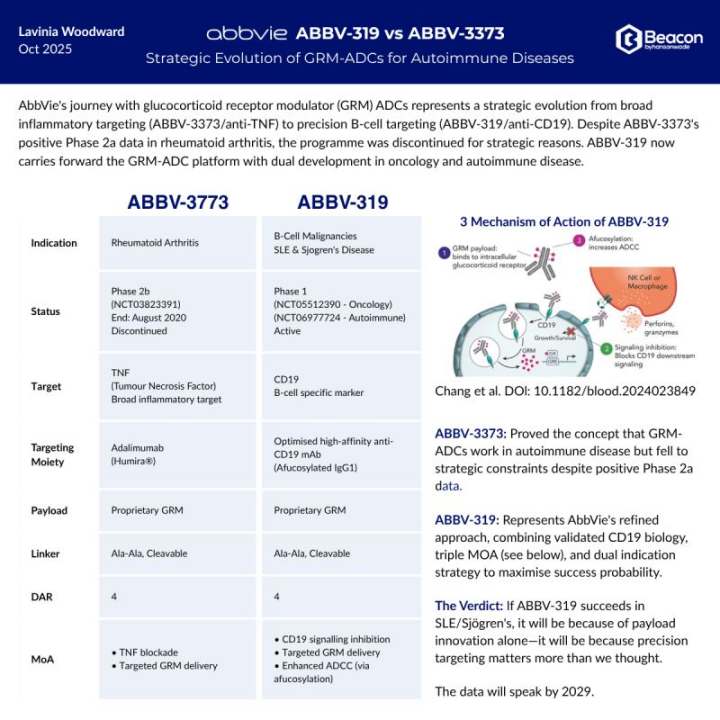
However, in August 2025, AbbVie introduced a new ADC with glucocorticoids as the payload. Its main target is CD19, but it is not for autoimmunity, rather for B-cell lymphoma. It aims to reduce glucocorticoid-related toxicity while having three different mechanisms of action (MOA) to enhance therapeutic efficacy: (1) antibody-mediated delivery of glucocorticoid receptor modulators (GRM) effective payloads to activate apoptosis; (2) inhibition of the CD19 signaling pathway; (3) enhancement of Fc fragment-mediated effector functions through fucosylation of the antibody scaffold.
ABBV-319 has shown strong GRM-driven anti-tumor activity in vitro against various malignant B cell lines and in vivo in xenograft models derived from patient samples (PDX).
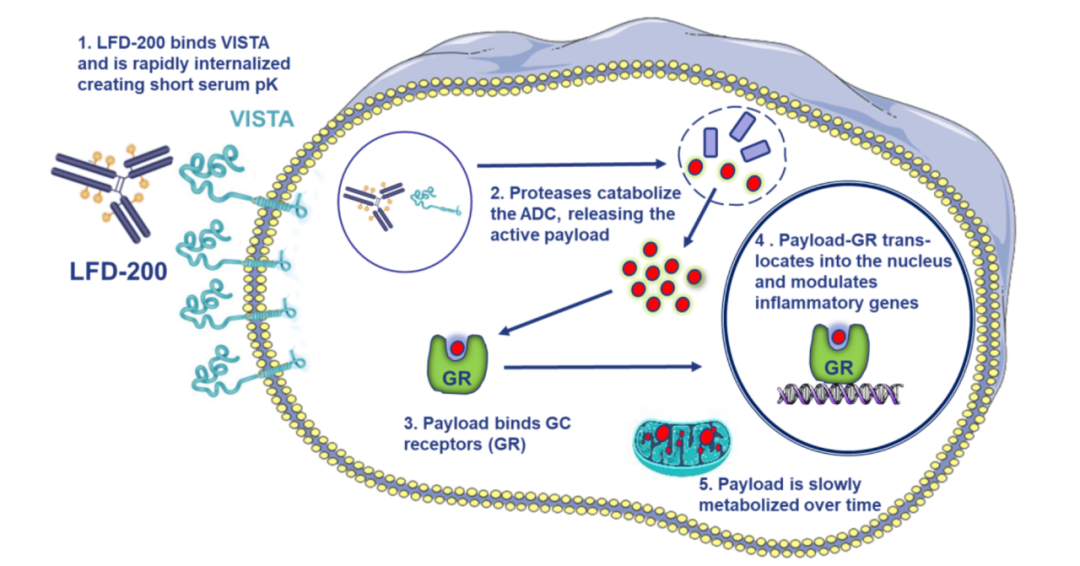
In addition, as mentioned at the beginning of the article, perhaps VISTA will be a promising target for future autoimmunity ADCs, as VISTA’s unique biological characteristics, such as rapid internalization and intracellular accumulation, make it an ideal choice for ADC therapy. Lifordi’s main ADC candidate LFD-200’s preclinical studies indicate that this drug has a short serum half-life, long retention time in immune cells, and can exert long-term immunosuppressive effects within these cells without causing systemic administration-related toxicity.
Currently, its clinical Phase I trial for RA is ongoing. This double-blind, randomized, single/multiple dose (SAD/MAD) Phase I clinical trial plans to recruit 176 subjects at seven research centers outside the United States. The study will evaluate the safety, tolerability, pharmacokinetics, and pharmacodynamics of subcutaneous LFD-200.
This Phase I clinical trial is based on previous results presented at the American College of Rheumatology (ACR) showing that LFD-200 can achieve sustained glucocorticoid (GC) exposure for at least 7 days in immune cells of non-human primates (NHP). This candidate drug also inhibited the expression of pro-inflammatory cytokines after 13 weeks of clinically relevant dosing, with no observed toxic reactions.
Domestically, there is no need to elaborate, as Ying’en Bio has specifically built its own platform in this area— DIMAC. DIMAC provides targeted treatment solutions with lower systemic exposure, stronger efficacy, and better safety to reshape the treatment of autoimmune diseases. Molecules developed on the DIMAC platform have demonstrated effective and broad anti-inflammatory activity in preclinical studies, with long drug action time, high stability, and low systemic exposure, promising to provide patients with chronic autoimmune diseases with treatments that have lower side effects and higher efficacy.
Currently, its flagship pipeline DB-2304 targets BDCA2 and has entered Phase I clinical trials.
Conclusion: In any case, ABBV-3373’s failure provides us with very valuable experience, such as its efficacy being not significantly different from that of Adalimumab, and it led to a severe allergic reaction in one patient, but it still opened a new path for future researchers, a new path to reduce the side effects of anti-inflammatory treatments.
Reprinted from the Gazelle Society