Hello everyone, this week I am sharing an article published in JACS titled “Identification of a Highly Cooperative PROTAC Degrader Targeting GTP-Loaded KRAS(On) Alleles.” The corresponding authors are Professors Alessio Ciulli and Kirsten McAulay from the University of Dundee, along with Peter Ettmayer from Boehringer Ingelheim. Their research primarily focuses on the mechanism of action of PROTACs, the structure of ternary complexes, and the fundamental research on E3 ligases.
KRAS is one of the most frequently mutated oncogenes in cancer, particularly common in pancreatic cancer, colorectal cancer, and non-small cell lung cancer. It acts as a molecular switch, cycling between the GTP-bound ‘activated’ state and the GDP-bound ‘inactive’ state, thereby regulating cell growth signals.
Most oncogenic mutations (such as G12, G13, Q61) impair KRAS’s ability to hydrolyze GTP, causing it to remain in the persistently activated KRAS(on) state, driving uncontrolled tumor growth. For a long time, KRAS was considered ‘undruggable.’ Only recently have covalent inhibitors targeting the KRASG12C mutation (primarily present in the inactive state) achieved clinical breakthroughs. However, this only covers a small portion of patients. Other common mutations, such as G12D, G12V, and those more inclined towards the activated state like G12R, Q61K, Q61L, and Q61R, still lack effective therapeutic options. Notably, KRASG12R, which accounts for about 5% of all KRAS mutations, is a common subtype in pancreatic cancer and is insensitive to existing G12C inhibitors. Unlike previous KRAS degraders that primarily targeted specific mutations (like G12C or G12D), this study aims to target the activated state of KRAS itself. Theoretically, this could cover all KRAS variants that are oncogenic due to their retention in the GTP-bound state, achieving true ‘state-selective’ degradation.
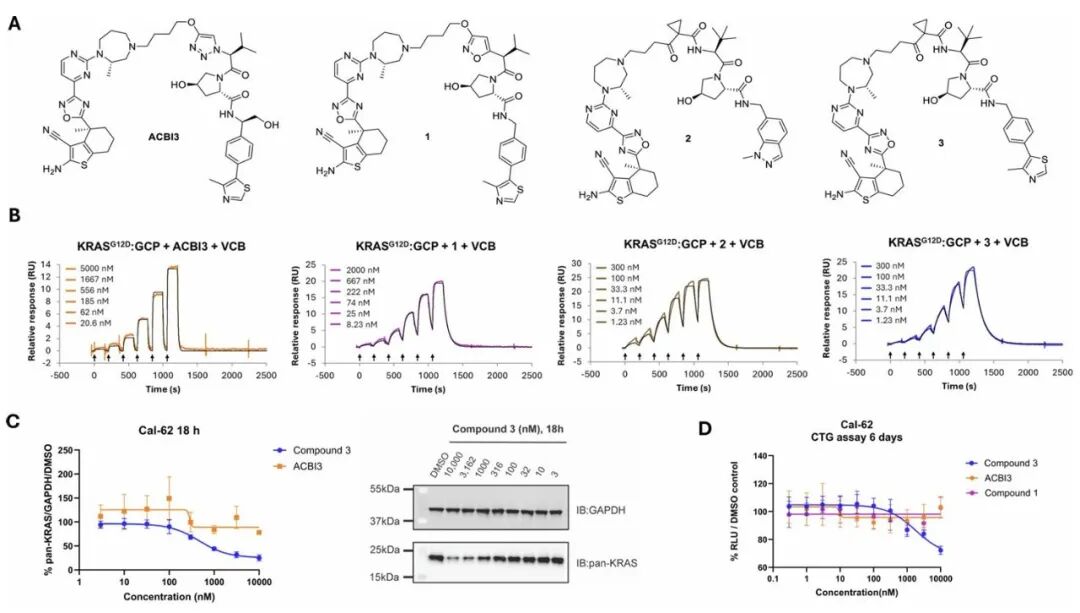
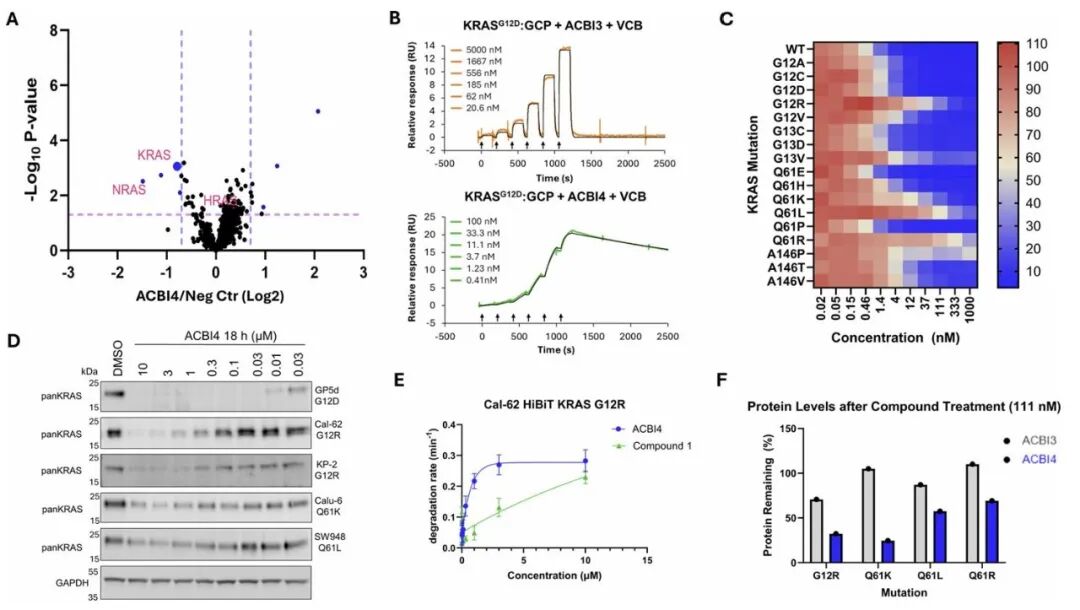
The team previously developed the pan-KRAS degrader ACBI3, which effectively degrades 13 common KRAS mutations but has minimal effect on the four mutations that lean towards the activated state: G12R, Q61K, Q61L, and Q61R. The fundamental reason is that ACBI3 and its analogs bind to GDP-KRAS far better than to GTP-KRAS.
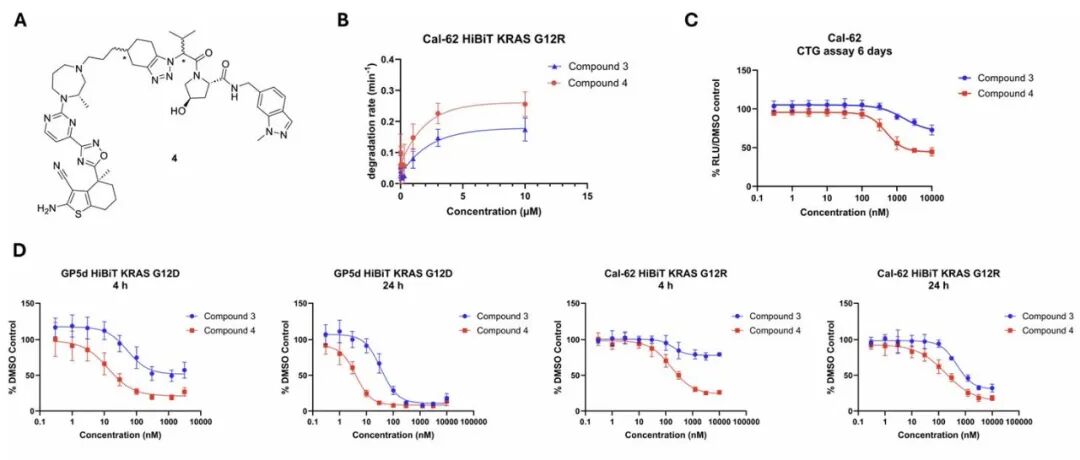
Based on compound 3, the team further synthesized compound 4 using strategies such as linker rigidity. They then separated the four diastereomers of 4 and were pleasantly surprised to find that one of the isomers, ACBI4, exhibited extremely outstanding properties.
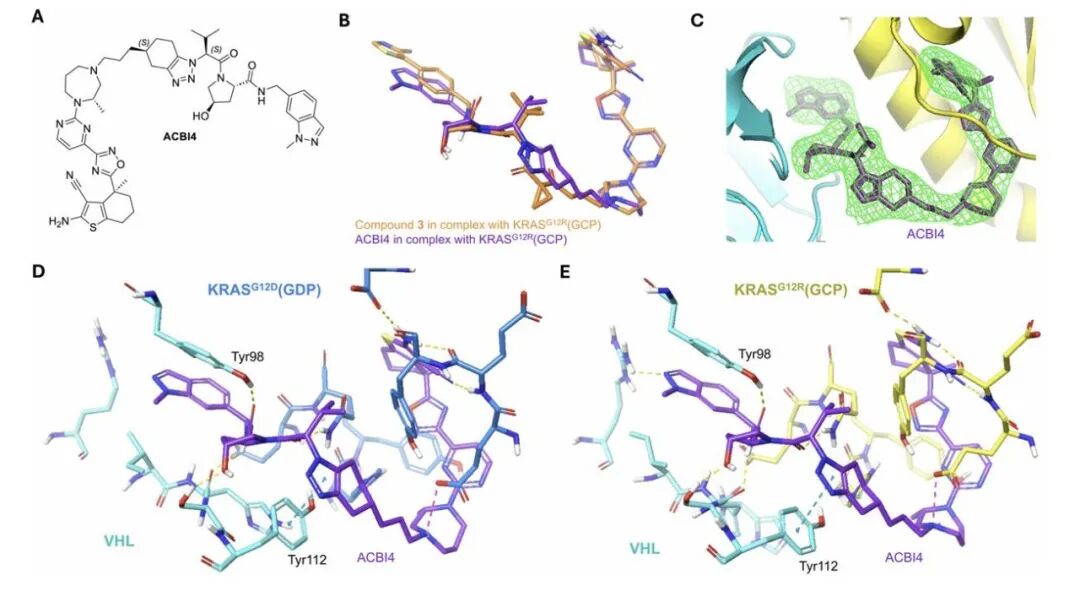
Through high-resolution X-ray crystallography, the team successfully elucidated the structure of the ternary complex formed by ACBI4 with KRASG12R-GCP and VHL. Structural analysis indicated that the overall binding mode of ACBI4 is similar to that of previous analogs, but its precise stereochemical configuration and the rigidity of its linker are key to forming an exceptionally stable interaction interface, which explains its extraordinary cooperativity and stability from a structural basis.
ACBI4 demonstrates excellent molecular characteristics, with a half-life of the ternary complex formed with KRASG12D-GCP reaching 3283 seconds and a dissociation constant of 0.9 nM, indicating extremely high affinity. More remarkably, its cooperativity factor is as high as 143, meaning that in the presence of VHL and KRAS, ACBI4 acts as a ‘molecular glue,’ enhancing binding efficacy over a hundredfold, greatly facilitating the formation of the ternary complex. At the cellular level, ACBI4 exhibits strong degradation activity and anti-proliferative effects in KRASG12R mutant Cal-62 cells, successfully degrading the KRAS(on) variants (including G12R, Q61K/L/R) that ACBI3 could not. Mechanistic validation confirmed that it acts through the VHL-proteasome pathway, while global proteomics analysis further showed its high selectivity for KRAS, with only a slight impact on HRAS/NRAS at extremely high concentrations, demonstrating an excellent therapeutic window.
In summary, this study not only provides a powerful chemical probe to explore the biological functions of KRAS(on) but also demonstrates through practice that by optimizing the cooperativity and stability of PROTAC ternary complexes, the limitations of weak target binding can be overcome, transforming the ‘undruggable’ target state into a ‘degradable’ one, paving a new path for developing therapies targeting a broader range of KRAS mutant cancers.
Author: CZH
Editor: LYC
DOI: 10.1021/jacs.5c10354
Original link: https://doi.org/10.1021/jacs.5c10354