Journal of the American Chemical SocietyTransforming One-Dimensional Strips into Two-Dimensional Covalent Organic Frameworks via Imine and Amide Bonds
 Graphical Abstract
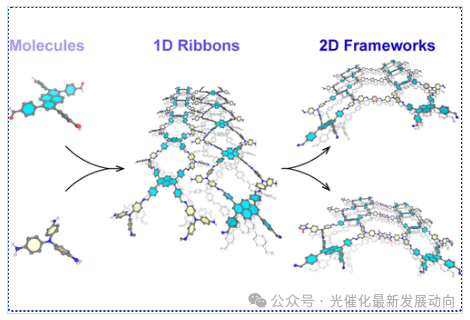 Graphical InterpretationThe design and synthesis of two-dimensional and three-dimensional crystalline covalent organic frameworks (COFs) from macromolecules or even infinite building units remain largely undeveloped. Here, we report a strategy to link molecular and one-dimensional strips into a two-dimensional vesicular framework. The triangular, tri(4-aminophenyl)amine (TAA) and square, 1,3,6,8-tetra(para-formylphenyl)pyrene (TFPPy) organic building units are connected in a substoichiometric manner via imine bonds, resulting in a one-dimensional strip containing free amines, referred to as COF-76, which is then used to connect the strips to the two-dimensional frameworks COF-77 and COF-78. In addition to this stepwise approach, we also demonstrate the in situ synthesis of these COFs. We believe that our ability to connect infinite building blocks (e.g., the strips of COF-76) to higher-dimensional COFs paves the way for covalent frameworks composed of layered chemical structures.The network chemistry of covalent organic frameworks (COFs) involves covalently connecting discrete molecular building blocks into extended crystalline structures.The network chemistry database contains a vast number of theoretically accessible structures, starting from small molecular organic building units, but designing and synthesizing frameworks from large or even infinite building blocks remains a significant challenge.The main reason is the difficulty in maintaining control over solubility and crystallinity during the synthesis process.Inspired by nature’s precise control in connecting small molecules into one-dimensional chains and assembling them into more complex two-dimensional and three-dimensional structures, we envisioned connectingmolecular building units into covalent organic strips and crystalline frameworks. This requires forming one-dimensional strips with reactive functional groups on their main chains to network them into two-dimensional frameworks. Current strategies for introducing reactive functional groups onto the main chains of COFs rely on post-synthetic deprotection of reactive groups.However, post-synthetic modification often comes at the cost of loss of crystallinity and porosity.Recently, a second strategy of protecting-free groups has been introduced, relying on substoichiometric linking of molecular building units. Thus, frameworks with periodically uncompressed “frustrated” functionalities can be targeted.Here, we base our approach on the latter strategy, reacting squares and triangles in a 1:2 substoichiometric ratio to synthesize one-dimensional strips with unreacted, frustrated amine functional groups (Figure 1).These amines are then used to connect the one-dimensional strips to the two-dimensional COFs via imine and amide chemistry. In addition to this stepwise approach, we also report the in situ synthesis of these layered crystalline two-dimensional frameworks starting from three discrete small molecules.Figure 1illustrates both synthetic routes.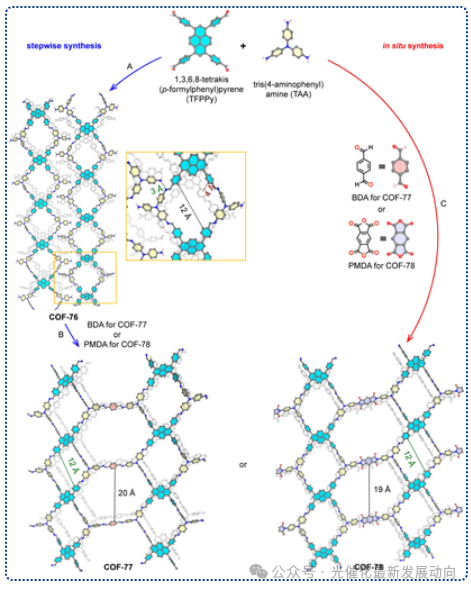
Figure 1.Synthesis of 1D COF-76, 2D COF-77, and COF-78 via stepwise (A and B) and in situ methods (C). 1,3,6,8-tetra(para-formylphenyl)pyrene (TFPPy) and tri(4-aminophenyl)amine (TAA) react in a 1:2 stoichiometric ratio to generate COF-76 (A). COF-76 is connected via imine (with benzene-1,4-dialdehyde, BDA) and amide condensation (with pyromellitic dianhydride, PMDA) to form COF-77 and COF-78, respectively (B). COF-77 and COF-78 are formed in one step from TFPPy and TAA with BDA or PMDA (C). Atomic sphere colors: C, gray; N, blue; O, red. For clarity, hydrogen atoms are omitted except for aldehyde and amine hydrogens.
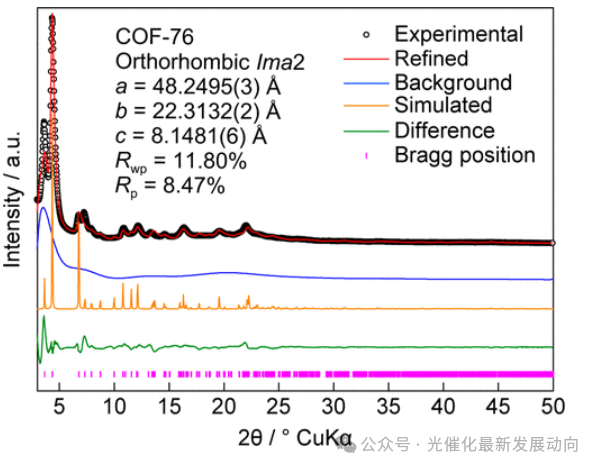 In this model, individual one-dimensional strip structures are interlocked by free amine groups pointing towards imine bonds (H···N = 3 Å, Figure 1). Along the c-axis direction, COF-76 molecular chains stack with an interlayer distance of 4 Å (centroid carbon distance). COF-76 exhibits cylindrical pore channels with a diameter of 12 Å (measured based on van der Waals radii of carbon atoms, Figure 1).The nitrogen adsorption isotherm of COF-76 measured at 77K shows an I-type curve, indicating its permanent porous structure, with a BET surface area of 860 m² g⁻¹ (see Supporting Information S6 section). The pore size distribution calculated from its nitrogen adsorption isotherm, based on a cylindrical geometric model and nitrogen-cylinder pore-oxide surface model using density functional theory (DFT), is 12 Å, which matches well with the modeled pore size (Figure 1). The experimental pore volume extracted from the nitrogen adsorption isotherm is 0.42 cm³ g⁻¹, which aligns well with the theoretical value (0.44 cm³ g⁻¹) obtained from the pore calculation function of PLATON software (reference 29).To construct two-dimensional extended COF structures, we connect through the unreacted amine groups on the COF-76 backbone. The target designed two types of connection methods: imine bond-based and amide bond-based connections, forming COF-77 and COF-78, respectively (Figure 1). The imine bond connection is achieved through the condensation reaction of the free amines of one-dimensional COF-76 with BDA, while the amide bond connection involves the reaction of the free amines of COF-76 with PMDA to form the two-dimensional extended structure COF-78 (Figure 1).Literature reports two synthetic strategies for COF-77 and -78: the first stepwise synthesis method first prepares the one-dimensional strip structure from TFPPy and TAA, which is then isolated and characterized before obtaining the two-dimensional extended structure through connection reactions (imine or amide conditions); the second in situ synthesis method allows the one-dimensional strip structure and two-dimensional COF to form synchronously in a single-step reaction. Both strategies ultimately generate the same two-dimensional framework products COF-77 and COF-78 with bex topology (see Supporting Information S5 section, reference 24).When synthesizing via the stepwise method, COF-76 is dissolved with BDA (1 equivalent) in nitrobenzene/mesitylene (3:1, 2 mL) and 2% volume trifluoroacetic acid is added, reacting at 85°C for 5 days to obtain crystalline COF-77. The in situ synthesis method involves dissolving TFPPy, TAA, and BDA in nitrobenzene/mesitylene (3:1) in a 1:2:1 stoichiometric ratio, adding p-toluidine (20 equivalents) as a modulator, and heating at 85°C for 5 days to obtain a product with equivalent crystallinity.For the synthesis of amide-type COF-78, the stepwise method places COF-76 with PMDA (1 equivalent) in mesitylene/N-methylpyrrolidone/isoquinoline (volume ratio 1:0.2:0.02, 1.22 mL) and reacts at 160°C for 5 days to obtain crystals. The in situ method first dissolves TFPPy and TAA (1:2 stoichiometric ratio) in nitrobenzene/mesitylene (3:1) containing 2% trifluoroacetic acid and p-toluidine (20 equivalents), reacts at 85°C for 1 day, then adds PMDA’s mesitylene/NMP/isoquinoline solution, and continues to react at 160°C for 5 days. Elemental analysis, PXRD, and surface area tests indicate that the crystallinity of the products obtained by both methods is comparable (see Supporting Information S2, S5, S6 sections). When the three linkers are reacted under the same conditions at 85°C, only the formation of COF-76 is observed, confirming the preferential generation of the one-dimensional strip structure before the formation of the two-dimensional network.COF-77 and COF-78 are subjected to chloroform solvent exchange for 12 hours and activated under vacuum at 90°C for 3 hours to ensure the complete removal of residual solvent from the pores.The progress of the connection reaction is tracked by FT-IR spectroscopy: the characteristic peak of the free amine group at 3352 cm⁻¹ in COF-76 disappears in COF-77, indicating successful formation of imine bonds; the FT-IR spectrum of COF-78 shows characteristic peaks of amide carbonyl at 1774 cm⁻¹ and 1722 cm⁻¹, as well as a vibration peak of C-N-C functional group at 1375 cm⁻¹ (Figure 3a, reference 30). The 13C CP-MAS NMR spectrum shows imine carbon signals at 162.9 ppm and 163.6 ppm for COF-77 and COF-78, respectively, with COF-78 showing an amide carbonyl signal at 164.6 ppm (see Supporting Information S4 section, reference 30). The signal of unreacted amines (α-carbon of aminobenzene) disappears, while the amide α-carbon resonance peak shifts from the free amine at 146.0 ppm to a broad peak at 156.7 ppm for COF-77 and 155.6 ppm for COF-78 (see Supporting Information S4 section).
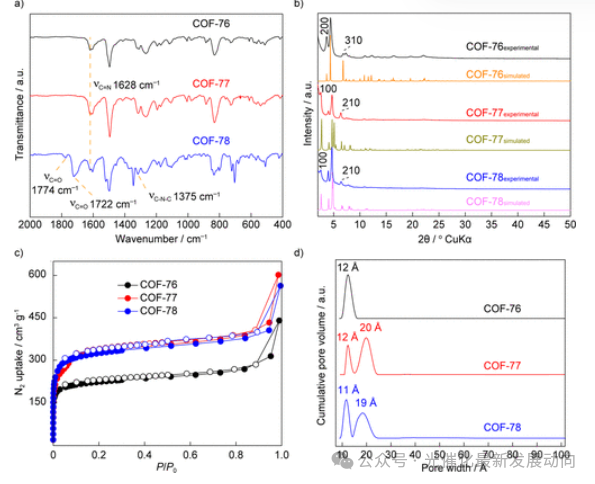 Figure 3. Overlay of FT-IR spectra of COF-76, COF-77, and COF-78 with labeled characteristic functional group vibration peaks (a); experimental and simulated PXRD patterns of COF-76, COF-77, and COF-78 (b); N2 adsorption isotherms of COF-76 (black), COF-77 (red), and COF-78 (blue) at 77 K (c); pore size distribution plots of COF-76, COF-77, and COF-78 (d).Structural characterization of COF-77 and COF-78 is performed via PXRD, comparing their patterns with COF-76 (Figure 3b). Two new low-angle strong diffraction peaks confirm the increase in unit cell parameters of COF-77 and COF-78 (2θ/CuKα corresponding to 2.4° and 6.3°, 2.6° and 6.6°; Figure 3b). The structure is determined to be a bex topological network, which is a dual-node network composed of 3-coordinated and 4-coordinated secondary structural units (see Supporting Information Figure S11). This structure generates two types of pore channels: the smaller pore channels originate from the one-dimensional strip structure (12 Å), while the larger pore channels are produced by the two-dimensional extended structure formed by the strip connections (19-20 Å, Figure 1). Detailed structural models of COF-77 and COF-78 are provided in the Supporting Information S5 section.The N2 adsorption isotherms at 77 K confirm that COF-77 and COF-78 possess permanent porosity. Both frameworks exhibit I-type isotherms, with BET surface areas of 1288 m² g⁻¹ and 1265 m² g⁻¹, respectively (see Supporting Information S6 section), significantly higher than that of COF-76 (860 m² g⁻¹; Figure 3c). The BET surface area of COF-78 synthesized via the stepwise method is slightly lower than that of the in situ synthesized product (1080 m² g⁻¹; see Supporting Information S6 section). Based on the same calculation model as COF-76, the pore size distributions of COF-77 and COF-78 calculated from the N2 adsorption isotherms match closely with the structural models (small pore sizes of 12 Å and 11 Å, large pore sizes of 20 Å and 19 Å; Figure 3d).This study presents a new strategy for assembling discrete organic molecules into one-dimensional strip structures, which are then connected into two-dimensional frameworks. This strategy employs a protecting-free group method to prepare one-dimensional strip structures with active amine functional groups, which are subsequently networked through imine and amide reactions, successfully obtaining crystalline two-dimensional frameworks COF-77 and COF-78 with bex topology.This work demonstrates a new method for synthesizing crystalline frameworks using infinite molecular building units. We validated the effectiveness of this strategy through imine and amide chemistry and emphasize that this strategy can be generalized to other connection methods.DIO:10.1021/jacs.9b13971
Academic Exchange
Testing Discussion
Appointment for Testing