
Editor’s Note:Multi-agent Systems (MAS) evolved from distributed artificial intelligence, aimed at solving real-world problems that are large-scale, complex, real-time, and involve uncertain information. After nearly 30 years of development, MAS has become a cutting-edge discipline and research hotspot in international artificial intelligence.In this issue, I have compiled a course on multi-agent systems taught by Associate Professor An Bo from Nanyang Technological University, hoping to enhance everyone’s understanding of MAS.
Note: This course is part of the RLChina 2020 Summer Camp on Reinforcement Learning, initiated by researchers from well-known domestic and international universities and research institutions. The summer camp is conducted in the form of online public classes, covering rigorous mathematical derivations, the latest research results, and theories. Related course videos are live-streamed on ZOOM and Bilibili. The Institute of Automation, Chinese Academy of Sciences (WeChat: casia1956) has obtained authorization from the course instructor to edit and organize the course summary without changing its original meaning.
This issue features the course “Multi-Agent Systems” taught by Associate Professor An Bo from Nanyang Technological University (NTU), covering three parts: history and current status, key research areas, and research progress.Associate Professor An believes that research in Multi-Agent Reinforcement Learning (MARL) has just begun and is still in its early stages, playing a very important role in the future with broad application scenarios. He encourages more people to join the research and welcomes everyone to communicate with him via email.

An Bo
Associate Professor, Nanyang Technological University
Watch the Course
dvdf
Course Overview
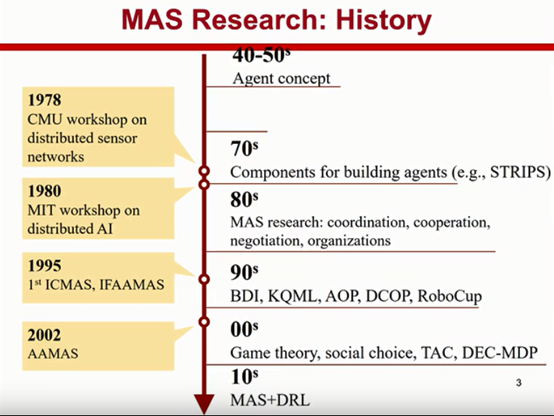
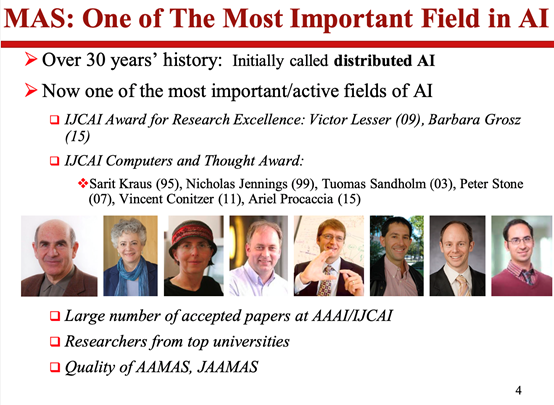
Associate Professor An starts from the origin of the concept of Agent, outlining important historical milestones in the research of Multi-Agent Systems (MAS), significant conferences in the field, and key figures.
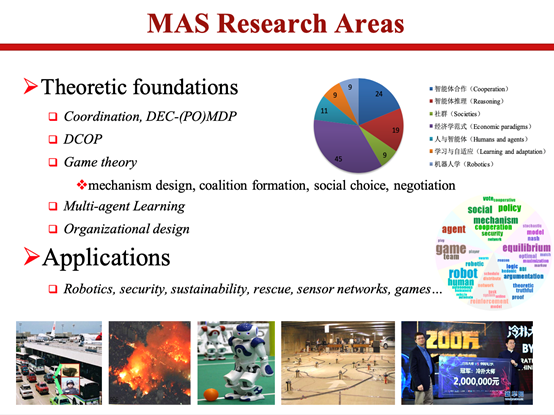
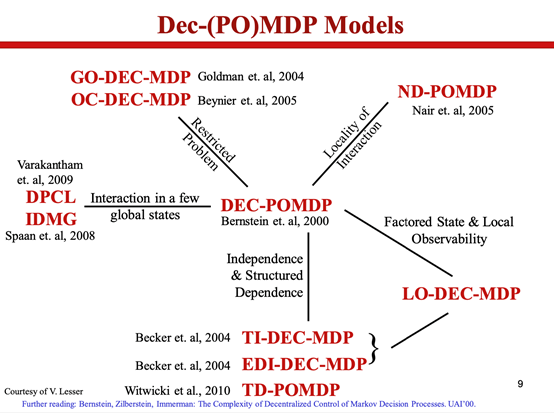
This chapter introduces the theoretical foundations and applications of MAS research. Associate Professor An elaborates on the cooperation among multi-agent systems and some early methods, including Partial Global Planning (PGP), Towards Flexible Teamwork, the Dec-POMDP framework that has surged in popularity over the past decade since 2000, and related models; as well as distributed constraint satisfaction and optimization, organizational structure design, and game theory.
This chapter introduces a significant recent work—the DeepStack framework in the context of poker, discussing the concepts and algorithms involved, including regret matching and Counterfactual Regret Minimization (CFR). It also analyzes complex security-related games using game theory and introduces two recent works: Converging to Team-Maxmin Equilibria in Multiplayer Norm-Form Games and Manipulating a Learning Defender and Ways to Counteract.
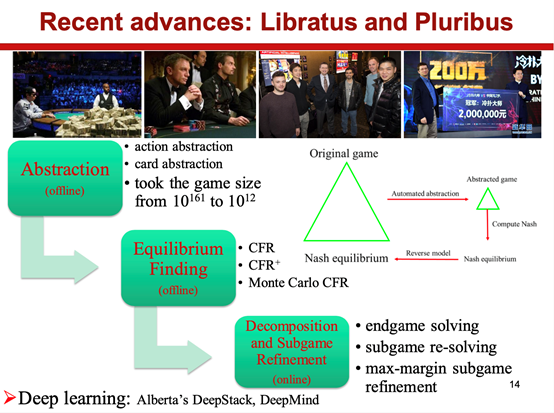
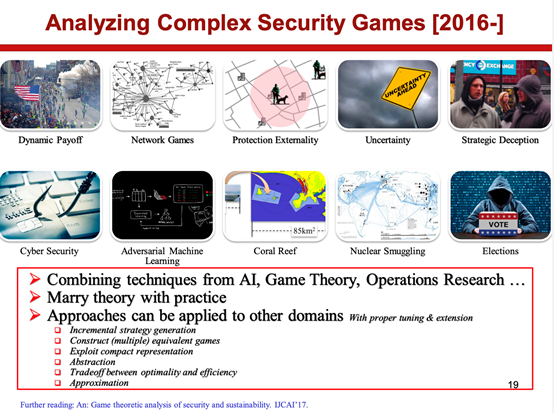
Associate Professor An raises a question for the entire RL field: When do we need to utilize RL?
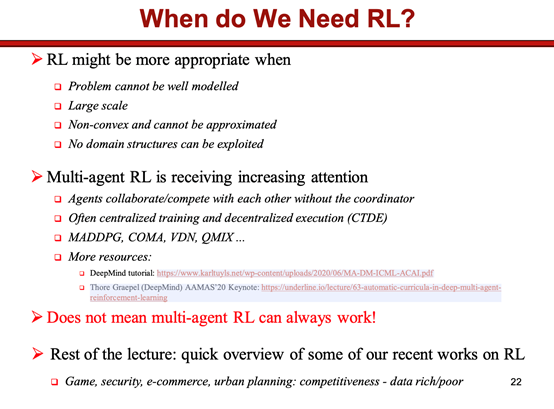
Finally, Associate Professor An briefly introduces some of his research group’s recent work in the field of MAS, involving bridge bidding, e-commerce, and intelligent transportation planning, among others.
[1] Competitive Bridge Bidding with Deep Neural Networks. AAMAS 2019
[2] Impression Allocation for Combating Fraud in E-commerce via Deep RL. IJCAI 2018
[3] Improving Robustness of Fraud Detection Using Adversarial Examples. WWW 2019
[4] Dynamic Electronic Road Pricing (ERP). AAAI 2018
[5] Scaling up Dynamic Electronic Road Pricing. IJCAI 2019
[6] Learning Expensive Coordination: An Event-Based Deep RL Approach. ICLR 2020
[7] Interactive Influence-based HRL. IJCAI 2020
[8] Efficient Multi-agent Communication. ICML 2020
[9] Learning Behaviors with Uncertain Human Feedback. UAI 2020
Email: [email protected]
Welcome to leave messages in the background, recommend topics, content, or information you are interested in!
If you need to reprint or submit articles, please contact us privately in the background.