0. Summary
AIM-Mapping proposes a framework for training with “privileged information” and multi-robot collaborative exploration of unknown environments: during training, the critic has access to the global map, using “differential features + mutual information” for supervision; during testing, only local maps are used, allowingtopological graph matching to assign high-quality long-range target points to each robot, achieving approximately 10% faster exploration rates than existing methods in both simulation and real-world scenarios.
Paper Title: Asymmetric Information Enhanced Mapping Framework for Multirobot Exploration based on Deep Reinforcement LearningPaper Link: https://arxiv.org/pdf/2404.18089Core Keywords: Multi-robot exploration, Deep Reinforcement Learning (DRL), Asymmetric Information, Mutual Information, Graph Matching
01 Motivation
In multi-robot collaborative exploration tasks, robots often face a dilemma: they want to collaborate efficiently, but everyone is “walking in the dark”. Due to the unknown environment, robots can only make decisions based on local observations, leading to repeated exploration, path conflicts, and even unnecessary detours to explore a small corner. Existing multi-robot exploration methods mainly fall into two categories, both with drawbacks:
- 1. Traditional Heuristic Methods (e.g., Frontier-based, Potential Field): The rules are human-defined, making it difficult to adapt to complex and changing environments, often leading to local optima, and causing collisions between robots or uneven task distribution.
- 2. Deep Reinforcement Learning (DRL) Methods: Although they can learn strategies, state value assessments in unknown environments are very unstable (due to incomplete maps). This is akin to asking someone who only sees a tip of an iceberg to evaluate the entire iceberg’s value, leading to significant bias, making training hard to converge and decisions short-sighted.
02 Core Method: The Three Pillars of AIM-Mapping
AIM-Mapping is an asymmetric deep reinforcement learning framework based on the Actor-Critic architecture. It is called “asymmetric” because the Critic (evaluation network) has access to global privileged information, while the Actor (policy network) only sees local information.
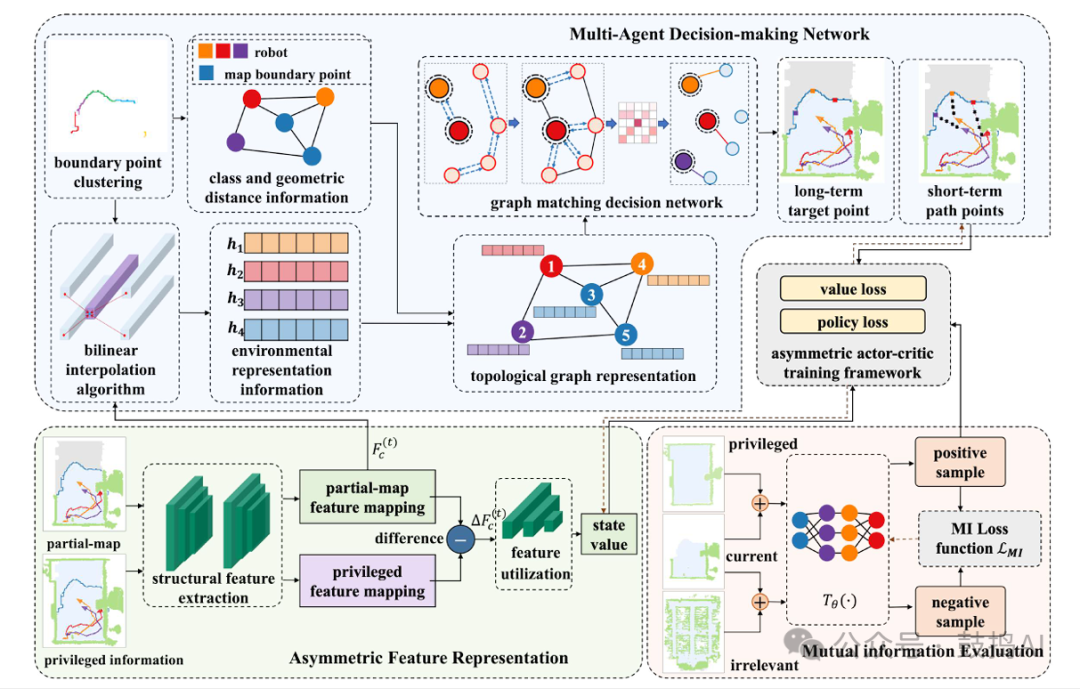
It consists of three core modules:
1. Asymmetric Feature Representation Module (AFR) — Enhancing Evaluation Accuracy
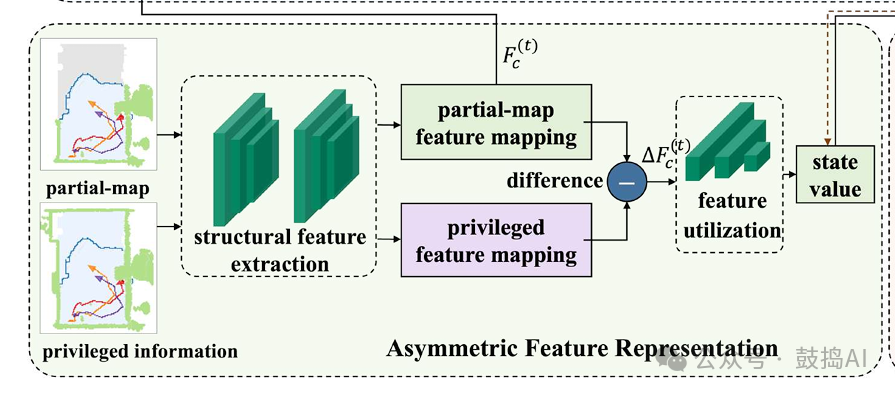
- • Differentiated Input:
- • Policy Network (Actor): Inputs the local map currently detected by the robot (Partial-map).
- • Value Network (Critic): Inputs the local map + privileged information of unexplored areas.
- • Differential Encoding Design: The author did not simply stack the two maps but designed a Structured Convolutional Network (SCNet) to extract features separately and compute the feature difference.
- • Function: This “difference” is used to train the value network. It tells the AI: “The gap between your current understanding (local map) and the god’s eye view (global map) is your potential.” This greatly stabilizes value estimation in unknown environments.
2. Mutual Information Evaluation Module (MIE) — Intrinsic Exploration Motivation
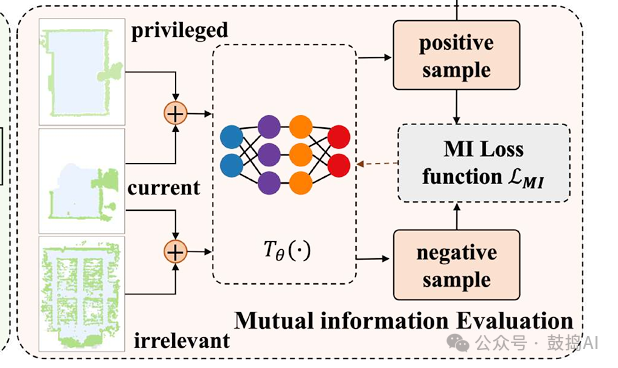
In the early stages of exploration, external rewards (coverage area) may be sparse. The author introduces mutual information as an intrinsic reward.
- • Intuitive Understanding: The robot is not just “running the map,” but is also “reducing uncertainty.”
- • Implementation Method: A neural network is constructed using variational inference to estimate the mutual information between the global map and local observations.
- • Effect: Even if no new area is explored temporarily, as long as this step significantly reduces environmental uncertainty (i.e., gains high information), the robot will receive a reward. This addresses the issues of sparse rewards and blind exploration.
3. Multi-Agent Decision Network Based on Graph Matching (MADN) — Assigning Targets Like Solving a Math Problem
With features and rewards established, how do we decide where each robot should go? The author abandons simple coordinate regression and instead adoptstopological graph matching.
- • Mapping: Treats robots and map boundary points (Frontiers) as nodes in a graph.
- • Graph Neural Network (GNN): Extracts node features (including geometric distances and environmental structure information).
- • Sinkhorn Algorithm Matching: This is a highlight. The author models the multi-robot target assignment as a bipartite graph matching problem, using the Sinkhorn algorithm to generate adoubly stochastic matrix, directly outputting the probability of each robot corresponding to which boundary point.
- • Advantages: Compared to greedy algorithms, this method can find a globally optimal assignment scheme, avoiding two robots competing for the same target.
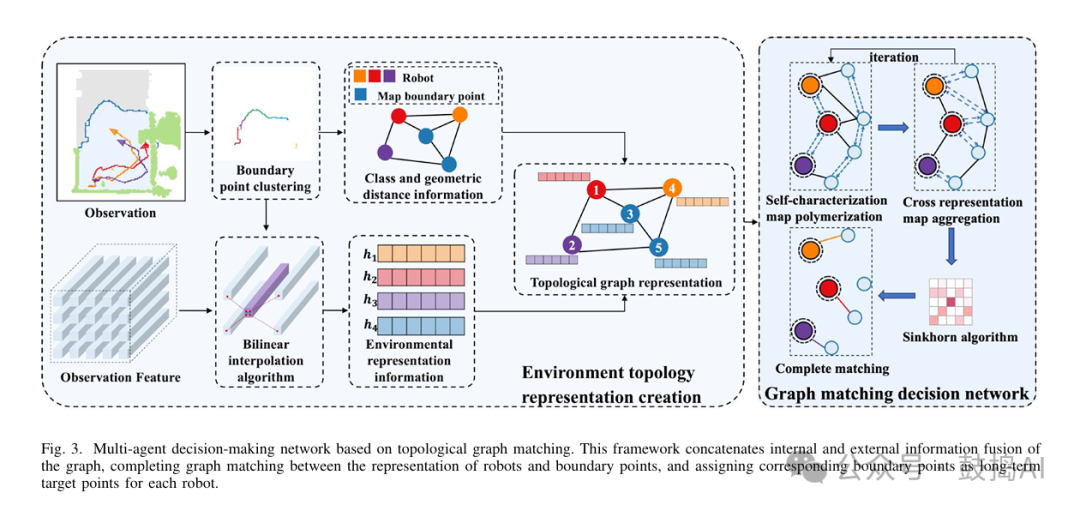
The complete process from Observation to Topological Graph to Sinkhorn Matching
03 Experimental Results and In-Depth Analysis
The author conducted extensive testing in the iGibson simulation environment (a realistic indoor physics engine) and in real-world scenarios.
1. Comparison Benchmarks
- • Traditional Methods: Utility, mTSP, Voronoi, CoScan.
- • Learning Methods: Ans-Merge (single-robot RL extension), NCM (neural graph matching).
2. Core Achievements (iGibson & MatterPort3D)
- • Efficiency Dominance: In scenarios of varying sizes, AIM-Mapping consistently had the least completion time (Time steps). Particularly in large scenarios (>100 square meters), it reduced the number of steps by about 10% compared to the strongest baseline NCM, and was several times faster than the traditional Ans-Merge method.
- • Exploration Rate: Stably achieving 96%-97% coverage, with very low variance, indicating that the algorithm is highly robust (not failing due to random starting points).
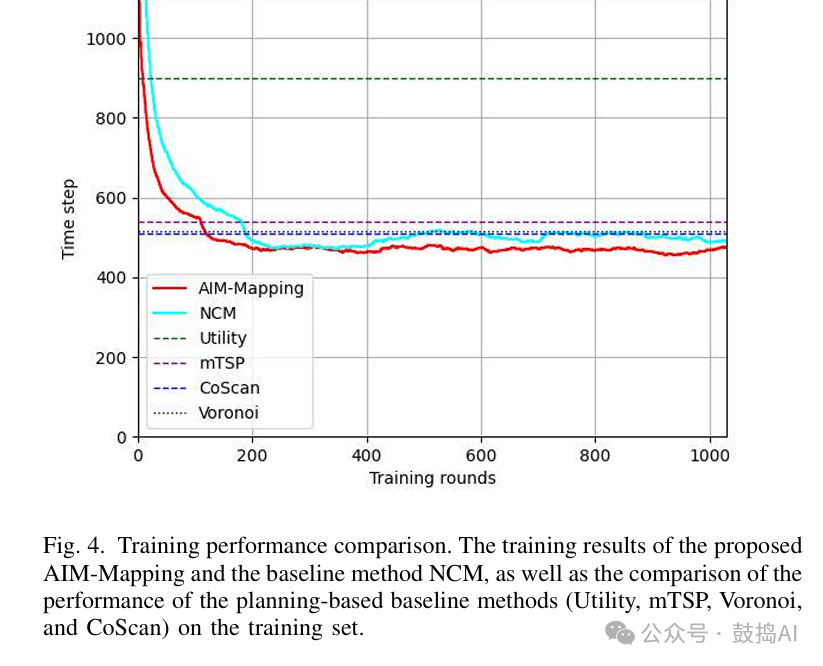
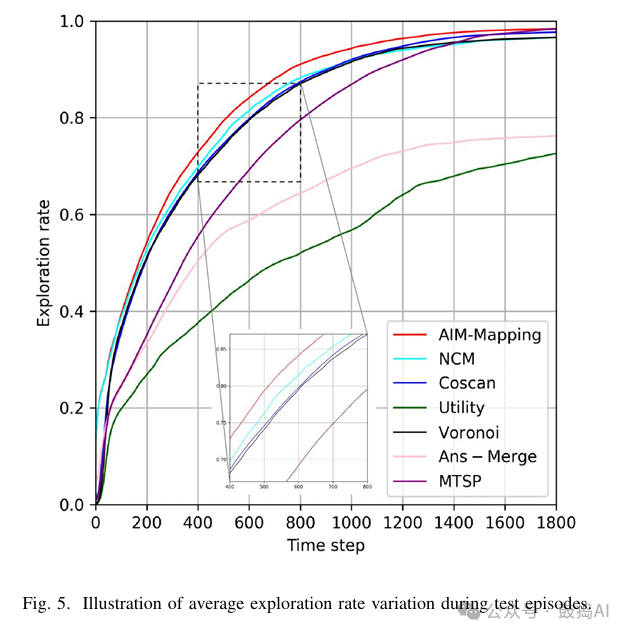
Comparison of training curve convergence speed and average exploration rate
3. Ablation Experiments: What Did They Prove?
- • Removing Privileged Information? Performance drops directly. This proves that “god’s eye view” training is crucial for the Critic’s state value assessment.
- • Removing Mutual Information? Exploration becomes slower. This proves that mutual information as an intrinsic reward can effectively guide exploration direction.
4. Real-World Testing
Three AgileX robots equipped with radar were used for real-world testing. The results showed that the strategies trained in simulation could be directly sim-to-real transferred, with minimal trajectory overlap between multiple robots, clear division of labor, and smooth task completion without collisions.
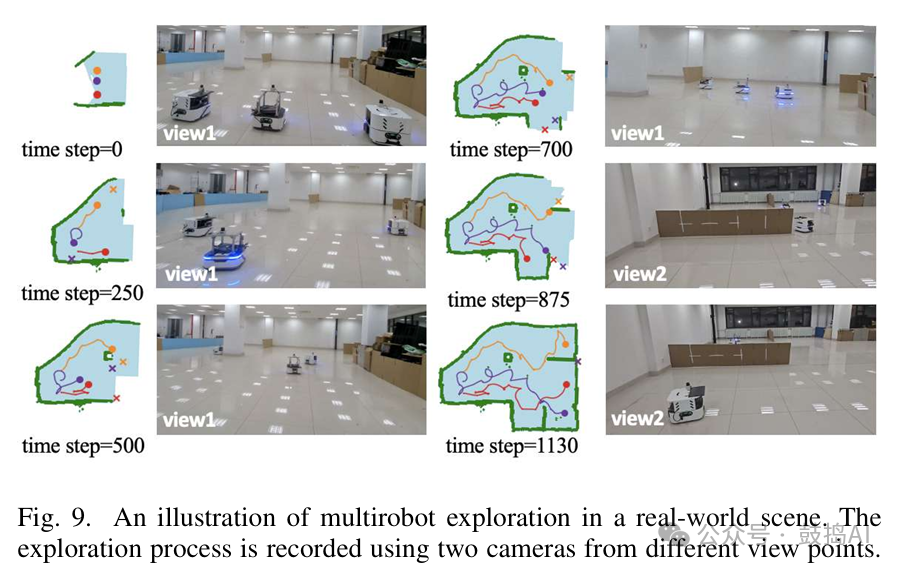
Figure: Shows the multi-robot trajectory map in a real-world scenario, where the division of different colored trajectories is very clear.
We welcome you to click the card below to follow “Dabbling AI” public account
Thank you for reading. If there are any inaccuracies, please follow the WeChat public account “Dabbling AI” to leave feedback, and we welcome everyone’s criticism and suggestions.
Previous Selected Recommendations
Review of the ICRA 2025 Challenge: Track Analysis, Results Summary, and Technical Highlights
Challenges in Deploying Air and Ground Robots Based on Basic Models: What Challenges Will Be Encountered? (ICRA 2025 workshop)
Breaking Free from Odometry Constraints! Pure Vision + Large Models Enable Legged Robots to Achieve Semantic-Level “Free Walking”
Leaving Stairs That Wheels Cannot Climb to the ‘Dog’: How HEHA Improved Heterogeneous Multi-Robot Exploration Speed by 30%?
RAL 2025 | FLARE: Breaking Through the Efficiency Bottleneck of Large-Scale Drone Exploration!
The Evolution of Autonomous Drone Racing Over Ten Years (Part 1)
Meta’s Latest Achievement SAM 3D: Transforming a Single Image into 3D in Seconds! How LVI-Q Enables Quadruped Robots to Navigate in Darkness, Long Corridors, Chaotic Lighting, and Bumps Without Getting Lost?
Please open in the WeChat client