1. Basic Principles and Complementarity of GM and LSTM
1. Core Features of the GM Model
-
Basic Principle: The original unordered sequence is transformed into a smooth sequence with exponential regularity through Accumulated Generating Operation (AGO), establishing a first-order differential equation (e.g., GM(1,1)) for prediction. Its mathematical form is:
where X is the accumulated sequence, and a is the parameter to be estimated.
-
Advantages:
- Requires a small sample size (≥4 data points);
- Does not rely on data distribution assumptions, suitable for highly random and incomplete information “grey systems”;
- High computational efficiency, suitable for short to medium-term predictions.
-
Limitations: Accuracy decreases for long-term predictions, insufficient capture of nonlinear relationships.
2. Core Features of LSTM
-
Basic Principle: Controls cell state (long-term memory) through forget gates, input gates, and output gates, solving the gradient vanishing problem of traditional RNNs. Core formulas include:
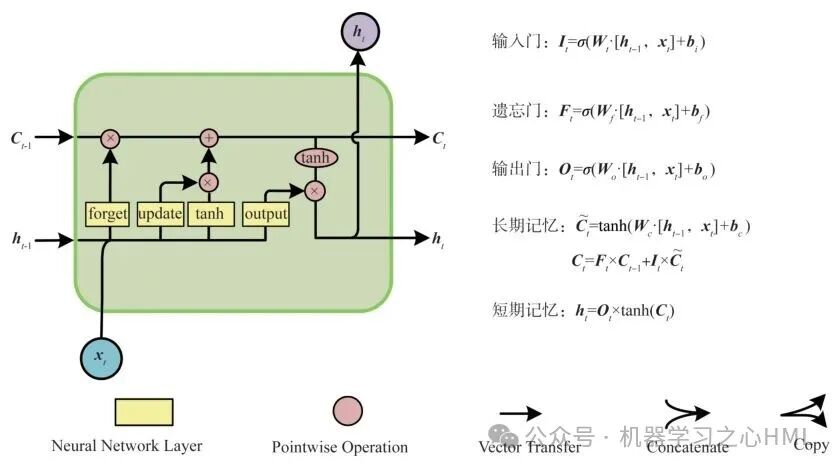
-
Advantages:
- Captures long-term dependencies, suitable for complex nonlinear sequences;
- Performs excellently in time series predictions (e.g., stock prices, wind speeds).
-
Limitations: Requires a large amount of training data, high computational cost, sensitive to parameters.
3. Complementarity Analysis
- GM provides data preprocessing capabilities: Transforms the original sequence into a more regular accumulated sequence, reducing noise impact;
- LSTM provides nonlinear modeling capabilities: Learns complex patterns in GM residuals;
- Combination method: GM extracts trend components, LSTM fits residual components, or predicts results through weighted fusion.
2. Implementation Framework of GM+LSTM Combined Model
- Steps:
- GM predicts the original sequence, obtaining the trend component T;
- Calculate the residual sequence R;
- LSTM trains the residual sequence, predicting the residual value R_pred;
- Final prediction: Y = T + R_pred.
3. Code Acquisition
Code acquisition (not for public benefit, please do not take advantage)