Editor: Duohang Source: Tech Xplore

According to Tech Xplore, it is well known that the physical movements of humans and other animals are supported by a variety of complex biological and neural mechanisms. Although robotics experts have been trying for decades to develop systems that simulate these mechanisms, the processes that drive the movement of these systems remain fundamentally different.
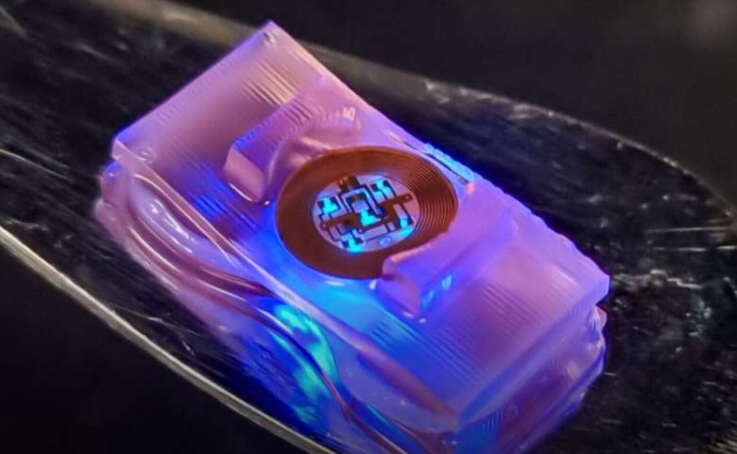
Researchers from the University of Illinois at Urbana-Champaign, Northwestern University, and other institutions have recently developed a new type of biohybrid robot that combines live mouse cells with 3D-printed hydrogel structures equipped with wireless optoelectronic technology.
A paper published in the journal Science Robotics describes these robots, which feature neuromuscular junctions that can control neurons using optogenetics technology, simulating the neural mechanisms that support human movement.
“This paper represents a significant step forward in our research on biohybrid robots over the past 15 years, demonstrating an important milestone in using neurons to control muscles and thereby control the movement of these crawling biohybrid robots,” said Rashid Bashir, senior author of the paper, professor of bioengineering at the University of Illinois at Urbana-Champaign, and dean of the Grainger College of Engineering.
In humans, the autonomous movement of specific body parts is controlled by the brain. Specifically, it is known that neurons control muscles, generating the forces that prompt actions and movements.
Bashir and his colleagues have been attempting to replicate this critical physiological process in miniature biohybrid robots.
Bashir stated, “Another goal of our research is to demonstrate that we can use onboard wireless micro-LEDs developed by Professor John Rogers’ team at Northwestern University to optically stimulate and train neural tissue, thereby altering the movement speed of the biohybrid robots.”
The biohybrid robots developed by the researchers are based on a polymer scaffold that can be easily manufactured using 3D printing technology. This scaffold was meticulously designed by Professor Yonggang Hwang’s team at Northwestern University using advanced modeling and simulation methods.
Subsequently, the research team used biohybrid tissue engineering methods to cultivate biological muscle tissue around the polymer scaffold, enhancing the performance of the scaffold.
Essentially, they differentiated mouse stem cells into motor neurons and implanted them onto the 3D-printed structures, where the muscle tissue was also differentiated and grown using nutrient-rich culture media to promote its proliferation and the formation of neuromuscular junctions.
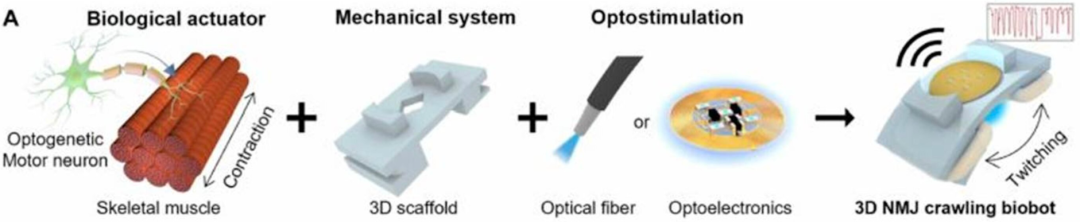
Diagram of the final device components—neuromuscular bioactuators, 3D-printed scaffold, and wireless optoelectronic devices. Image source: Min et al.
Bashir explained, “Live muscle contracts when stimulated (by electrical, optical, or neuronal means); if the scaffold is designed properly, the robot will move in a specific direction. The widespread interest and rationale for developing these living machines is to understand the design rules for biohybrid machines and living cells, and potentially leverage their advantages such as biodegradability, low energy consumption, learning, and emergent properties.”
Bashir and his colleagues’ latest research may soon inspire other roboticists and geneticists to create similar biohybrid robot systems. In the future, these systems could be useful for studying movement processes, completing various tasks in biological environments, or applications in regenerative medicine.
Bashir added, “Our work could pave the way for creating biological machines with neural tissue that can learn, adapt, and respond to stimuli. We now want to continue our work to design higher-order functions such as learning, memory, and decision-making based on external stimuli. We plan to design more complex forms of movement, such as bidirectional movement and overcoming obstacles.”
Related Articles ·
▷ Recent Advances in Electronic Skin: Tactile Data Processing, Large-Scale Manufacturing, and Energy Autonomy Technologies
▷ Design and Development of Package Delivery Robots
▷ Types, Prototype Construction, and Steering Mechanisms of Wheeled Pipeline Inspection Robots
▷ 3D Printing Technologies for Soft Robots
▷ Magnetically Controlled Soft Robot Technology
▷ Bioinspired Soft Robots: Material Selection, Actuation, and Design
▷ History of Quadruped Walking Robots and Various Design and Development Methods
▷ Robustness of Multimodal Fusion in Robotics
▷ Honda’s ASIMO and Humanoid Robot Research
▷ Hardware Design of Bipedal Humanoid Robots: A Technical Review
▷ Mechanical Principles of Humanoid Robots