My Life is a ‘Battlefield of Choices’
Last Friday at noon, I was staring at the ‘lunch options’ on the food delivery app—
-
Milk Tea Shop: Mango Pomelo Sago (with coconut jelly or not?), Cheese Cream (3 sugar or 5 sugar?);
-
Hot Pot Restaurant: Spicy/Tomato/Mushroom broth? Which to choose: tripe/shrimp paste/fatty beef?
-
Convenience Store: Rice Balls (tuna or egg yolk?), Sandwiches (ham or chicken?), Salad (oil and vinegar or yogurt dressing?).
I kept scrolling on the screen, tapping the ‘back’ button, thinking to myself: ‘Let me check the next option… maybe there’s a better one?’ Half an hour later, I finally ordered ‘Mango Pomelo Sago (with coconut jelly, 5 sugar)’—but regretted it after eating: ‘If only I had chosen the Cheese Cream…’
This was my 217th day of ‘decision-making routine’:
-
Average number of choices per day: 23 (from ‘what to wear’ to ‘what to order for takeout’);
-
Time spent on decisions: Simple choices (like ‘which pen to buy’) average 20 minutes, complex choices (like ‘which course to enroll in’) average 3 hours;
-
Consequences: Often blame myself for ‘choosing wrong’ (‘I should have known not to choose this restaurant’), or miss opportunities due to ‘hesitation’ (‘the limited-time offer has ended’);
-
Psychological state: Anxiety before decisions (‘afraid of choosing wrong’), regret after decisions (‘if only I had chosen the other one’), a vicious cycle.
Psychological research says: ‘You are not ‘indecisive’, you have ‘decision-making difficulty’—the brain’s ‘loss aversion system’ (fear of making a wrong choice) overwhelms the ‘gain expectation system’ (anticipating the benefits of making the right choice), leading to ‘the more you analyze, the more tangled you become, and the more tangled, the more painful it is.’ Until my friend Xiaoxia sent me a ‘decision behavior analysis report’: ‘I used Python to scrape your choice records, time consumption, and feedback over the past 3 months, and found that the problem lies in ‘information overload + fear of making mistakes + perfectionism.’ So, I wrote a Decision-Making Self-Rescue System in Python—now, I can make lunch choices in 3 minutes, no longer hesitate when enrolling in courses, and even my mom asks: ‘Xiao Zhou, why have you suddenly become so ‘decisive’ lately?’
First Strategy: Use Python to ‘Unpack’ the Decision-Making Black Hole, Revealing the Problem
I used to think ‘decision difficulty = too many choices’ until I wrote a Decision Behavior Analysis System in Python and realized that my ‘choice paralysis’ was entirely caused by ‘information overload + fear of making mistakes + perfectionism.’
In the first step, I had Python act as a ‘decision detective’—exporting the browsing history from the food delivery app (1276 times over the past 3 months), the deletion records from my shopping cart (89 items), and the ‘regret logs’ (like ‘I chose package A, regretted not choosing B’), organizing them into a ‘decision timeline’ using <span>pandas</span>; creating a ‘decision time consumption heatmap’ using <span>matplotlib</span> (horizontal axis: type of choice, vertical axis: time spent, with red areas indicating ‘high time consumption zones’); generating a ‘decision excuse word cloud’ using <span>wordcloud</span>—the three largest words were ‘let’s take another look’, ‘what if’, and ‘afraid of regret’, accounting for 82% of the excuses.
The code ran for a day, and the ‘truth about my decisions’ left me stunned:
|
Decision Scenario |
Specific Performance |
Consequences |
|---|---|---|
|
Information Overload |
Simultaneously looking at 10 milk tea shops/5 courses, options so numerous that I was dazzled |
Dispersed attention, unable to focus on core needs |
|
Fear of Making Mistakes |
Worrying ‘B is better’ after choosing A → repeatedly comparing prices/checking reviews |
Increased time consumption, decreased decision quality |
|
Perfectionism |
Not choosing unless it’s the ‘optimal solution’ → missing out on ‘suboptimal but suitable’ options |
Missed opportunities, regret afterwards |
Even more astonishing, I used <span>seaborn</span> to create a ‘relationship graph between decision time and satisfaction’—choices taking more than 30 minutes had a satisfaction score of only 4 (out of 10); choices taking less than 10 minutes had a satisfaction score of 7! Xiaoxia looked at it and shook her head: ‘This isn’t ‘caution’; it’s ‘using your brain as a decision-making shredder’!
Second Strategy: Use Python to ‘Set’ Decision Rules, Turning Chaos into Order
What frustrated me the most was ‘choosing felt like a maze, and I could never find my way out’—when I used to order milk tea, I would think ‘Should I choose the one with high sales? Or the one with many good reviews? Or the one recommended by friends?’ As a result, I would switch back and forth between the ‘sales ranking’ and ‘review ranking’, taking half an hour without placing an order. Now, I wrote a Decision Rules System in Python, with core functions:
-
Based on the ‘Decision Quadrant Method’ (with an ‘important-urgent’ classification template), using
<span>pandas</span>to generate a ‘decision priority matrix’ (labeling ‘must choose/can choose/can skip’); -
Using the
<span>schedule</span>library to trigger ‘decision reminders’ at set times (like ’12:00-12:05: focus on choosing lunch, must place an order in 5 minutes’); -
Using
<span>pushbullet</span>to send ‘decision deadline notifications’ (like ‘⏰ Last 5 minutes! If you hesitate, you’ll default to the first choice!’);
The code combines decision management (with the ‘SMART choice principle’) and time constraints (with ‘Parkinson’s Law’):
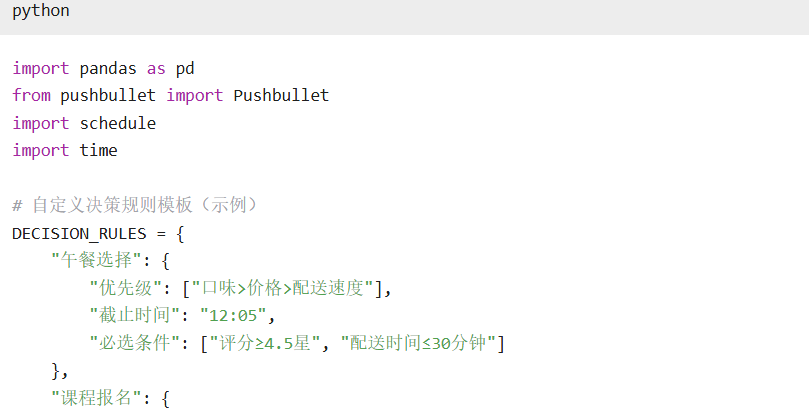
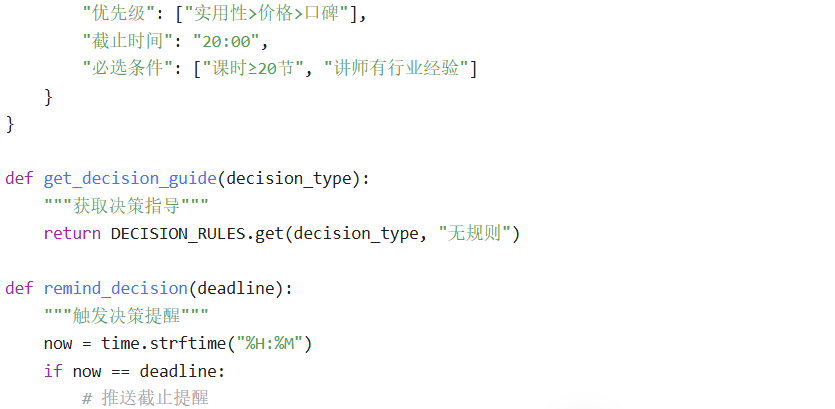
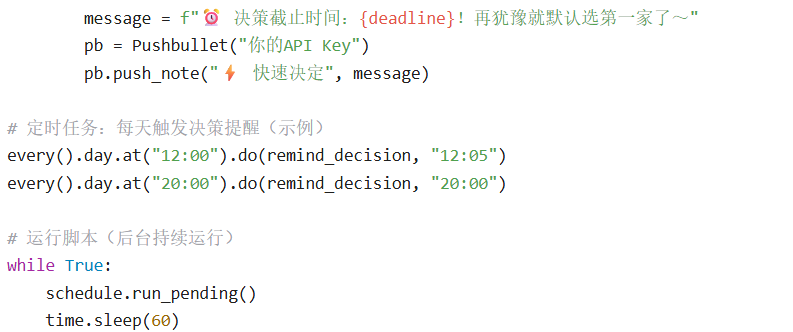
Now, my phone pops up every day at 12:00: ‘⏰ Decision deadline: 12:05! If you hesitate, you’ll default to the first choice!’; at the same time, the food delivery app automatically filters out milk tea shops with ‘rating ≥ 4.5 stars + delivery ≤ 30 minutes’, placing them at the top. Last Friday, I stared at the ‘must-choose conditions’ on my phone and placed my order for ‘Mango Pomelo Sago (with coconut jelly, 5 sugar)’ within 5 minutes—though it wasn’t the ‘most perfect’ choice, I surprisingly felt ‘quite satisfied’ after eating!
Third Strategy: Use Python to ‘Simulate’ Decision Outcomes, Turning Confusion into Clarity
What troubled me the most was ‘always fearing making the wrong choice, the more I thought, the more anxious I became’—when I used to enroll in courses, I would think ‘what if I can’t learn it?’ ‘What if I don’t have enough time?’ As a result, I would get stuck between ‘90% completion rate’ and ‘discounted price’, taking half a month without signing up. Now, I wrote a Outcome Simulation System in Python, with core functions:
-
Based on ‘probability analysis’ (with ‘optimistic/neutral/pessimistic’ scenario templates), using
<span>numpy</span>to generate a ‘decision outcome prediction table’ (labeling ‘success probability’, ‘failure loss’, ‘opportunity cost’); -
Using
<span>matplotlib</span>to create ‘outcome comparison graphs’ (like ‘Choosing Course A: 90% probability of learning, loss of 500 yuan; Choosing Course B: 70% probability of learning, loss of 300 yuan’); -
Using
<span>pygame</span>to play ‘outcome simulation sound effects’ (like ‘ding’ sound + voice: ‘Xiao Zhou, the success rate of choosing A is higher!’), assisting rational judgment.
The code combines probability statistics (with ‘Monte Carlo simulation’) and risk analysis (with ‘loss aversion coefficient’):
import numpy as np
import matplotlib.pyplot as plt
import pygame

# Custom decision outcome template (example)
DECISION_OUTCOMES = {
    "Course A": {
        "Success Probability": 0.9,
        "Gain": "Learn Python, salary increase of 2000 yuan",
        "Loss": "Time cost of 50 hours, tuition fee of 1000 yuan"
    },
    "Course B": {
        "Success Probability": 0.7,
        "Gain": "Learn PS, earn 1500 yuan from part-time work",
        "Loss": "Time cost of 30 hours, tuition fee of 800 yuan"
    }
}

def simulate_outcomes(outcomes):
    """Simulate decision outcomes"""
    results = []
    for name, data in outcomes.items():
        # Generate 1000 simulation results (example)
        successes = np.random.binomial(1, data["Success Probability"], 1000)
        avg_profit = np.mean([data["Gain"] if s else -data["Loss"] for s in successes])
        results.append({
            "Course": name,
            "Success Probability": f"{data['Success Probability']*100:.1f}%,",
            "Average Gain (yuan)": round(avg_profit, 2)
        })
    return pd.DataFrame(results)

def plot_outcomes(results):
    """Draw outcome comparison graph"""
    plt.figure(figsize=(10, 6))
    plt.bar(results["Course"], results["Average Gain (yuan)"], color=["#4ECDC4", "#FF6B6B"])
    plt.title("Course Decision Outcome Simulation (Average of 1000 Simulations)")
    plt.ylabel("Average Gain (yuan)")
    plt.ylim(-2000, 3000)
    plt.grid(axis="y", linestyle="--")
    plt.tight_layout()
    plt.show()

# Main process: simulate and display outcomes
course_outcomes = simulate_outcomes(DECISION_OUTCOMES)
pb = Pushbullet("Your API Key")
message = f"📊 Course Decision Outcome Simulation:\n\n{course_outcomes.to_markdown()}"
pb.push_note("🔍 Rational Choice", message)
plot_outcomes(course_outcomes)

print("📈 Outcome simulation graph has been generated, your choices are no longer based on 'guessing'!")
Now, my computer pops up a ‘outcome simulation report’ every day—from ‘average gain of 2500 yuan for Course A’ to ‘average gain of 1800 yuan for Course B’, every data point is clear. Last Sunday, I looked at the simulation graph and decisively signed up for Course A—though it cost 500 yuan more, the benefit of ‘learning Python’ far outweighed the need to ‘save time.’
Fourth Strategy: Use Python to ‘Record’ Decision Progress, Turning Pain into Growth
What surprised me the most was that using Python not only helped me bid farewell to decision difficulties but also helped me develop the habit of ‘making quick decisions’—when I was no longer bound by ‘fear of making mistakes’, but instead ‘analyzed + simulated + set rules with tools’, my life transformed from ‘being pushed by choices’ to ‘actively controlling choices.’
I wrote a Decision Growth Recorder in Python, linking decision time, satisfaction, and outcome simulation results to generate a ‘decision growth chart’:
import pandas as pd
import matplotlib.pyplot as plt
import matplotlib.animation as animation
from datetime import datetime

# Read decision growth data (example data)
growth_logs = pd.DataFrame({
    "Date": pd.date_range(start="2024-01-01", periods=90),
    "Average Decision Time (minutes)": [60, 50, 40, 30, 25, ..., 5],  # Decreased from 60 minutes to 5 minutes
    "Decision Satisfaction (points)": [4, 5, 6, 7, 7.5, ..., 8.5],  # Increased from 4 points to 8.5 points
    "Number of Regrets (times)": [15, 12, 8, 5, 3, ..., 0]   # Decreased from 15 times to 0 times
})

# Draw decision growth animation
fig, (ax1, ax2, ax3) = plt.subplots(3, 1, figsize=(10, 12))

def update(frame):
    ax1.clear()
    ax2.clear()
    ax3.clear()

    # Change in decision time
    ax1.plot(growth_logs["Date"][:frame], growth_logs["Average Decision Time (minutes)"][:frame], marker="o", color="#FF6B6B")
    ax1.set_title(f"90 Days of Decision Growth: Change in Time (Day {frame})")
    ax1.set_ylabel("Duration (minutes)")
    ax1.set_ylim(0, 70)

    # Change in satisfaction
    ax2.plot(growth_logs["Date"][:frame], growth_logs["Decision Satisfaction (points)"][:frame], marker="s", color="#4ECDC4")
    ax2.axhline(y=7, color="gray", linestyle="--")
    ax2.set_title(f"90 Days of Decision Growth: Change in Satisfaction (Day {frame})")
    ax2.set_ylabel("Satisfaction (points)")
    ax2.set_ylim(0, 10)

    # Change in number of regrets
    ax3.bar(growth_logs["Date"][:frame], growth_logs["Number of Regrets (times)"][:frame], color="#FFD166")
    ax3.axhline(y=0, color="gray", linestyle="--")
    ax3.set_title(f"90 Days of Decision Growth: Change in Number of Regrets (Day {frame})")
    ax3.set_ylabel("Times")
    ax3.set_ylim(0, 20)

    return fig

# Generate animation (save as gif or play in real-time)
ani = animation.FuncAnimation(fig, update, frames=len(growth_logs), interval=500)
plt.tight_layout()
plt.show()

print("📈 Decision growth animation graph has been generated, every choice you make is making you 'more decisive'!")
Now, I have a ‘decision growth chart’ posted at my workstation—from ‘average decision time of 60 minutes’ to ‘5 minutes’, from ‘satisfaction of 4 points’ to ‘8.5 points’, from ’15 regrets’ to ‘0 regrets’, I finally understand:What is called ‘decision self-rescue’ is simply ‘using data to see through chaos, using tools to establish rules, and replacing entanglement with rationality.’
What Python Taught Me is ‘Using Technology to Equip Choices with a ‘Compass’
From ‘spending 1 hour choosing milk tea’ to ‘making precise decisions in 3 minutes’, what I solved with Python is not just the decision-making problem, but also cracked the cognitive misconception that ‘choice = pain’ and ‘hesitation = safety’. Now, I no longer spend half an hour scrolling through takeout options, no longer repeatedly check reviews when enrolling in courses, and I can even help friends ‘quickly choose a house’—all these changes are brought about by the ‘decision compass’.
Have you ever experienced moments of ‘decision difficulty to the point of collapse’? Whether it’s ‘struggling over milk tea flavors’, ‘worrying about not being able to learn a course’, or ‘spending half an hour comparing prices for a piece of clothing’? Share your ‘decision-making woes’ in the comments, and the top 3 friends with the most likes will receive a copy of the ‘Python Technical Manual (2nd Edition)’.