
Reference Information
Document Title: Surface Functionalized Sensors for Humidity-Independent Gas Detection
Publication Date: March 15, 2021
Journal: Angewandte Chemie International Edition
DOI: 10.1002/anie.202015856
Title: Breakthrough in Humidity Interference! New Gas Sensors Achieve Humidity-Independent Detection
Introduction
In the field of gas detection, humidity interference has always been a challenging issue. Traditional semiconductor metal oxide (SMOX) gas sensors are affected by changes in humidity, leading to variations in baseline resistance and sensitivity, which results in decreased detection accuracy. However, a recent study published in Angewandte Chemie proposed an innovative solution that successfully achieved humidity-independent gas detection through surface functionalization design.
Research Highlights
This study, led by Fengdong Qu and colleagues, successfully addressed the humidity interference problem by coating the surface of SMOX with a layer of metal-organic framework (MOF) and hydrophobic polymer (PDMS). This dual-layer coating not only protects the SMOX surface but also enhances gas selectivity, allowing the sensor to maintain stable responses across a relative humidity range of 0-90%.
Technical Details
Dual-layer Coating Design:
MOF Layer: As the first layer, the MOF has a porous structure that can selectively filter gas molecules while catalyzing the oxidation of volatile organic compounds (VOCs), thereby reducing the impact of interfering gases.
PDMS Layer: As the second layer, PDMS is a hydrophobic polymer that effectively prevents water molecules from contacting the SMOX surface, thus minimizing the influence of humidity on the sensor.
Experimental Validation:
Selectivity Testing: The researchers conducted selectivity tests on the CoSnO₃@MOF@PDMS sensor, which showed a significantly higher response to H₂S compared to other interfering gases (such as NH₃, ethanol, and xylene).
Humidity Stability Testing: Under different humidity conditions (0-90% RH), the sensor’s response remained almost unchanged, demonstrating excellent humidity-independent performance.
Image Analysis
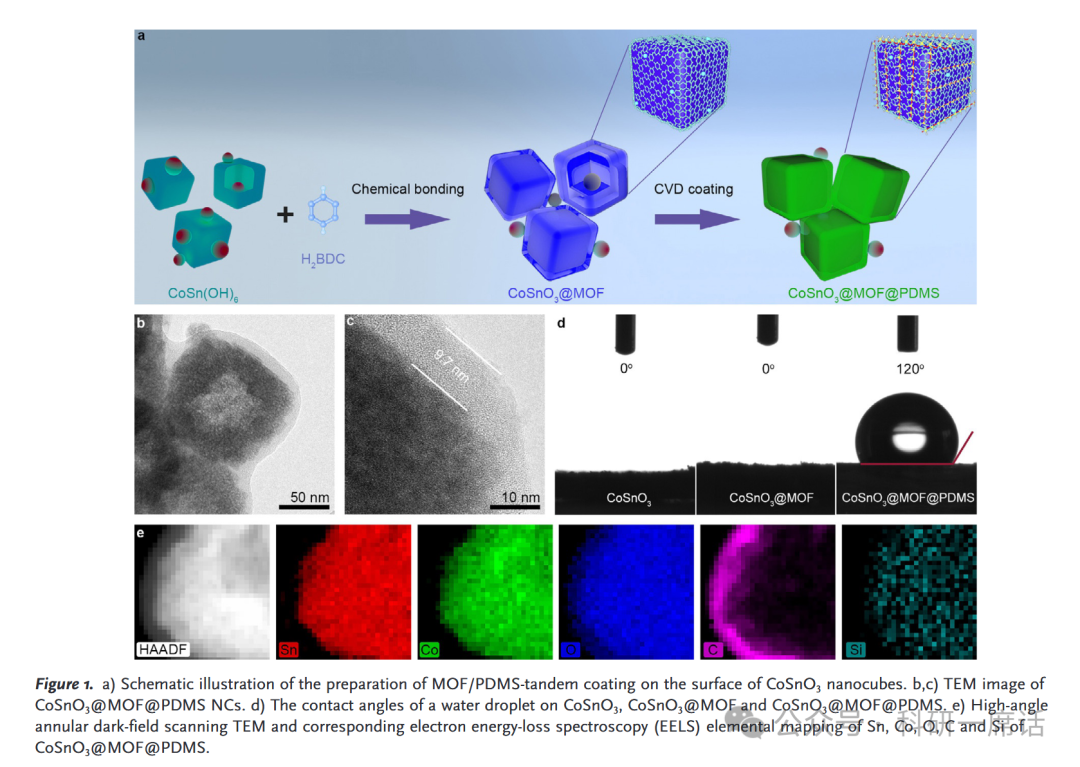
Figure 1: Shows the preparation process and structural characterization of CoSnO₃@MOF@PDMS nanoparticles. TEM images and elemental mapping clearly demonstrate that the PDMS and MOF layers are successfully coated on the CoSnO₃ surface, with the hydrophobicity of the coating significantly increased (water contact angle increased from 0° to 120°).
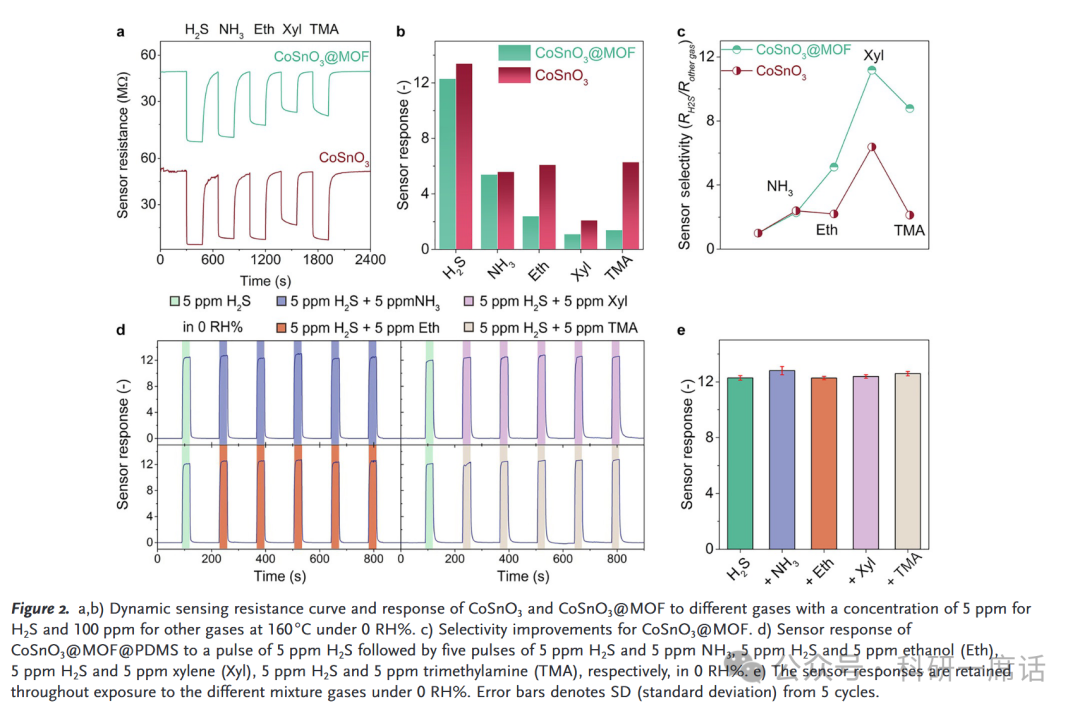
Figure 2: Compares the responses of CoSnO₃ and CoSnO₃@MOF@PDMS sensors in different gases. The results show that CoSnO₃@MOF@PDMS has significantly improved selectivity to H₂S, and its response stability under varying humidity is superior to that of the uncoated sensor.
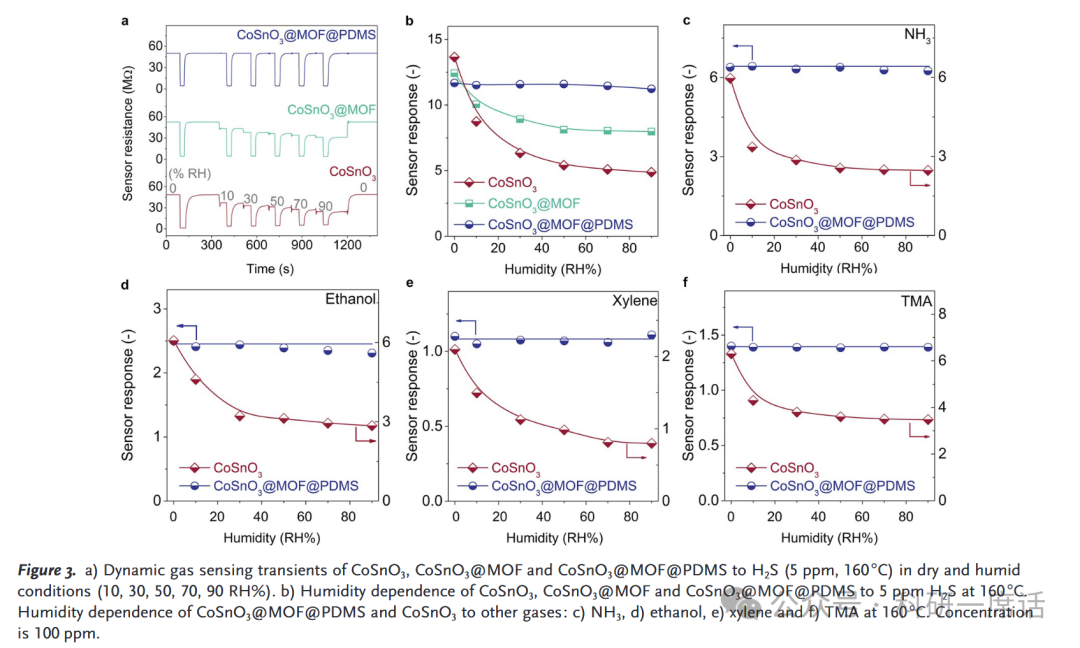
Figure 3: Displays the response curves of the sensor under different humidity conditions. It can be seen that the baseline resistance and response of CoSnO₃@MOF@PDMS are almost unaffected by changes in humidity, while the traditional CoSnO₃ sensor shows significant humidity dependence.
Application Prospects
This research not only provides a universal humidity-independent solution for SMOX gas sensors but also offers new ideas for the design of other gas sensors. With this dual-layer coating strategy, future gas sensors can achieve high-precision and high-selectivity gas detection under various environmental conditions, with wide applications in environmental monitoring, industrial safety, and more.

Conclusion
Humidity interference has long been a challenge in the field of gas sensors, and this study successfully achieved humidity-independent gas detection through innovative surface functionalization design. In the future, with further optimization and promotion of this technology, we can expect to see more high-performance gas sensors applied in real life.