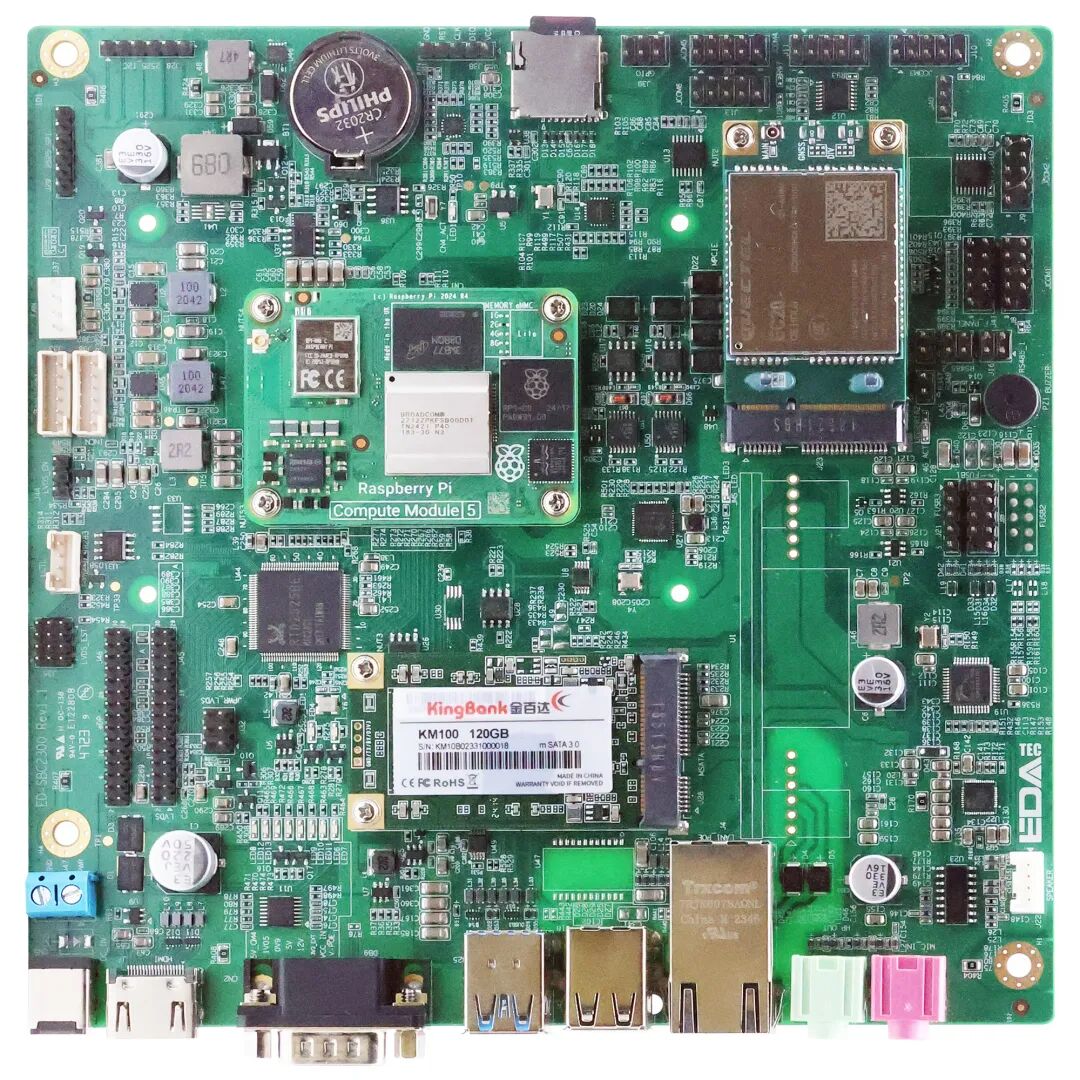
Shanghai Jinghang has launched the ED-SBC3300, a Mini-ITX industrial computer motherboard designed based on the Raspberry Pi CM5 module, specifically built for harsh industrial environments and edge computing scenarios. This product combines the ease of use of the Raspberry Pi ecosystem with the reliability of industrial-grade equipment, offering a rich array of interface options and powerful computing performance in a compact size. The following sections will detail the technical features and industrial application value of this innovative product from multiple dimensions.
Product Overview and Core Positioning
The ED-SBC3300 is an industrial-grade single-board computer developed by Shanghai Jinghang Electronic Technology Co., Ltd., adopting the Mini-ITX standard size (170mm×170mm) and weighing only 100g, yet integrating impressive computing power and interface density. As an extension of the Raspberry Pi ecosystem into the industrial field, this motherboard is designed based on the Broadcom BCM2712 SoC, which features a quad-core ARM Cortex-A76 architecture (ARM v8) with a clock speed of up to 2.4GHz, providing ample processing power for edge computing tasks.

The design philosophy of this product is to be a “versatile player” in industrial automation and IoT gateways, with core advantages reflected in:
– Industrial-grade reliability: fanless design, wide operating temperature range (-25°C~50°C), and 9V~36V wide voltage input, suitable for harsh environments
– Rich interface options: natively provides 7×RS232 + 2×RS485 industrial interfaces, reducing the need for expansion modules
– Dual-screen display capability: supports simultaneous output of HDMI 4K and LVDS touch screens, meeting HMI requirements
– Flexible expandability: supports various expansion methods such as mSATA SSD and 4G LTE modules
Compared to consumer-grade Raspberry Pi products, the ED-SBC3300 meets the stringent requirements for stability, durability, and functionality in industrial scenarios by enhancing hardware design and interface configuration while maintaining software ecosystem compatibility.
Hardware Architecture and Performance Parameters
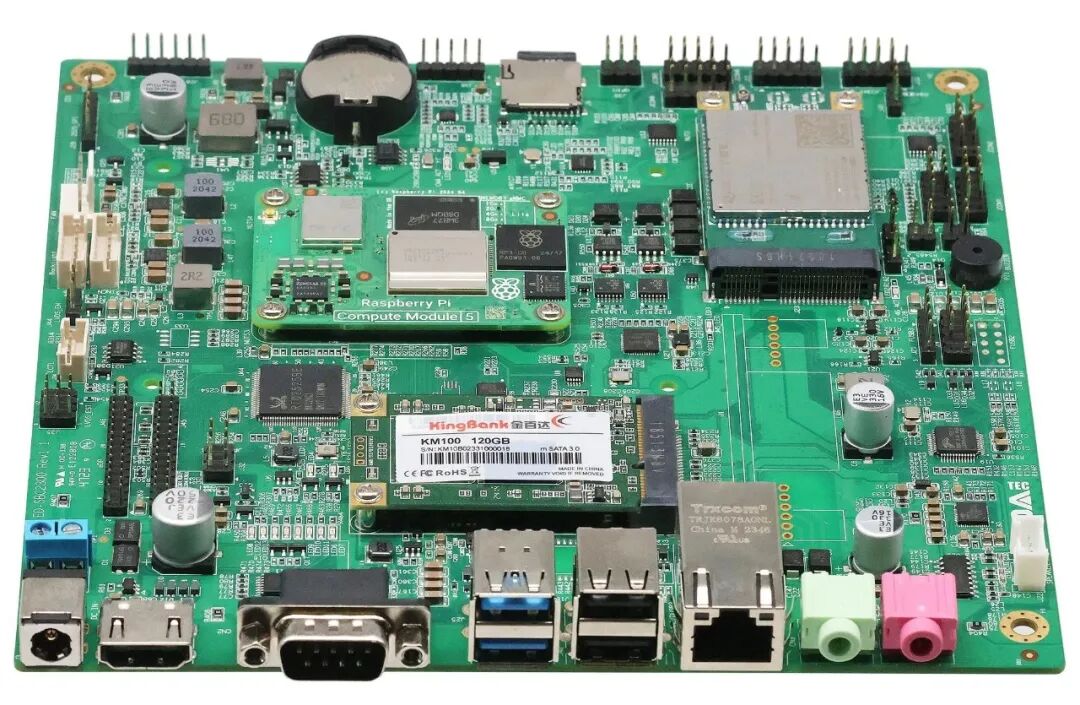
The hardware design of the ED-SBC3300 reflects the dual pursuit of performance and reliability in industrial computing platforms, with core components and configuration options carefully selected and optimized.
Processor and Graphics Capabilities:
– Equipped with Broadcom BCM2712 SoC, featuring a quad-core ARM Cortex-A76 architecture (64-bit), base frequency of 2GHz, dynamically boostable to 2.4GHz
– Integrated GPU supports OpenGL ES 3.1 and Vulkan 1.2 graphics APIs, meeting industrial visualization needs
– Video Processing Unit (VPU) supports H.265 (HEVC) hardware decoding, capable of processing 4Kp60 video streams
Memory and Storage Configuration:
– Memory options: available in 2GB/4GB/8GB/16GB LPDDR4-4267 SDRAM to meet different application needs
– Built-in storage: standard 16GB/32GB/64GB eMMC flash storage, providing stable and reliable system storage
– Storage expansion: supports user data storage expansion via Micro SD card slot and mSATA interface (up to 1TB)
Power Design and Power Management:
– Wide voltage input: supports 9V~36V DC input, suitable for unstable power environments in industrial sites
– Optional PoE power supply: complies with IEEE 802.3af/at standards, simplifying wiring and reducing costs
– Power protection: integrates reverse polarity protection circuits to prevent equipment damage from misoperation
– Power consumption control: typical power consumption is below 60W, and the fanless design minimizes energy consumption
Industrial-grade Reinforced Design:
– Cooling solution: uses all-aluminum heat sinks for passive cooling, avoiding fan failure risks while being dustproof and shock-resistant
– Circuit protection: all I/O interfaces are equipped with over-voltage/over-current protection components
– Real-time clock: integrates RTC (real-time clock) with a CR2032 battery holder to ensure accurate time after power loss
– Data security: built-in encryption chip and EEPROM enhance system security
It is worth mentioning that the ED-SBC3300 offers multiple model options, allowing users to choose different configurations based on actual needs:
– ED-SBC3310: 1×Gigabit Ethernet + 2×USB 2.0 + 2×USB 3.0
– ED-SBC3311: 2×Gigabit Ethernet + 2×USB 3.0
– ED-SBC3320: 1×Gigabit Ethernet + 2×USB 2.0 + 2×USB 3.0 + LVDS display interface + audio
– ED-SBC3321: 2×Gigabit Ethernet + 2×USB 3.0 + LVDS display interface + audio
This modular design concept allows users to precisely match application needs, avoiding resource waste while also reducing overall ownership costs.
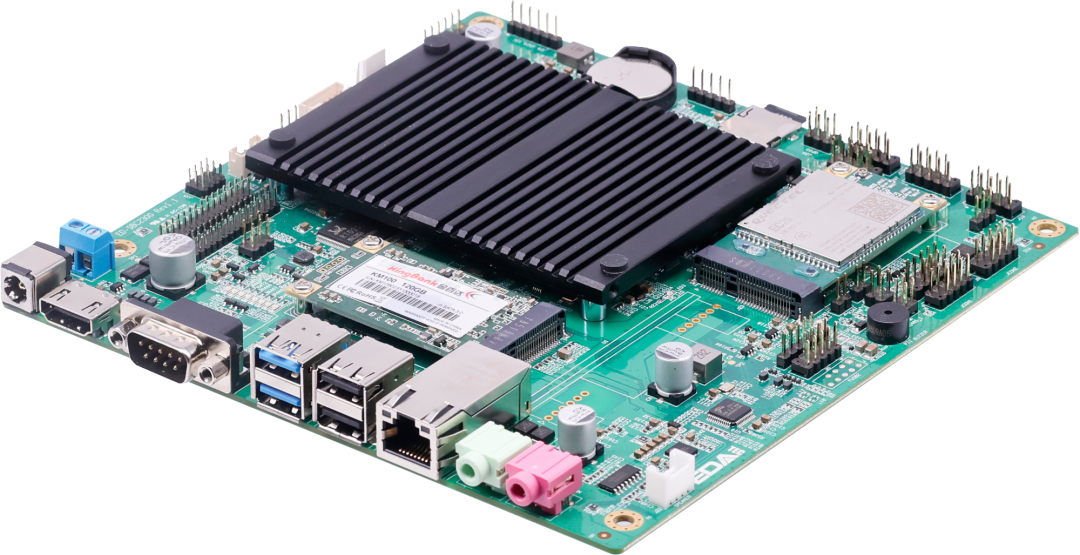
The ED-SBC3300 series single board reserves screw holes for installing heat sinks, supporting optional heat sinks.
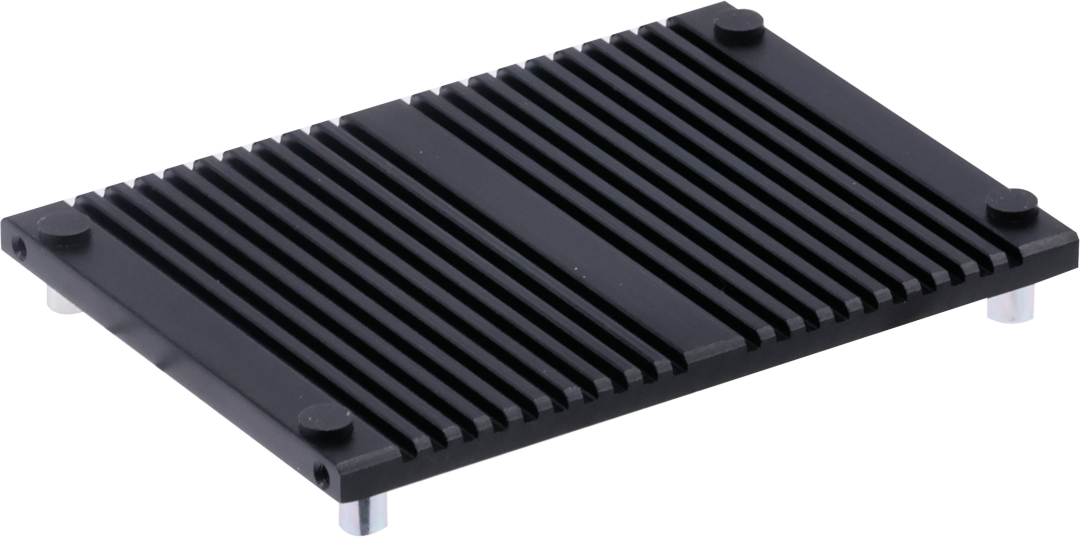 As shown in the figure below:
Rich Industrial Interfaces and Expansion Capabilities
The most notable feature of the ED-SBC3300 is its exceptionally rich industrial interface configuration, allowing it to connect directly to various industrial devices and sensors without the need for additional conversion modules or expansion boards, greatly simplifying system design and reducing failure points.
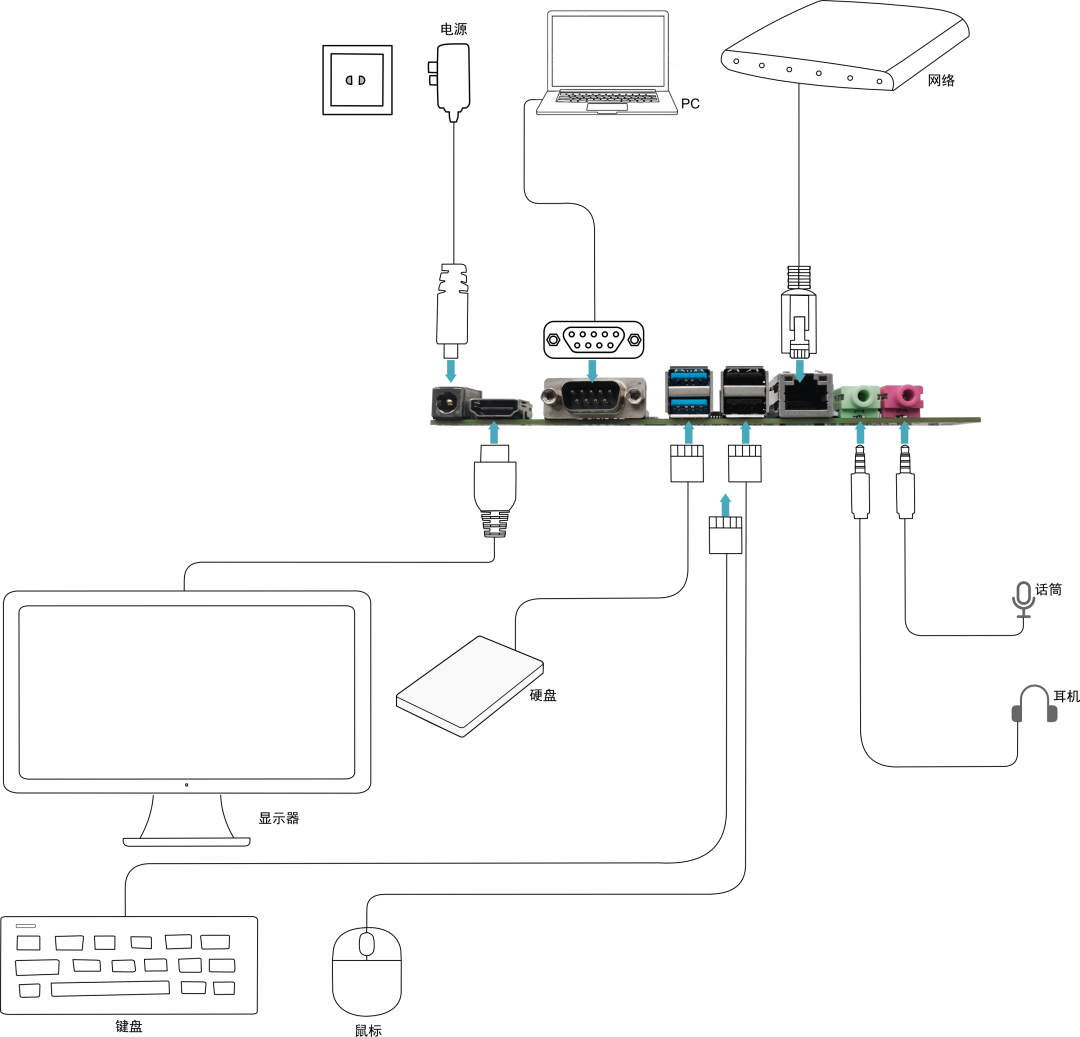
Communication Interfaces:
Wired Network:
-
1/2 Gigabit Ethernet interfaces (model dependent), supporting PoE power supply options, suitable for industrial network deployment
Industrial Serial Ports:
-
7×RS232 interfaces (some models exposed via pin headers)
-
2×RS485 interfaces (note current firmware limitations, may require manual modification by the manufacturer)
Wireless Connections:
-
Dual-band Wi-Fi (2.4GHz & 5GHz)
-
Bluetooth 5.0
-
Optional 4G LTE module (expanded via PCIe interface), supporting global mainstream frequency bands
USB and External Device Interfaces:
-
High-speed USB: 2×USB 3.0 interfaces (Type-A, 5Gbps)
-
Standard USB: 3/5×USB 2.0 interfaces (model dependent, 480Mbps)
-
Front Panel Interfaces: supports connection of power buttons, reset buttons, and status LEDs
Display and Multimedia Interfaces:
-
HDMI Output: 1×HDMI 2.0 interface, supporting 4K@60Hz resolution
-
Industrial Display: some models provide LVDS interfaces (up to 1080p@60Hz), supporting touch functionality
-
Audio Interfaces: high-end models equipped with 3.5mm audio input/output and amplifier interfaces (can drive 2×4Ω 3W speakers)
Storage and Expansion Interfaces:
-
mSATA Interface: supports SSD expansion via Mini PCIe connector (note some brand compatibility issues)
-
Micro SD Card Slot: for user data storage and system backup
-
GPIO Expansion: 6-Pin GPIO header (VCC/GND/4×GPIO), providing flexible customization control capabilities
Special Function Interfaces:
-
RPI_BOOT Interface: 3-Pin header, can enter Raspberry Pi boot mode via shorting, facilitating system recovery
-
Power-On Auto Boot: 3-Pin jumper settings, meeting unattended application needs
-
LVDS Control Interface: includes backlight drive, brightness control, voltage regulation, and other dedicated interfaces (only for models with LVDS)
The interface layout of the ED-SBC3300 fully considers the convenience of use in industrial sites. All major interfaces are concentrated at the board edge for easy wiring; key connectors use industrial-grade specifications to ensure long-term plug-and-play reliability; electrostatic and surge protection circuits cover all external interfaces, enhancing system robustness. This “full interface coverage” design philosophy allows the motherboard to directly interface with the vast majority of industrial devices, significantly reducing system integration complexity.
Software Support and Development Ecosystem

The ED-SBC3300 inherits the rich software ecosystem advantages of the Raspberry Pi while being specifically optimized for industrial applications, providing users with a flexible development environment and a stable operating platform.
Operating System Support
Officially Supported Systems:
-
Raspberry Pi OS (Desktop) 32-bit
-
Raspberry Pi OS (Lite) 32-bit
-
Raspberry Pi OS (Desktop) 64-bit
-
Raspberry Pi OS (Lite) 64-bit
Third-party System Compatibility:
-
Ubuntu Core
-
Yocto Linux
-
Windows IoT Core
-
Domestic Industrial Real-time Operating Systems (custom drivers required)
Industrial Software Toolchain
-
Development Environment: Fully supports mainstream languages such as Python, C/C++, Java
-
Industrial Protocol Stack: Pre-installed industrial protocol libraries such as Modbus RTU/TCP, CANopen, EtherCAT
-
HMI Framework: Supports graphical development tools like Qt, Node-RED
-
AI Inference Framework: Compatible with edge AI frameworks like TensorFlow Lite, PyTorch Mobile
Dedicated Functional Software Packages
-
Dual-screen management tool: Independently configure HDMI and LVDS display content and resolution
-
Serial port configuration tool: Flexibly set RS232/485 parameters, including baud rate, data bits, parity, etc.
-
GPIO control library: Simplifies control interfaces for digital I/O and PWM
-
Power management tool: Monitors system power consumption, sets timed power on/off strategies
Industrial-grade Software Features
-
Watchdog Timer: Hardware watchdog combined with software daemon ensures continuous system operation
-
System Recovery Mechanism: Supports quick recovery from backup images, reducing downtime
-
Security Updates: Regularly pushes security patches to maintain system security
-
Remote Management: Integrates remote access tools like SSH, VNC, supports OTA updates
The ED-SBC3300 maintains compatibility with Raspberry Pi community software, meaning developers can reuse a large amount of existing code and project resources. Meanwhile, Shanghai Jinghang provides a dedicated industrial software package (Industrial IO Package) that includes drivers and example code for various industrial interfaces, significantly lowering the development threshold.
For industrial users particularly concerned about long-term support, Shanghai Jinghang promises at least 10 years of product lifecycle support, including ongoing security updates and critical vulnerability fixes. This long-term stability is especially important for industrial automation projects, ensuring sustainable operation and maintenance of the system.
Industrial Scene Applications and Solutions
The ED-SBC3300, with its powerful processing capabilities, rich interfaces, and industrial-grade reliability, has found extensive applications across various industrial fields. Here are several typical application scenarios and solutions:

Smart Factory and Production Line Control
As the central control unit for smart production lines, the ED-SBC3300 can fully leverage its dual Ethernet and multiple serial port advantages:
-
One Gigabit Ethernet port connects to the EtherCAT device network for real-time control of motion devices
-
The other port connects to the factory MES system to upload production data
-
RS485 interface collects sensor data (e.g., temperature, vibration, pressure)
-
RS232 interface connects to legacy PLCs and devices
-
Edge-side real-time analysis of device status and product quality reduces cloud round-trip latency
Typical Configuration:
-
Model Selection: ED-SBC3311 (dual Ethernet)
-
Memory Configuration: 8GB RAM + 64GB eMMC
-
Expansion Storage: mSATA SSD for storing historical data
-
Display Configuration: HDMI output for production line data dashboard, LVDS screen embedded in device panel for local control

Warehouse Logistics Edge Gateway
In smart warehousing environments, the ED-SBC3300 can serve as a multifunctional edge gateway:
-
4G LTE module enables AGV cart position data transmission
-
Wi-Fi connects RFID readers and barcode scanners within the warehouse
-
USB 3.0 interface connects to industrial cameras for automatic package scanning and sorting
-
RS485 interface connects environmental sensors to monitor warehouse temperature and humidity
-
Edge-side preprocessing of data, only uploading key information to the cloud
Typical Configuration:
-
Model Selection: ED-SBC3321 (with wireless expansion capability)
-
Communication Module: Install 4G LTE module and SIM card
-
Peripheral Connections: Connect industrial cameras via USB, RS485 to sensor array
-
Power Solution: Use PoE power supply to simplify wiring
Digital Signage and HMI All-in-One Machine
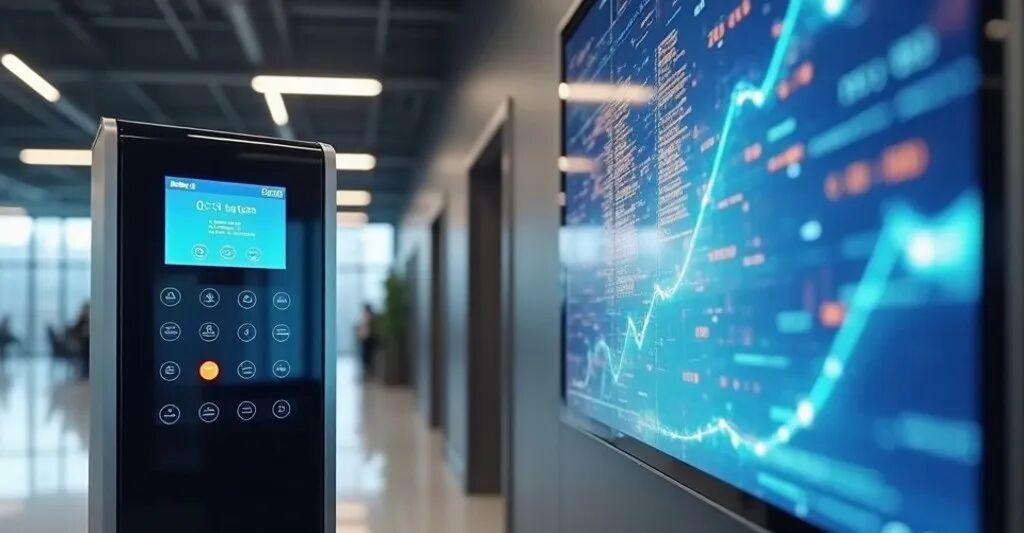
The dual-screen display capability of the ED-SBC3300 makes it an ideal platform for digital signage and Human-Machine Interface (HMI):
-
HDMI outputs 4K advertising content to large screens
-
LVDS touch screen embedded in device panel provides interactive control
-
USB interface expands touch module for user input
-
Timed power on/off function aligns with business hours
-
Remote updates of advertising content via 4G/Wi-Fi
Typical Configuration:
-
Model Selection: ED-SBC3320 (with audio and LVDS)
-
Display Configuration: Connect 1080p LVDS touch screen and 4K HDMI display
-
Audio Output: Drives stereo speakers for background music/alerts
-
Storage Expansion: Large-capacity mSATA SSD for storing advertising materials
Target Customers and Value Proposition
The ED-SBC3300 primarily targets the following customer segments:
1. Industrial Automation Integrators: Need a reliable control hub to connect various industrial devices
2. Equipment Manufacturers: Seeking embedded computers as the intelligent core of their devices
3. Edge Computing Developers: Need AIoT applications that balance performance, power consumption, and interface requirements
4. Digital Signage Suppliers: Dual-screen display and compact size suitable for commercial displays
For these customers, the core values offered by the ED-SBC3300 include:
-
Lower Total Cost of Ownership: High interface integration reduces the need for additional expansion modules
-
Shortened Development Cycle: Accelerates application development using the mature Raspberry Pi ecosystem
-
Enhanced System Reliability: Industrial-grade design reduces field failures
-
Future Scalability: Ample performance headroom and interface reserves to adapt to changing demands
Compared to traditional PLC + industrial computer solutions, the ED-SBC3300 offers a more cost-effective and flexible alternative, especially suitable for modern smart factories and IoT applications. For resource-constrained development teams, it significantly lowers the development threshold and cycle for industrial control systems.
The pricing strategy of the ED-SBC3300 positions it in the mid-range market, higher than consumer-grade Raspberry Pi but lower than high-end industrial PCs, providing excellent cost-performance ratio. Especially considering its rich interface options and the cost savings on expansion modules, the overall return on investment is highly attractive to industrial users.
Conclusion and Outlook
The ED-SBC3300, as a Mini-ITX industrial computer motherboard developed by Shanghai Jinghang based on the Raspberry Pi CM5, successfully merges the development convenience of consumer-grade Raspberry Pi with the reliability requirements of industrial-grade devices, creating a truly suitable embedded computing platform for harsh industrial environments. Through a comprehensive analysis of this product, we can clearly see its unique value in the fields of industrial automation and edge computing.
Future Development Directions
Based on the current design and market feedback of the ED-SBC3300, we can foresee several possible evolution directions:
1. Performance Upgrade Version: Adopting more powerful processor modules (such as future Raspberry Pi CM6) to meet higher computing demands
2. Wide Temperature Expansion Version: Expanding the operating temperature range to -40°C~70°C to adapt to extreme environments
3. Function Optimization Version: Perfecting support for all RS232/485 interfaces, adding more industrial protocol hardware acceleration
4. AI Acceleration Version: Integrating NPU units to enhance edge AI inference capabilities
As an official partner of Raspberry Pi, Shanghai Jinghang is expected to continue iterating the ED-SBC series products, further strengthening its position in the industrial computing field. With the deepening development of Industry 4.0 and AIoT, embedded computers like the ED-SBC3300, which combine performance, reliability, and flexibility, will play an increasingly important role.
Final Recommendations
For potential users considering the ED-SBC3300, we recommend:
1. Detailed Needs Assessment: Choose the appropriate model based on actual interface requirements to avoid resource waste
2. Prototype Validation: Test key functions (especially serial and network) in real environments
3. Consult the Manufacturer: Understand the latest firmware status and compatibility information
4. Long-term Planning: Consider the 5-10 year product lifecycle and technical support needs

The ED-SBC3300 represents a balance point for industrial single-board computers—achieving a satisfactory balance between performance, interfaces, reliability, and cost. Whether as a replacement for traditional industrial computers or as the control core of new smart devices, it demonstrates exceptional adaptability and value potential, making it worthy of serious consideration by developers and managers in the industrial automation field.
Understanding these technical limitations and following best practices will help users avoid potential issues and fully leverage the value of the ED-SBC3300 in industrial applications. Shanghai Jinghang provides comprehensive technical documentation (including data sheets and hardware user manuals) as well as professional technical support services to assist users in overcoming various challenges encountered during implementation.
Product Information:
https://edatec.cn/zh/sbc/sbc3300
Data Sheet Download:
https://edatec.cn/docs/zh/sbc3300/ds/
User Manual Download:
https://edatec.cn/docs/zh/sbc3300/um/1-hardware/
If you find this article helpful, remember to like, bookmark, follow, and share~
We are happy to provide you with industrial Raspberry Pi solutions; please contact us if you have project needs~
Official Website: www.edatec.cn/cn