1
Research Overview
01
Surface-enhanced Raman spectroscopy (SERS) is a powerful spectroscopic-structural correlation technique widely used in fields such as chemistry, biology, and environmental analysis. However, in complex systems, co-adsorption and competitive adsorption of non-target molecules often lead to signal overlap, limiting the accuracy of SERS in the qualitative and quantitative analysis of trace target substances.
To address this issue, Professor Tian Zhong’s and Professor Liu Guokun’s team from Xiamen University jointly developed the intelligent self-supervised algorithm SSNet, which can high-fidelity separate and identify target signals from mixed SERS spectra without prior knowledge of the matrix.
Taking the detection of trace toxic substances from the hooknose plant in food as an example, SSNet achieves expert-level accuracy in terms of peak position, intensity, and relative intensity; its sensitivity even surpasses that of experts by an order of magnitude when similar matrix knowledge is available. This algorithm can also distinguish various structurally similar toxic molecules, providing new ideas and technical support for the intelligent application of SERS in field detection, in situ, and in vivo analysis.

2
Working Principle
02
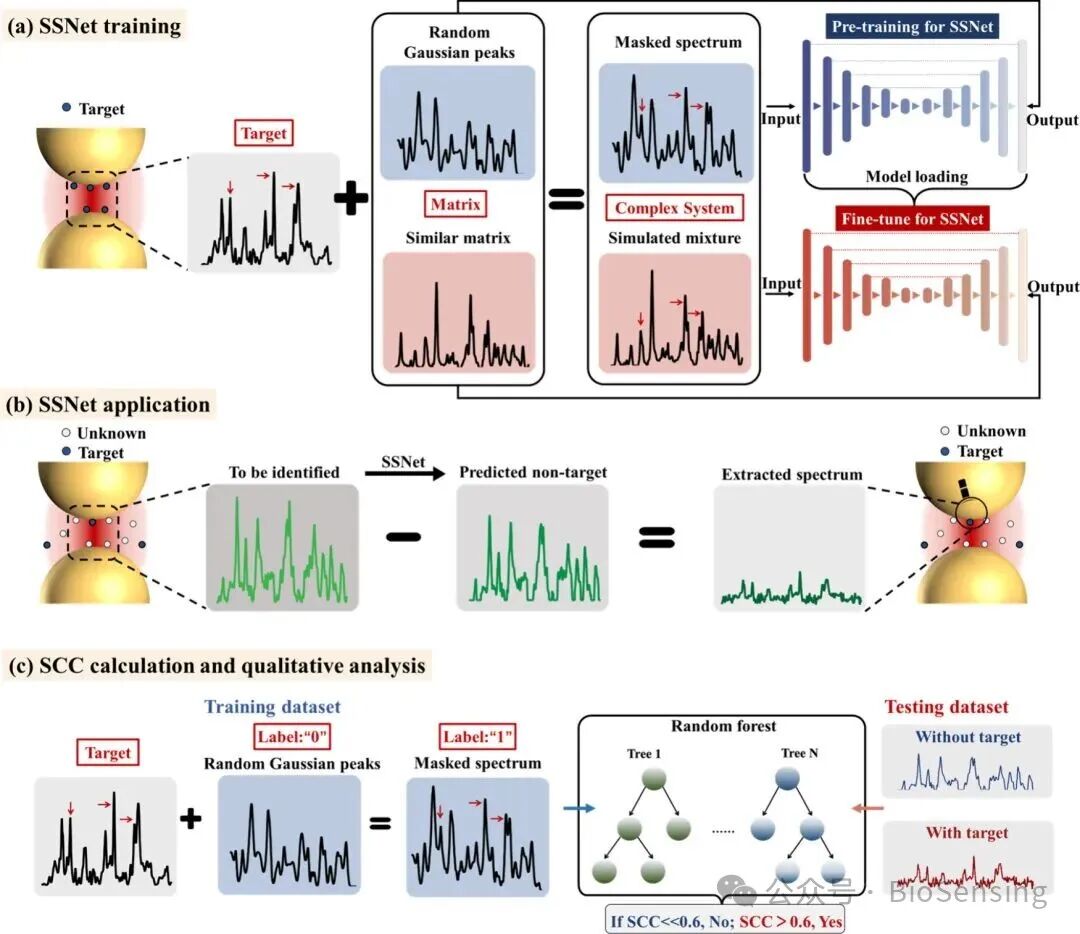
The method first enhances the concentration-dependent SERS spectra of the target substance through random masking with Gaussian peak masks, thereby self-supervising the training of a U-Net model. Subsequently, the model is fine-tuned using experimentally measured spectra from similar matrices, enabling it to automatically “remove” background signals. During the testing phase, mixed spectra are input into the model, which outputs predicted non-target signals that are subtracted from the original spectra to obtain the difference spectrum. Finally, the peak-sensitive similarity coefficient (SCC) between the difference spectrum and the target reference spectrum is calculated; when SCC > 0.6, the presence of the target substance can be determined.
3
Graphical Analysis
01
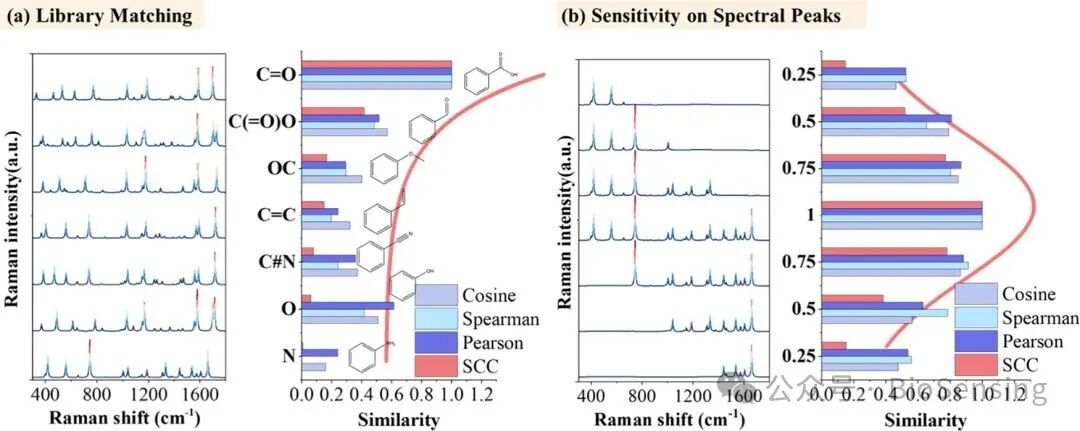
Calculation and Validation of SCC
(a) Spectral Library Matching: The accuracy of SCC is verified by calculating the similarity between the theoretical Raman spectrum of benzoic acid and the spectra of other phenolic derivatives.
(b) Comparison of Peak Sensitivity: Selectively removing Raman peaks in ascending or descending order and calculating the change in similarity between the removed spectrum and the original spectrum.
02
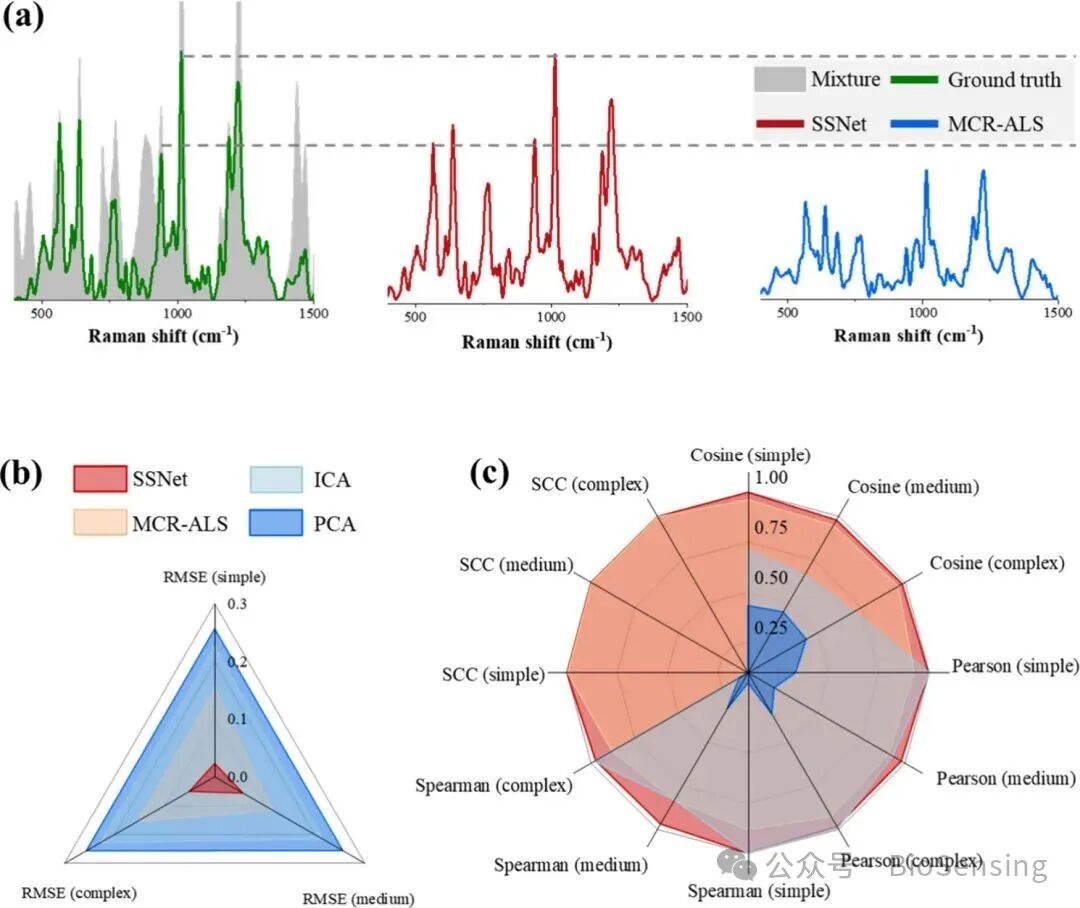
Evaluation of the performance of various algorithms in extracting the SERS spectrum of 100 μg/L KM from simulated interference.
(a) SERS spectrum of KM (green line), mixed spectrum (gray background), and the KM spectrum obtained from SSNet (red line) and MCR-ALS (blue line) unmixing.
(b) Root Mean Square Error (RMSE) between the unmixing spectrum and the true spectrum.
(c) Comparison of spectral similarity between the unmixing spectrum and the true spectrum (including Pearson, Spearman, Cosine similarity, and SCC).
03
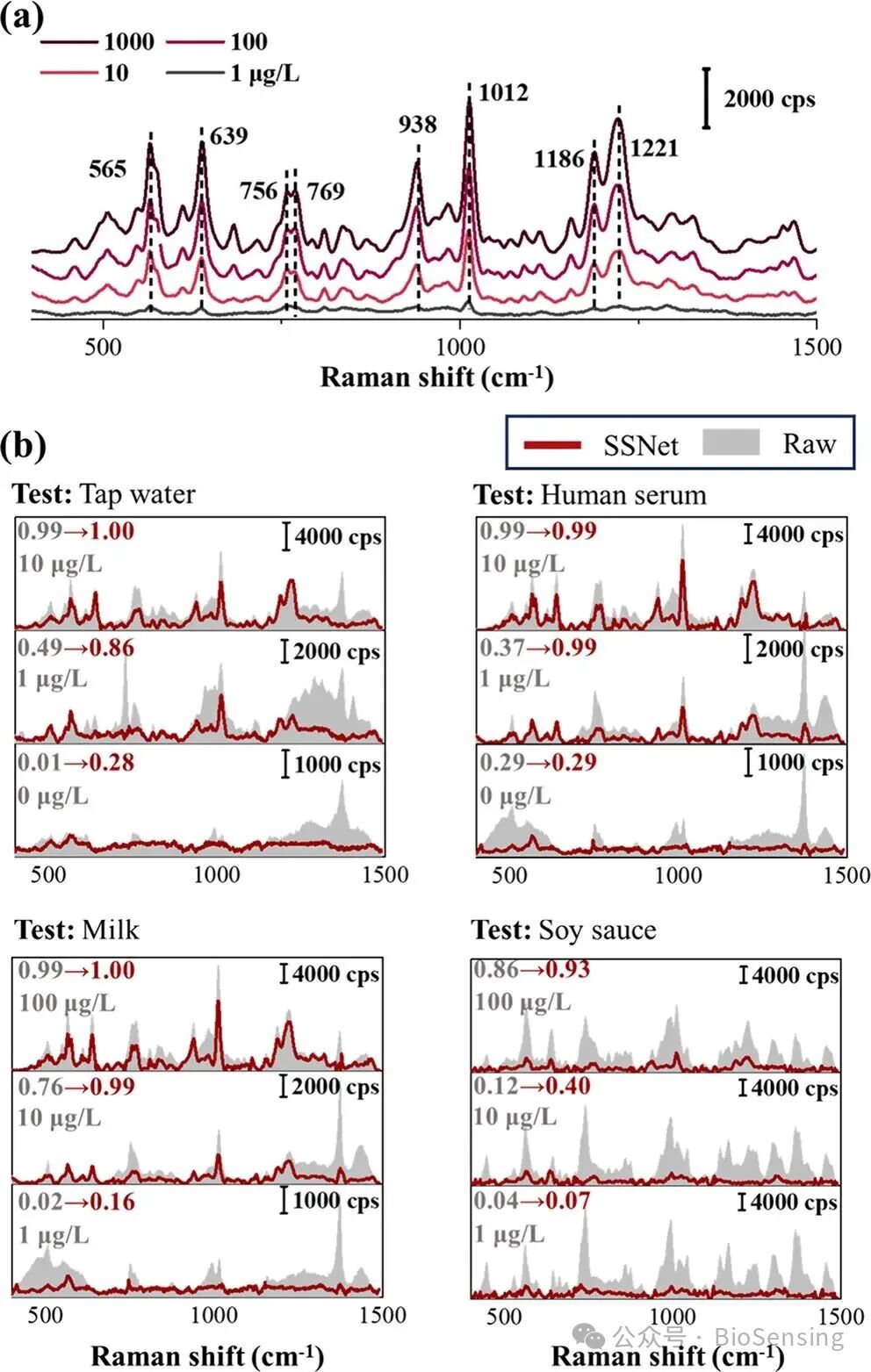
Pre-trained SSNet achieves unmixing and qualitative identification of trace KM SERS spectra in different food matrices.
(a) SERS spectra of KM with a concentration gradient, showing consistent peak positions and relative intensities, indicating stable adsorption behavior on the surface of Au NPs.
(b) Mixed SERS spectra of different concentrations of KM spiked in tap water, milk, soy sauce, and human serum after SPE−LLE−BE pretreatment (gray background), and the spectra processed by pre-trained SSNet (red lines).
04
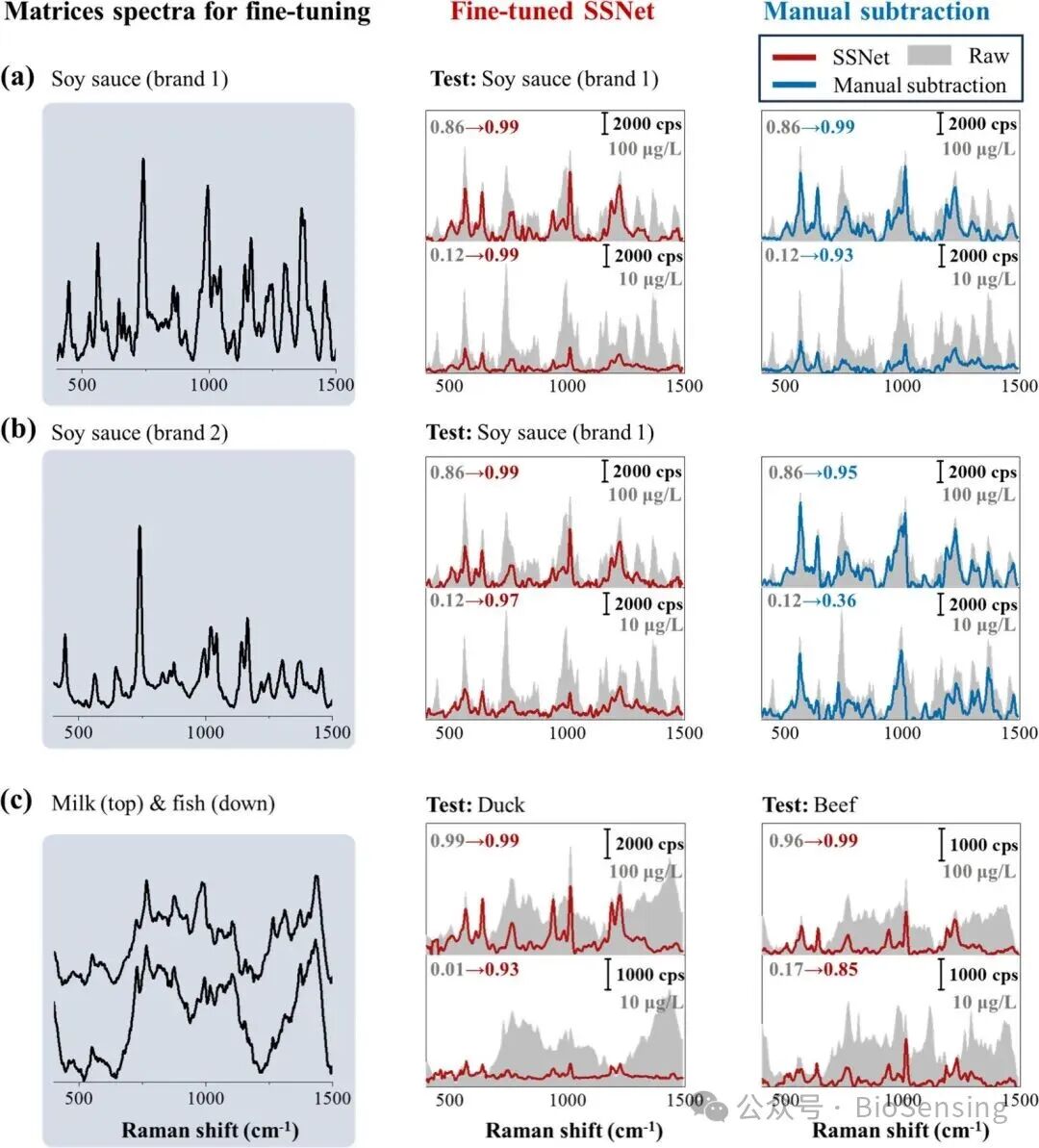
Fine-tuning SSNet (red line) and manual subtraction (blue line) for unmixing SERS spectra of soy sauce spiked with 10 and 100 μg/L KM under different scenarios.
(a) Laboratory spiking: The test matrix is identical to the known matrix (same brand of soy sauce).
(b) Similar sample blind screening: The test matrix (Brand 1 soy sauce) is similar but not identical to the known matrix (Brand 2 soy sauce).
(c) Cross-category sample blind screening: The test matrix (duck, beef) is different from the known matrix (milk, fish).
05
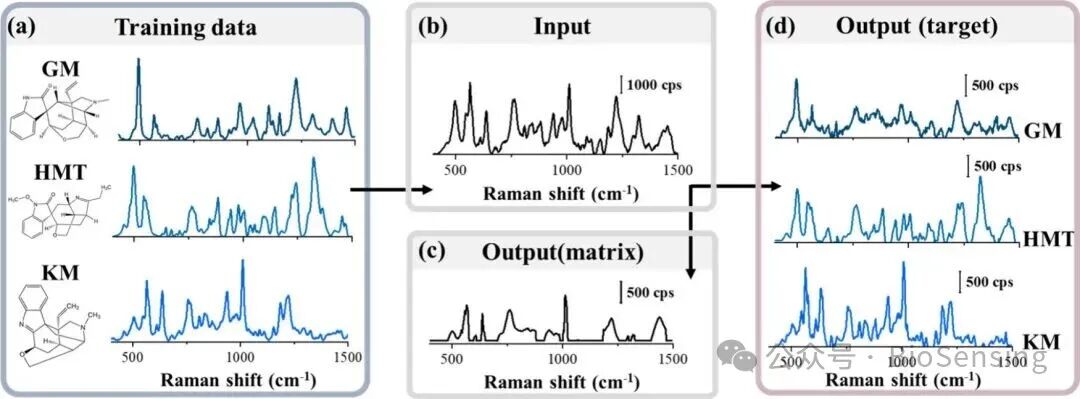
Using multi-layer SSNet (M-SSNet) to analyze multi-target mixed SERS spectra.
(a) SERS spectra of 1 mg/L GM, 1 mg/L HMT, and 100 μg/L KM existing separately.
(b) Ternary mixed spectrum spiked into soy milk (containing 1 mg/L GM, 1 mg/L HMT, and 100 μg/L KM), still affected by non-target peak interference.
(c) Background matrix spectrum obtained after unmixing with M-SSNet.
(d) Individual spectra of each target molecule after unmixing.
【Paper Information】
Luo, S.-H., Xu, J., Wang, W.-L., Xiong, C.-R., Wang, L.-P., Tian, Z.-Q., & Liu, G.-K. (2025). SSNet: A spectral unmixing framework for enhancing the qualitative sensitivity of SERS to trace targets in complex mixtures. Journal of the American Chemical Society.
https://doi.org/10.1021/jacs.5c16529 B1
IF: 15.6 Q1
【Editor】
This article was authored by: wl
Reviewed by: zyz
【Disclaimer】
1. The copyright of this article belongs to the original author. Please contact us for reprints in public accounts and media.
2. My knowledge is limited; if there are any omissions or errors, please feel free to criticize and correct, and discuss peacefully.
Submissions are welcome, submission email:

BioSensing