
3D Printed Apple Watch Cases
Apple revealed on its official website today that the titanium cases for the Apple Watch Series 11/Ultra 3 are entirely manufactured using 3D printing technology, reducing the raw materials used by half compared to traditional processes, and aiming for the company to achieve carbon neutrality by the end of 2030.
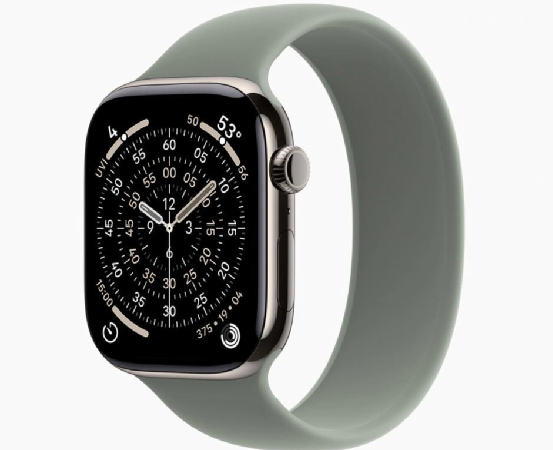
All cases for the Apple Watch Ultra 3 and the titanium version of the Apple Watch Series 11 are manufactured using 3D printing technology. However, prior to this, 3D printing technology had not been able to be used for the mass production of aesthetic components. Apple has been exploring 3D printing technology for the past decade, ultimately making this previously impossible task a reality.
Source: CNMO Mobile China

BYD Fangcheng Leopard Cumulative Sales Reach 100,000 Units
BYD Auto announced that the cumulative sales of the Fangcheng Leopard titanium series have reached 100,000 units.

Just last month, BYD also announced that the Fangcheng Leopard car achieved cumulative sales of 200,000 units, ranking in the top three for growth among new force brands, with an average transaction price of 238,800 yuan. In October this year, BYD sold 441,706 vehicles, setting a new high for the year. From January to October 2025, cumulative sales reached 3,701,852 units, with over 14.2 million new energy vehicles sold, including 31,052 units of the Fangcheng Leopard.
The BYD Fangcheng Leopard Titanium 7 was officially launched and began deliveries in September this year, offering four models priced between 179,800 and 219,800 yuan.
Source: Dongchedi

Chinese Robot Mass Production Video Questioned
UBTECH released a video on November 12 on social media showcasing the mass production delivery of its humanoid robot Walker S2, demonstrating capabilities such as battery swapping and marching in formation. In response to this video, Brett Adcock, founder and CEO of Figure, claimed on social media that “the robots in front are real — everything behind them is fake; if you see the main unit reflecting a lot of ceiling lights, it is likely computer-generated effects.”
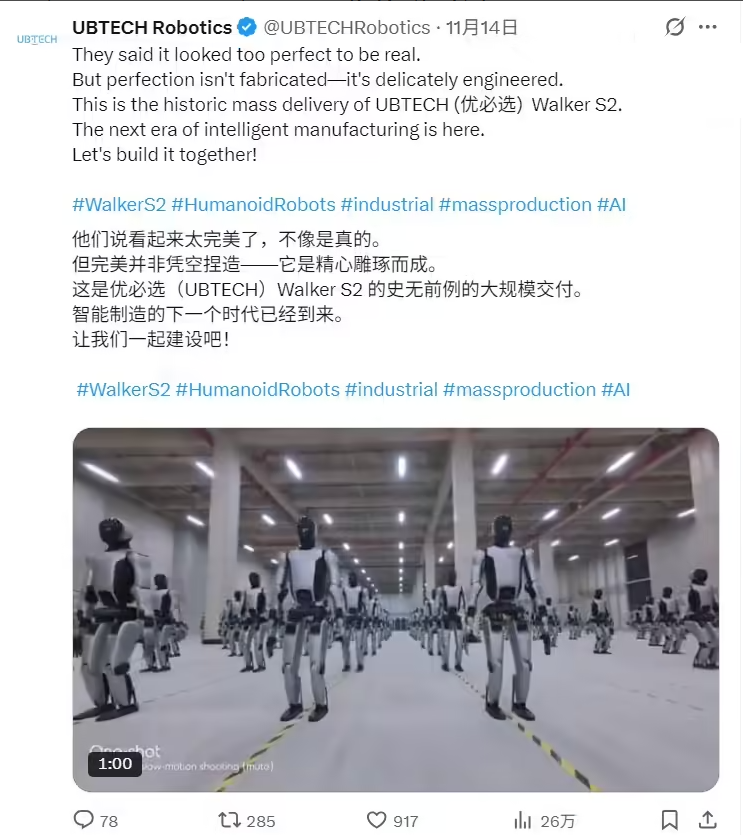
In response, UBTECH stated that the accusation is unfounded, and subsequently released a continuous shot video with original speed and sound, showing that there were indeed a large number of humanoid robot products on site. Following the release of the continuous shot video, another user tagged Brett Adcock, who responded, “I don’t want to argue with them — I just want to point out that the chaos in this market has gotten out of control.”
Source: Xinjingbao

Xpeng Motors Aiming for Profitability in Q4
Xpeng Motors has also submitted an impressive quarterly report, aiming for profitability in Q4. The financial report shows that the company’s total revenue for the third quarter reached 20.38 billion yuan, doubling year-on-year; deliveries of 116,000 new vehicles were at the high end of the second quarter guidance; and net losses narrowed to 380 million yuan, just one step away from breakeven. With several consecutive quarters of sequential growth, Xpeng’s scale effect is beginning to show, bringing them closer to their Q4 profitability goal.

Xpeng plans to open up a multi-energy route layout to continue boosting sales. In addition to the X9 extended-range version set to launch this week, three more extended-range vehicles will be launched in the first quarter of next year. With two energy forms being released simultaneously, Xpeng will further capture market share. For Q4, Xpeng has provided a delivery guidance of 125,000 to 132,000 vehicles. If achieved, this will continue to set quarterly records.
Source: Dongchedi

The World’s Smallest WearableEarphoneDevice
Tech media T3 published a blog yesterday (November 18), reporting that Lumia has launched the smart earring Lumia 2, claiming to be “the world’s smallest wearable device,” weighing less than 1 gram, yet capable of accurately tracking key health data such as sleep, body temperature, menstrual cycle, and readiness level.

The Lumia 2 smart earring weighs less than 1 gram but integrates the second-generation PreciseLight sensor, processor, battery, and various health sensors. Lumia claims that due to its unique advantage of being worn in the ear, the Lumia 2 can achieve higher precision and continuity in health data tracking compared to wrist devices, monitoring core indicators such as sleep quality, temperature changes, menstrual cycles, and readiness levels.
Source: Mobile Phoenix Network