Hello everyone, today I am sharing an article published in JACS: Metallo-coiled Coil Stabilization via Chemical Cross-Linking: Implications for Gd(III)-Based MRI Contrast Agents. The corresponding author is Professor Anna F. A. Peacock from the University of Birmingham, whose research group focuses on the design and application of functional metal peptides.

Coiled coils are a class of multifunctional metal-binding ligands inspired by proteins, characterized by distinct sequences and structures. Coiled coils provide a versatile ligand platform for designing metal-binding sites with high specificity and tunable properties, often outperforming traditional small molecule ligands in many cases. The authors have previously demonstrated that Gd(III)-bound coiled coils can exhibit superior performance compared to clinical small molecules based on Gd(III) for MRI contrast agents. However, they are often limited by poor stability, particularly under physiological conditions. Gd(III) coiled coils still face challenges in preventing the release of toxic Gd(III), which remains a barrier to clinical translation.
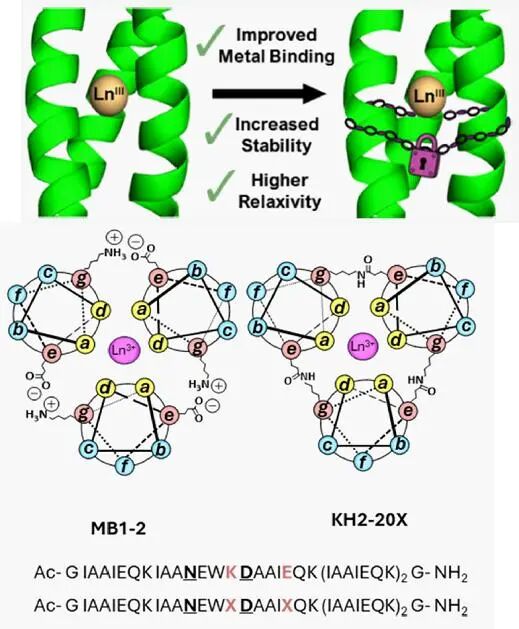
To address this challenge, the authors introduce a covalent interhelical peptide cross-linking strategy that significantly enhances the thermodynamic, kinetic, and proteolytic stability of lanthanide-binding coiled coils used as MRI contrast agents. This level of stability is crucial for advancing metal coiled coils into clinical applications. To tackle the stability issue, the authors introduced a layer of interhelical peptide cross-linking near the unstable Asn-Asp-Gd(III) binding site based on the cross-linked analog (MB1-2), resulting in KH2-20X. In KH2-20X, the 20th glutamic acid reacts with the adjacent chain’s lysine to create interhelical peptide cross-linking near the metal-binding site.
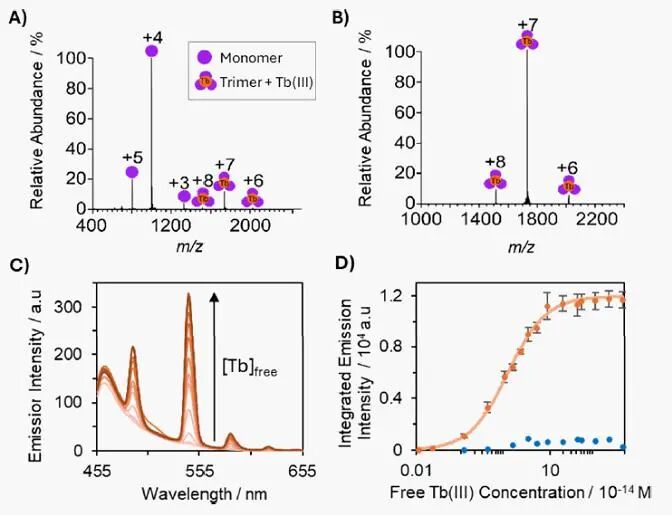
Subsequently, the authors evaluated the stability of the metal coiled coils. First, through thermal denaturation CD experiments, they studied the effect of peptide cross-linking on the stability of the coiled coils, finding that KH2-20X exhibited higher thermal stability than its non-cross-linked analog MB1-2. Using native mass spectrometry, the authors found that the degree of metalation of Ln(III) with KH2-20X was significantly increased, with MB1-2 showing only 10-15% metalation, while KH2-20X exhibited nearly complete metalation. Additionally, the log Ka of Tb(KH2-20X) was 13.9 ± 0.1, indicating substantial thermodynamic stability conferred by the covalent cross-linking in KH2-20X. Finally, the authors demonstrated that cross-linking could enhance its kinetic stability and proteolytic stability.
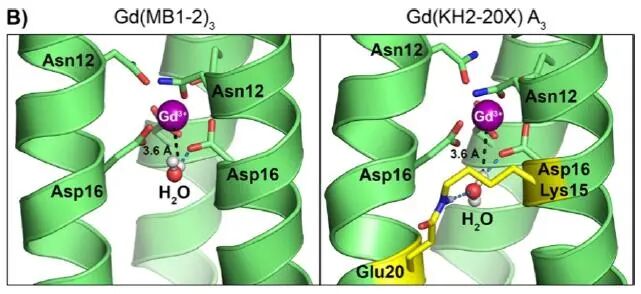
To reveal the potential application of this strategy in magnetic resonance imaging, the authors showed through 1H relaxation studies and molecular dynamics simulations that such potential MRI contrast agents operate via a second sphere water coordination mechanism, with optimized cross-linking enhancing MRI efficacy by approximately 30% at clinically relevant field strengths, highlighting its potential as a design principle for next-generation MRI contrast agents.
In summary, the authors achieved stabilization of metal coiled coils through chemical cross-linking, enhancing Gd(III)-based MRI imaging.
Authors: MB
Editor: LZ
DOI: 10.1021/jacs.5c13620
Original link: https://doi.org/10.1021/jacs.5c13620