In science fiction movies, surgical robots can always perform various complex operations with precision. However, in reality, achieving such stable and reliable delicate operations with robots has been a challenging problem for scientists.
Traditional solutions rely on complex electronic force sensors and algorithms, which lead to high costs and insufficient reliability in confined or special environments.
Is there a simpler solution?
Recently, a research team led by Academician Yang Wei and Professor Li Tiefeng from the Center for Interdisciplinary Mechanics at Zhejiang University, in collaboration with Academician Cai Xiujun’s team from the Shao Yifu Hospital affiliated with Zhejiang University, conducted interdisciplinary research. Their research results were published as a cover article in the prestigious journal Nature.
The research team drew inspiration from the everyday action of “tying shoelaces” to develop a mechanical intelligent transmission mechanism based on slip knots. They innovatively proposed “Sliputure”—an intelligent suture using slip knots, successfully applying it to surgical suturing and potentially guiding the design of other robots and intelligent structures.
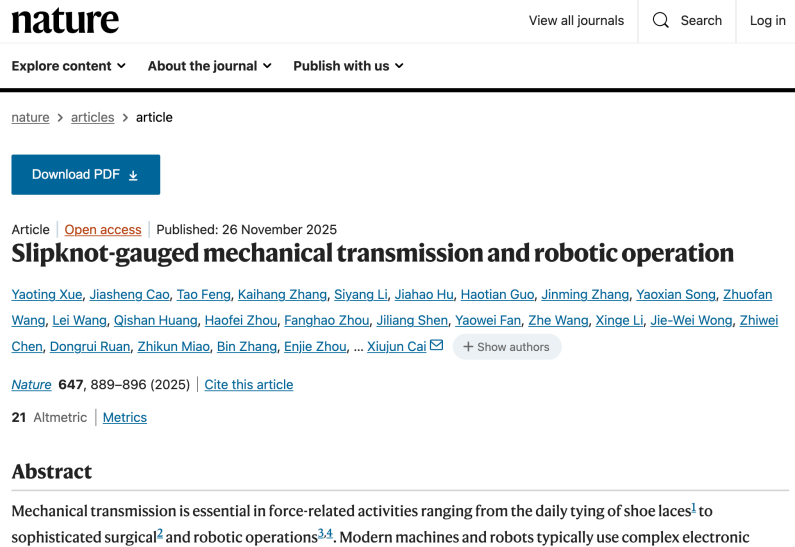
This technology allows machines to achieve a 95.4% ultra-high consistency in force transmission and perception without any electronic sensors or complex programs, as if endowed with innate muscle memory. Clinical experiments show that this technology can increase the knot-tying precision of novice surgeons by 121%, surpassing that of experienced medical experts.
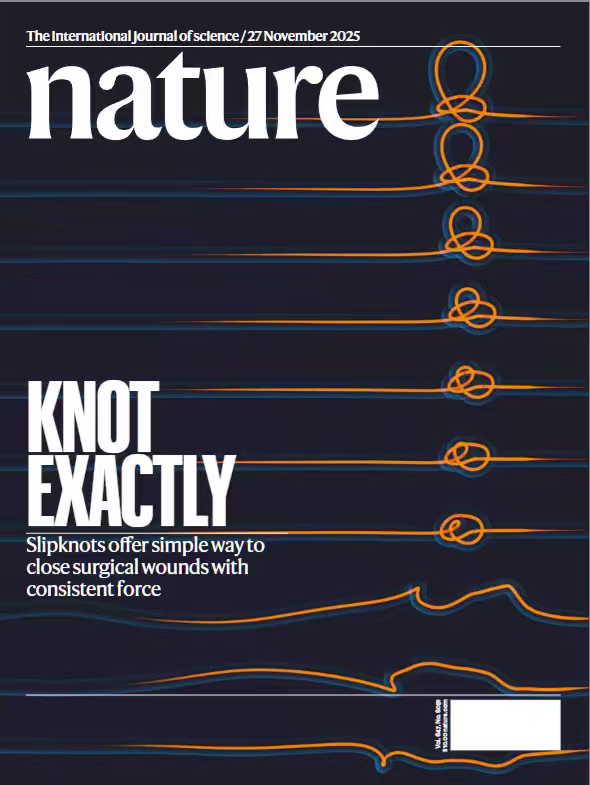
How is this achieved? What revolution will it bring to the field of robotics?
▍Facing a Major Challenge in Robotics: The Elusive “Tactile Sensation”
Whether in precision assembly or robotic surgery, “force control” has always been a core bottleneck for robots to achieve higher autonomy.
In the industrial sector, excessive gripping force can damage precision parts, while insufficient force may fail to complete tasks.
In the medical field, especially in gastrointestinal surgeries, the force of suturing is crucial: excessive force can lead to tissue ischemia and necrosis; insufficient force may cause anastomotic leaks, increasing patient mortality by over 30%.
Current robotic systems mostly rely on visual feedback and preset programs, essentially performing blind operations. Surgeons indirectly judge the force by observing tissue deformation, which varies greatly among individuals and is difficult to standardize. Adding force sensors faces a series of challenges, including spatial limitations, high costs, and decreased reliability in bodily fluid environments.
The research team turned their attention to ancient knots, attempting to find answers from “mechanical intelligence”—not relying on circuits and code, but allowing the machine’s body to possess intelligence through structural design itself.
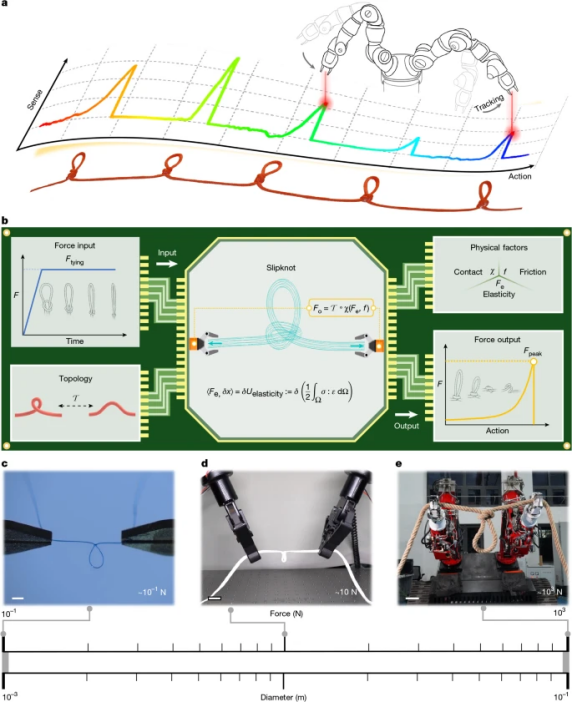
▍Stretching Tests: How Does the Slip Knot Become the Robot’s Tactile Nerve?
The research team systematically revealed the physical essence of the slip knot as a mechanical force controller through a set of precise experimental systems. In a strictly controlled experimental environment (21°C), standardized preparation of slip knots was achieved using a 3D-printed winding board, applying precise pre-tension, and utilizing high-speed photography (11,000 frames/second) and micro-CT (1.3µm resolution) to capture its configuration evolution in real-time, fully presenting the precise mechanical process of the slip knot from “strain energy storage” to “topological mutation”.
The core of this system is a clever mechanical closed loop that achieves precise force control through three steps:
-
Writing: The pre-tension applied during manufacturing encodes the “force password” into the topological structure, contact friction, and elastic deformation of the knot;
-
Storing: The unique geometric structure of the slip knot and internal friction create a stable “mechanical lock” that retains preset force information over time;
-
Reading: When the free end is pulled to a critical point, the slip knot undergoes a topological jump, releasing a highly consistent peak force (Fpeak).
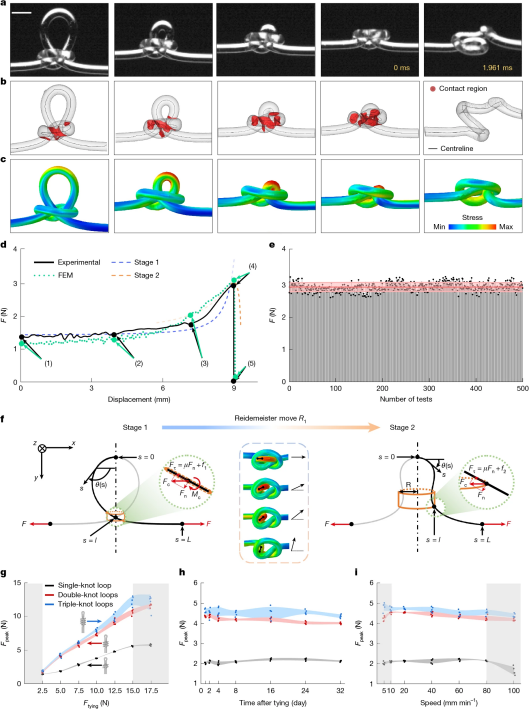
To comprehensively verify the reliability of the slip knot, the research team designed rigorous tests, and its outstanding stability was fully validated:
√ In 500 repeated tests, the consistency of peak force reached 95.4%;
√ By changing parameters such as the number of loops and material diameter, the output force value can be precisely set like adjusting code;;
√ It maintains stable performance in different liquid environments (synthetic blood, saline, etc.);
√ Even after being stored for 32 days, its “mechanical memory” remains intact.
In simple terms, the slip knot acts like a one-time, purely mechanical force control fuse. The robot or doctor only needs to perform a simple “pull” action, and when they sense the signal of the slip knot opening, they know that the right amount of force has been applied, without any electronic sensing or complex calculations.
▍Practical Validation: Revolutionary Applications from the Operating Room to Robotics
To validate the practical effects of the slip knot, the research team conducted multi-level, cross-dimensional experiments.
1. Supernatural Assistance for Surgeons, Transforming Novices into Experts
The slip knot can provide precise and secure mechanical transmission, meeting the core requirements of surgical operations for accuracy and consistency. Based on this, the team designed a “slip knot suture” that connects the slip knot with ordinary surgical sutures. Surgeons tie knots as usual, then pull the slip knot end until it opens, and the preset force is accurately transmitted to the surgical knot.
To verify its effectiveness, the team recruited surgeons with varying levels of experience to perform suturing tests on silicone models.
The results were encouraging: when using traditional sutures, novice surgeons had scattered knot-tying force, far inferior to experienced surgeons; however, after using the slip knot suture, the knot-tying precision of novice surgeons increased by 121%, even outperforming experienced surgeons using traditional sutures.
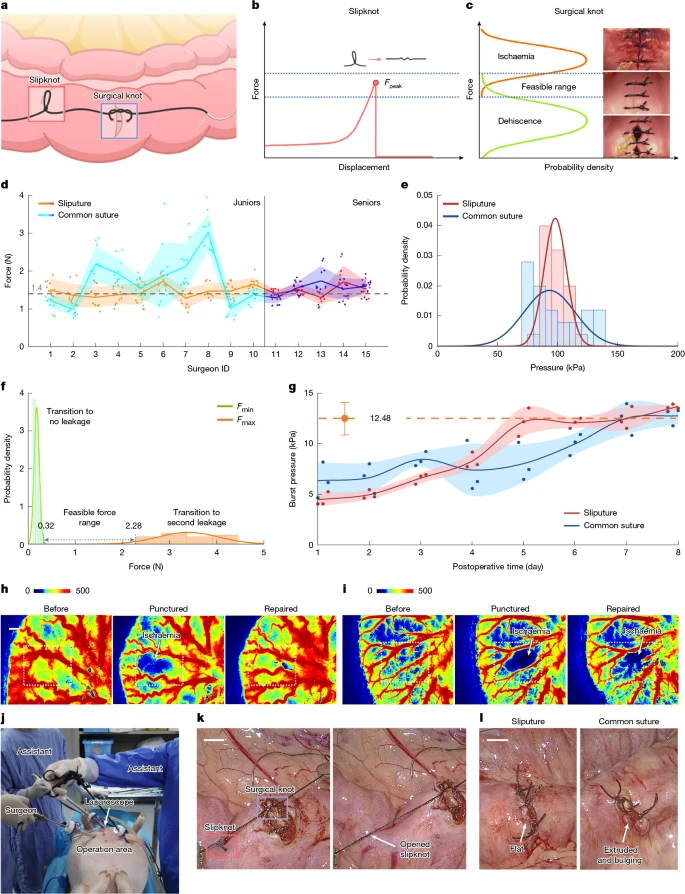
Next, the team conducted animal experiments to further validate the advantages of the slip knot technology. In rat models, compared to ordinary sutures, slip knot sutures not only significantly improved postoperative blood supply and reduced tissue adhesion and leakage but also accelerated wound healing by 2 days compared to ordinary sutures. The technology was subsequently successful in more complex laparoscopic surgeries in pigs, achieving a 71.3% improvement in precision over ordinary sutures.
2. Surgical Robots Can See Force, Achieving Intelligent Suturing
The research team integrated the slip knot system into robotic surgery and developed a vision-based automatic braking system. Specifically, the system ensures seamless connection between the suture and the robot, using real-time image processing technology to detect the slip knot. When human-robot collaboration is performing suturing, the camera tracks the morphological changes of the slip knot in real-time. Once the algorithm identifies the key visual features of the slip knot being pulled open, the system immediately sends a stop command to the robotic arm.
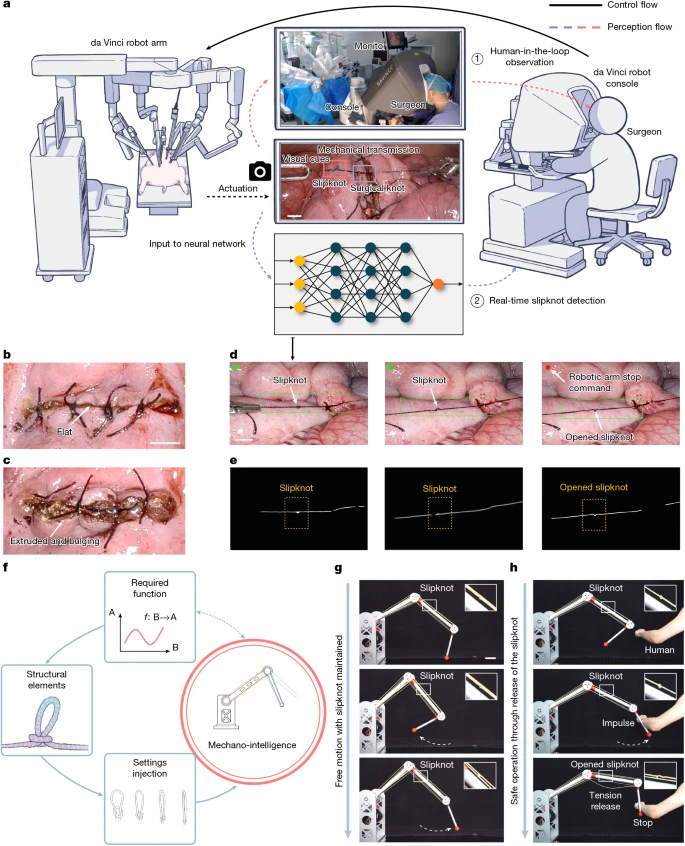
The results were equally significant, enabling robotic surgical systems, which originally lacked tactile sensation, to automatically and precisely control suturing force, avoiding tissue damage while significantly improving the consistency of suturing pressure compared to traditional methods.
This innovative approach has been validated in silicone models and live pig colon injury repair models.
3. Beyond Surgery, Equipping Robots with Mechanical Fuses
The application of this technology extends far beyond medicine and has been expanded into the robotics field. The team integrated the slip knot into a custom four-degree-of-freedom cable-driven robotic arm, designing it as an adjustable mechanical fuse, equivalent to an overload protection device.
When the robotic arm accidentally collides with a person or environment, causing the driving force to exceed the preset threshold of the slip knot, the slip knot will quickly open, interrupting the action, protecting both personnel and fragile items from excessive force damage, as well as safeguarding the robot’s components from damage due to overpressure.
Notably, this represents a significant breakthrough compared to traditional solutions: like a plug-and-play “add-on,” it can endow robots with precise force control capabilities without modifying the robot’s body, achieving seamless integration.
▍Future Prospects: Infinite Possibilities in Robot Design
What are the boundaries of the intelligence of a slip knot?
Not just on the operating table, the mechanical intelligence paradigm it validates provides a new perspective for the entire field of robot design.
Firstly, it replaces some complex electronic sensing and control through ingenious structural design, significantly reducing the manufacturing costs and barriers for high-end robots, making them widely applicable even in resource-scarce areas.
Secondly, it fully leverages the characteristics of pure mechanical structures that are immune to electromagnetic interference and do not require power supply, offering irreplaceable advantages in extreme environments such as space, deep sea, and wilderness rescue.
Thirdly, it further explores mechanical behaviors similar to slip knots, opening new directions in fields such as bionic robots and soft robotics.
A knot has sparked thoughts, cleverly solving the long-standing force control problem in the field of robotics. It is evident that the highest level of intelligence is often embedded in the simplest natural physical principles.
Paper link: https://www.nature.com/articles/s41586-025-09673-w?sessionid=
For inquiries regarding corporate cooperation, please contact the RoboTalk customer service (19560423866, same number for mobile and WeChat) for connection.
—————-END——————-

Industrial Robot Companies
Estun Automation | Aofei Robot | Feixi Technology | Faao Robot | Yuejiang Robot | Jiekai Robot | Songling Robot | Luoshi Robot | Yinglian Technology | Jicui Intelligent Manufacturing | Youao Robot | CGXi Changguangxi Intelligent Manufacturing | Atom Robot | Jizhi Robot | Haikang Robot
Service and Special Robot Companies
Yijiahe | Jingpin Special Equipment | Qiteng Robot | Shihe Robot | Jiuhua Robot | Pudu Robot | Xiaoben Intelligent | Robot Ji | Schroder Robot
Medical Robot Companies
Yuanhua Intelligent | Tianzhihang | Sizherui Intelligent Medical | Jingfeng Medical | Tuodao Medical | Zhenyida | Shurui® Robot | Luosenbot | Bangkec | Baihui Weikang | Dish Medical | Shuimu Dongfang | Kangnuo Siteng
Humanoid Robot Companies
UBTECH Technology | Yushu | Yundongchu | Xingdong Jiyuan | Weijing Robot | Zhujidongli | Leju Robot | Elephant Robot | Zhongke Shengu | Magic Atom | Zhongqing Robot | Pasini Perception | Cyborg Robot | Digital Huaxia | Ligong Huahui | Fourier Intelligent | Tianlian Humanoid Robot | Lingbao CASBOT | Qingbao Robot | Zhejiang Humanoid Robot Innovation Center | Dongyi Technology | Zhishen Technology | PNDbotics | Zhuoyide Robot | Luming Robot | Qinglang Intelligent
Embodied Intelligence Companies
Kuawei Intelligent | Galaxy General | Qianxun Intelligent | Lingxin Qiaoshou | Ruierman Intelligent | Weiyi Intelligent Manufacturing | Tuihang Technology | Zhongke Guiji | Shutu Technology | Lingqiao Intelligent | Xingchen Intelligent | Qiongche Intelligent | Ark Infinite | Keda Xunfei | Beijing Humanoid Robot Innovation Center | National Land Co-construction Humanoid Robot Innovation Center | Daimeng Robot | Shibite Robot | Xinghai Map
Core Component Companies
Green Harmonics | Yinshi Robot | Kunwei Technology | Maitai Intelligent | Qingtong Vision | Benmo Technology | Xinjingcheng Sensors | Landian Touch | BrainCo Strong Brain Technology | Yuli Instrument | Jiya Precision Machinery | Silan Technology | Shenyuan Sheng | Feipu Navigation Technology | Ruichi Zhiguang | NOKOV Measurement Technology | Yinxisi | Fude Robot | Cancer Intelligent Drive | Weihan Power | Lingyun Light Yuan Ke Vision | Xuanji Power | Yiyou Technology | Ruiyuan Precision | Lingzu Times | Xynova Future | HIT Huawike | Xinghui Sensors
Educational Robot Companies
Silicon Step Robot | Shihe Educational Robot | Daran Robot
Join the Community
Welcome to join the “RoboTalk” reader discussion group to discuss topics related to robotics, share cutting-edge technology and industry dynamics. Add WeChat “robospeak2018” to join!


Feeling tired? Click “See” to support us!