Written by | Lin WuyuThe biological functions of proteins often depend on complex protein-protein interactions (PPIs), thus the ability to design specific protein binders that regulate these interactions holds great potential for therapeutic and biotechnological applications. Traditional methods such as immunization, antibody library screening, and directed evolution can produce binders, but they are often cumbersome, time-consuming, and have limited controllability over target sites. In recent years, protein computational design has provided a new solution; however, methods based on physical modeling, such as Rosetta, have a very low success rate【1,2】 and are constrained by rigid scaffolds and predefined docking patterns. With the emergence of deep learning models (such as AlphaFold2【3】), significant breakthroughs have been made in protein structure prediction and de novo design, but existing methods still face the challenge of disconnect between scaffold generation and functional interface design【4】. Developing efficient, straightforward, and directly functional interface-targeted binder design strategies has become a core challenge in this field.Recently, researchers from the Protein Design and Immunoengineering Laboratory at the Swiss Federal Institute of Technology in Lausanne, including Bruno E. Correia, Martin Pacesa, and Sergey Ovchinnikov from MIT, published a research article in Nature titled One-shot design of functional protein binders with BindCraft. The researchers developed BindCraft, an open-source and automated de novo protein binder design process, achieving an experimental success rate of 10–100%. This method utilizes the weights from AlphaFold2 to generate high-affinity binders without the need for high-throughput screening or experimental optimization, even in the absence of known binding sites. The research team successfully designed functional binders targeting various challenging targets (such as cell surface receptors, allergens, CRISPR–Cas9, etc.) and validated their potential applications in allergy response regulation, gene editing modulation, and targeted delivery.This research marks a new stage in computational protein design towards a ‘one-to-one design-binder’ approach, which is of significant importance for therapy, diagnostics, and biotechnology.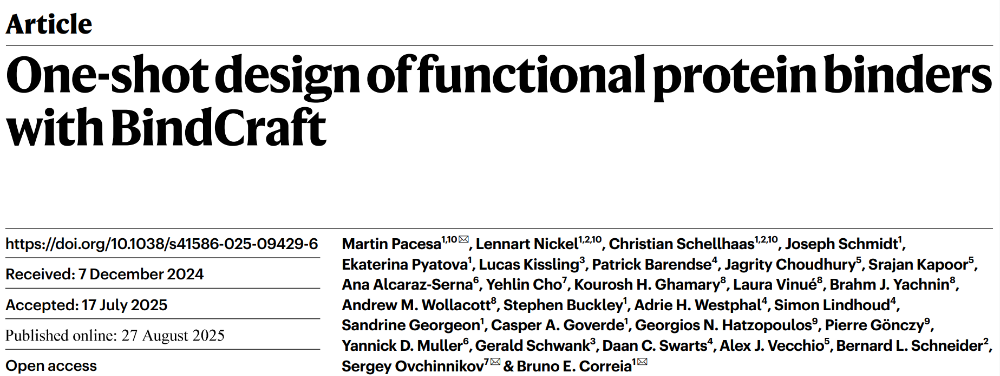 This article addresses the complexity of designing protein-protein interactions and proposes BindCraft, an open-source, automated de novo protein binder design process. This method directly utilizes the network weights of AlphaFold2 for backpropagation, allowing simultaneous optimization of both the binder scaffold and interface structure during the design process, avoiding the reliance on predefined scaffolds and rigid docking found in traditional methods. Compared to traditional processes that depend on high-throughput screening and experimental optimization, BindCraft achieves more efficient and controllable binder generation.
 The research team applied BindCraft to 12 structurally diverse and biomedically significant targets, including cell surface receptors, common allergens, artificially designed proteins, and multi-domain nucleases (such as CRISPR–Cas9). The results showed that the experimental success rate of this method was 10–100%, with an average of 46.3%, far exceeding the previous levels of less than 1%. Moreover, most of the obtained binders exhibited nanomolar-level affinity, demonstrating that BindCraft can generate high-quality functional binders without large-scale screening.
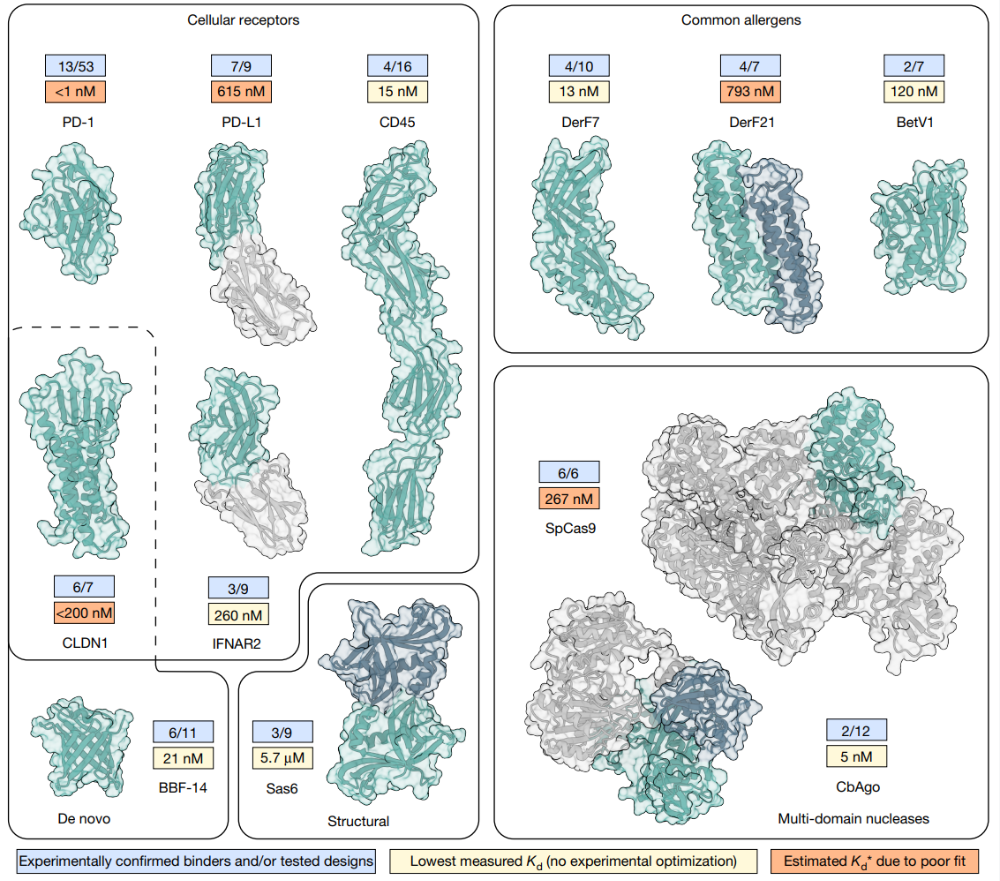 In terms of functional validation, the authors demonstrated various application potentials of BindCraft: for example, the designed binders can reduce the binding of the allergen Bet v1 to IgE in patient-derived samples, thereby alleviating immune responses; they can also modulate the activity of nucleases such as Cas9 and Argonaute, and achieve redirection of AAV capsids for targeted gene delivery through specific binding with cell receptors.In summary, the research team developed BindCraft, an automated de novo protein binder design tool based on AlphaFold2 backpropagation, capable of simultaneously optimizing the binder scaffold and interface structure during the design process, significantly improving design flexibility and success rates. With an experimental success rate of 10–100% across 12 challenging targets, most binders exhibited nanomolar-level affinity, while also achieving functional validations such as allergen blocking, nuclease activity modulation, and AAV targeted delivery. This tool addresses the cumbersome high-throughput screening, low experimental efficiency, and target limitations in traditional protein binder design, marking the feasibility of a ‘one design, one binder’ strategy, providing an efficient and viable new method for therapy, diagnostics, and biotechnological applications.Original link:https://doi.org/10.1038/s41586-025-09429-6
Editor: Eleven
References
1. Cao, L. et al. Design of protein-binding proteins from the target structure alone. Nature 605, 551–560 (2022).2. Gainza, P. et al. De novo design of protein interactions with learned surface fingerprints. Nature 617, 176–184 (2023).3. Jumper, J. et al. Highly accurate protein structure prediction with AlphaFold. Nature 596, 583–589 (2021).4. Watson, J. L. et al. De novo design of protein structure and function with RFdiffusion. Nature 620, 1089–1100 (2023).
Academic Collaborations
(*Ranked in no particular order)

Strategic Partners
(*Ranked in no particular order)
·
Reprint Notice
【Original Article】BioArt original article, personal forwarding and sharing are welcome, but reprinting without permission is prohibited. All published works are owned by BioArt. BioArt reserves all legal rights, and violators will be prosecuted.


BioArt
Med
Plants
Recruitment
Recent Live Recommendations

Click on the homepage to recommend activities
Follow for more latest activities!