We are all children of the stars!
——Carl Sagan
About 13.8 billion years ago, the universe was in a state of extremely high energy and density, with very high temperatures. After the Big Bang, through a long process of evolution, it formed into the shape we see today.
The Big Bang only created three or four chemical elements (hydrogen, helium, and lithium, possibly beryllium), while heavier chemical elements all come from the “star factories”. First and second generation stars synthesize lighter elements into heavier ones through nuclear fusion and supernova explosions. (Heavier elements also come from neutron star mergers) From this perspective, every molecule and every atom of our solar system, Earth, and even life on Earth comes from their contributions, hence, “we are all children of the stars”.
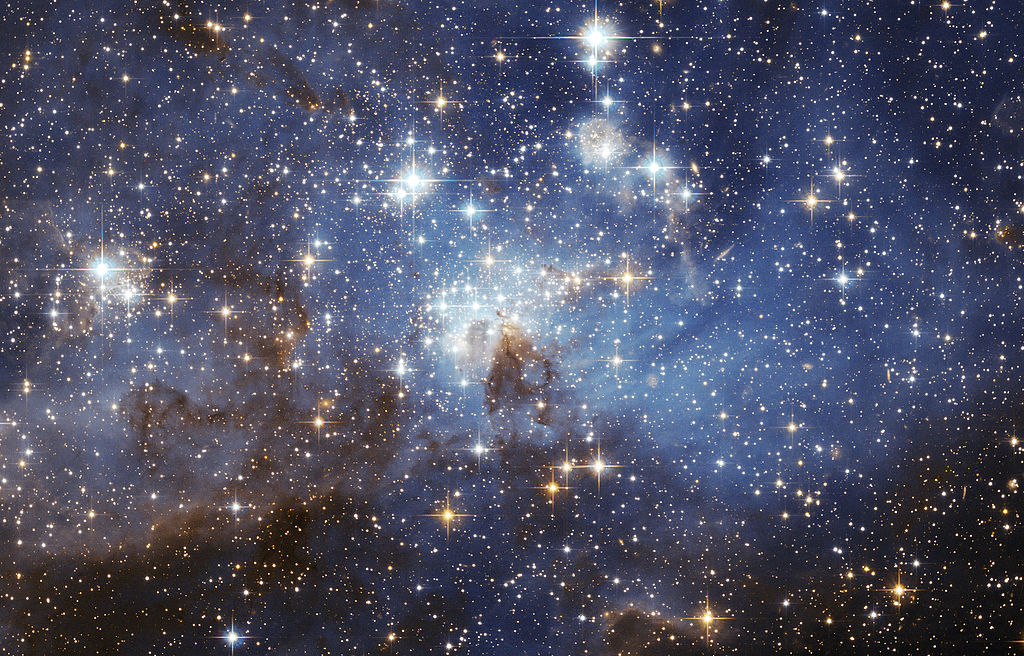
We are all children of the stars (Image source: wiki)
The early Earth actually lacked carbon
According to the current “condensation model” theory, the solar system formed from a cloud of gas and dust about 5 billion years ago. Because Earth is relatively close to the Sun and is classified as an “inner planet”, lighter materials on Earth were “blown away” by solar winds. Eventually, Earth appeared as a rocky “terrestrial planet”—dominated by iron, oxygen, silicon, and magnesium, while hydrogen and helium, the two most common light elements in the universe, were scarce. Fortunately, oxygen helped us lock in a lot of hydrogen in the oceans, creating the blue oceans. Otherwise, life might never have emerged.
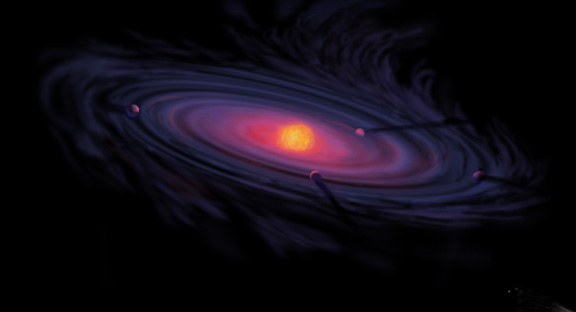
Artistic imagination of the protoplanetary disk at the formation of the solar system, where Earth was born (Image source: wiki)
Although carbon has a high boiling point, it easily forms gaseous substances like methane, carbon monoxide, and carbon dioxide at normal temperature and pressure. Research has found that when temperatures exceed 500K (about 230°C), planets struggle to retain carbon elements, and carbon gases begin to escape into space significantly. (This is the black “cliff” in the diagram below!) At the beginning of Earth’s formation, the inner solar system was a hot “soup”, and 500K was a temperature that could be easily reached. In this scenario, carbon on Earth clearly had its own ideas—it could escape and “sublimate” into space.
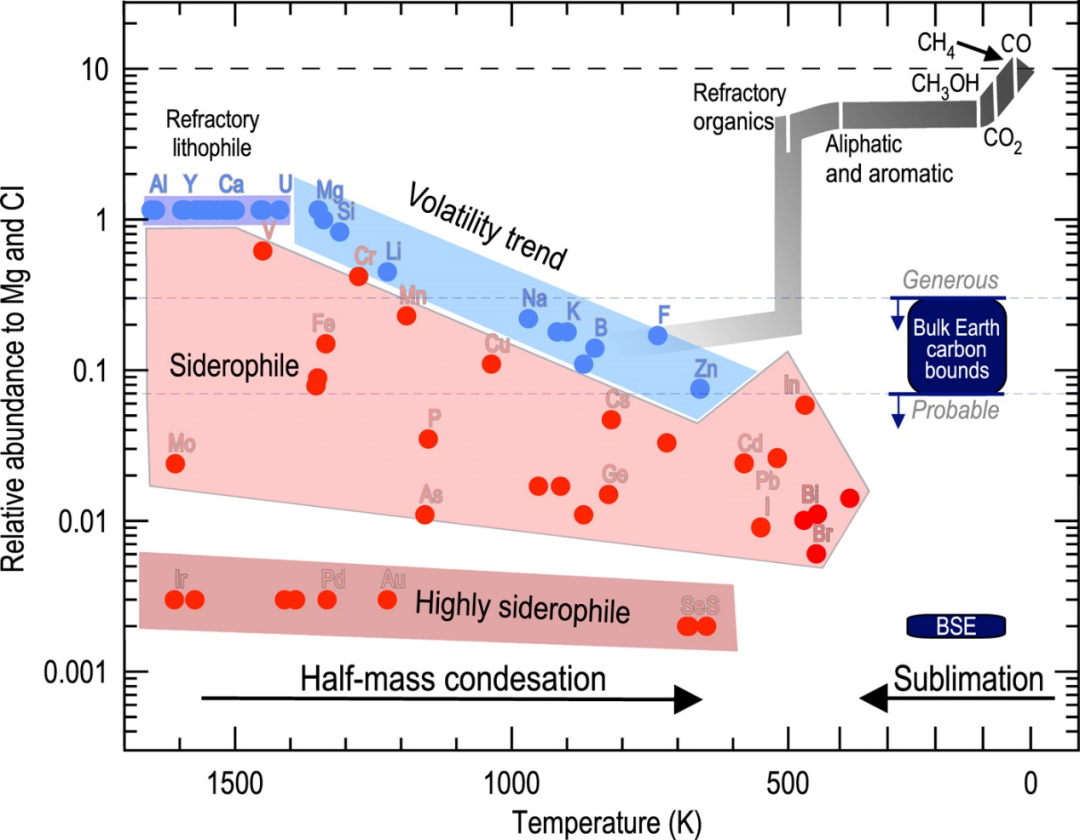
The gray thick line in the upper right corner represents the sublimation sequence of carbon elements. When the temperature of the initial nebula reaches about 500 K, it drops sharply by more than an order of magnitude. This reflects that more carbon is lost, leading to a “carbon-poor” planet.
(Image source: science advances)
This has also been confirmed by the carbon content in the metallic cores of iron meteorites.
Within the solar system, iron meteorites formed within a million years after the birth of the solar system, so they can be regarded as samples of the primitive Earth’s chemical composition. Professor Hirschmann from the University of Minnesota published an article in the Proceedings of the National Academy of Sciences, pointing out that the carbon content at the beginning of Earth’s formation may have been only 140 ppm (ppm means parts per million).
This is indeed minuscule; the carbon content in the crust is about 300 ppm. (Other estimates range from 200 to 1700 ppm, but they are all low.)
It turns out that our Earth suffered from “carbon-poor syndrome” right from its formation. Based on this, Hirschmann said, “This overturns previous ideas that planets lose a lot of carbon during accumulation.”

Professor Hirschmann from the University of Minnesota (Image source: University of Minnesota)
What is the dust line?
This interesting phenomenon prompted scientists to conduct in-depth studies on the early formation of the solar system, and they proposed a concept called the “dust line”, within the “dust line” (close to the Sun), carbon elements are almost not retained, while outside the “dust line”, a considerable amount of carbon elements can be retained.
After calculations, scientists found that before the Sun formed, the solar system was primarily dominated by accumulation, and the “dust line” was quite far, so Earth could hardly retain much carbon. However, once the Sun “lit up”, the solar system was mainly dominated by radiation, and the “dust line” moved inward to within Earth’s orbit, allowing Earth to start accumulating carbon elements.
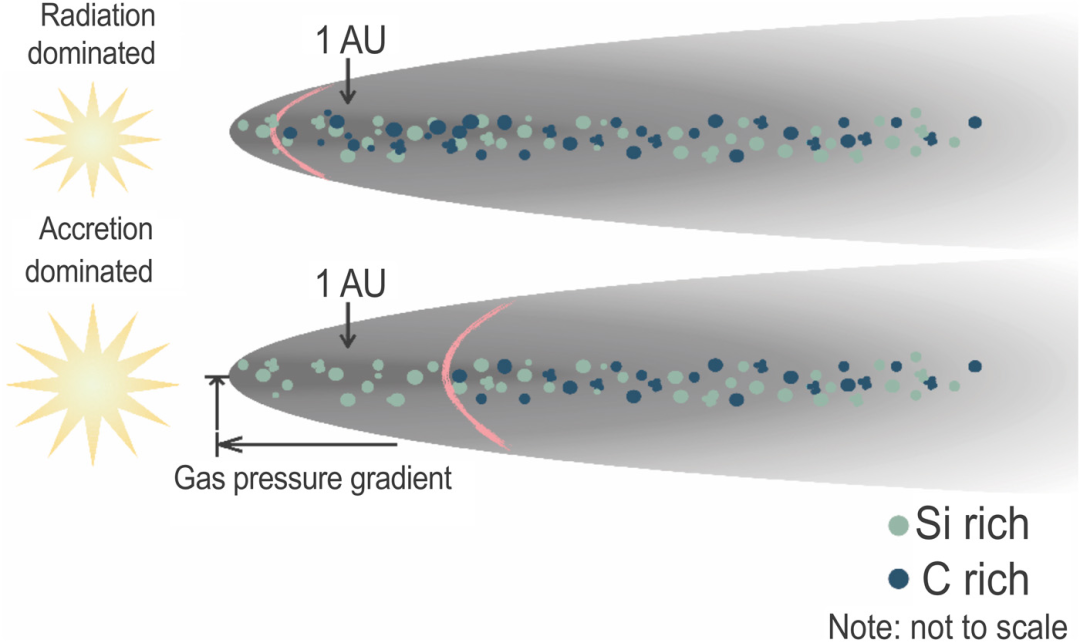
Diagram of the “dust line”: within the red line (dust line), carbon-rich materials are scarce. During the accumulation-dominated phase (lower part), it is far from the original Sun. After a million years, transitioning to a radiation-dominated era (upper part), the dust line migrates to within Earth’s current orbit. (Image source: science advances)
Carbon elements exist mostly in the form of carbonates in the crust and mantle, while they are concentrated in the core, where many iron carbides (Fe3C7) exist. Regarding this phenomenon, Professor Li Jie from the University of Michigan concluded—by studying the chemical composition of the core through seismic waves, it can be determined that carbon occupies about 0.5% of the total mass of the Earth (the previously mentioned 300 ppm is the crustal abundance), a figure far exceeding that at the beginning of Earth’s formation.
Where does carbon come from?
The question arises, where did all this carbon come from?

Professor Li Jie from the Department of Earth and Environmental Sciences at the University of Michigan (Image source: University of Michigan)
Professor Li Jie’s team inferred that most of the carbon on Earth likely came directly from the interstellar medium. During the first million years of the solar system’s formation, a series of asteroids would continuously transport water and carbon from beyond the “dust line” to Earth.
It turns out that in that chaotic era, the arrival of these “uninvited guests” in the form of asteroids did not just bring repeated impacts and disasters to Earth, but also brought precious water and carbon elements to the solar system. (Prior to this, there was already substantial evidence indicating that the water on Earth mainly came from asteroids.)
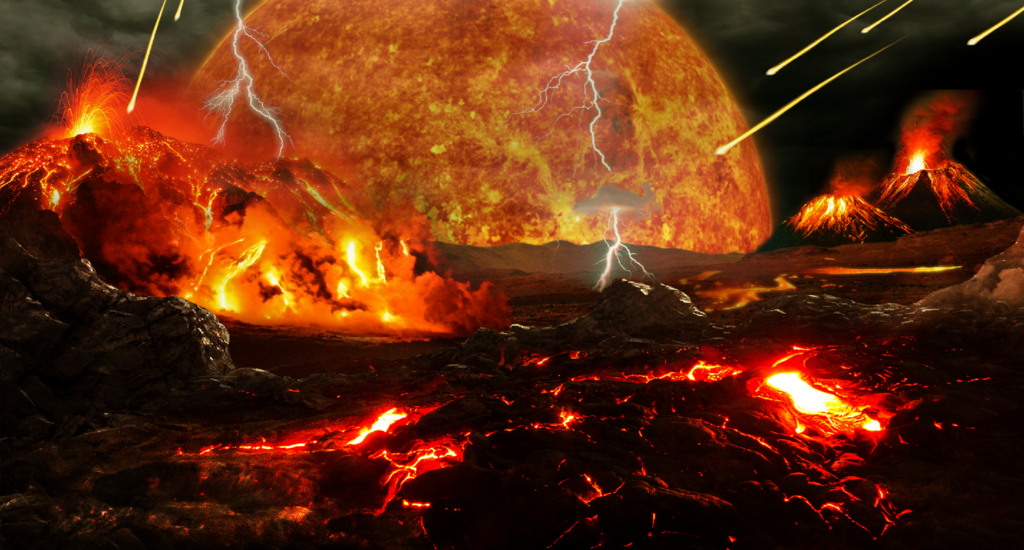
The first geological era after Earth’s formation—the Hadean, was filled with meteorite impacts. However, it was these “uninvited guests” that delivered carbon elements and water to us. (Image source: wiki)
Water is the source of life, and carbon is the framework of life; all organic matter is built on this magical “carbon chain”. Therefore, the vitality of Earth today hinges on this crucial million-year period.

Representing the biosphere’s gratitude to the interstellar medium (Image source: wiki)
The process of carbon accumulation on planets is very subtle. On one hand, carbon elements easily form gaseous substances and escape into space. On the other hand, carbon dioxide is one of the most famous greenhouse gases, which helps planets retain heat. If there is too much carbon on Earth, it could resemble Venus, where temperatures remain around 460-480°C; if there is too little carbon, it could resemble Mars, which is too desolate.
In this sense, Earth’s position is truly perfect. Is this the arrangement of the Creator, or is it the anthropic principle? (In short, the anthropic principle suggests that it is the existence of humans that can explain the various characteristics of our universe.)
Based on this research, scientists have already shifted their focus to distant deep space, continuing to observe super-Earths in exoplanets. With more data to support, existing theories will face more challenges and become even more convincing.
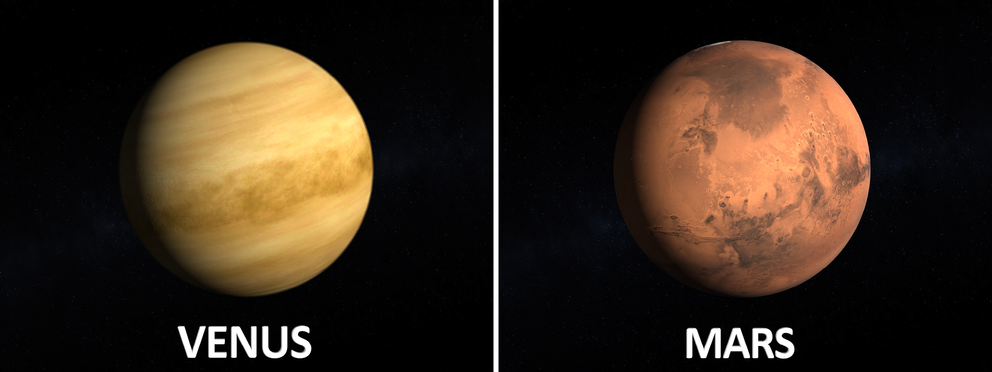
Venus and Mars, located just inside and outside Earth’s orbit, represent two extremes (Image source: University of Pennsylvania)
Research on this topic also reflects the necessity of interdisciplinary science. A striking example is that the authors of the paper “Earth’s carbon deficit caused by early loss through irreversible sublimation” come from so many institutions, covering such a wide range of specialties.
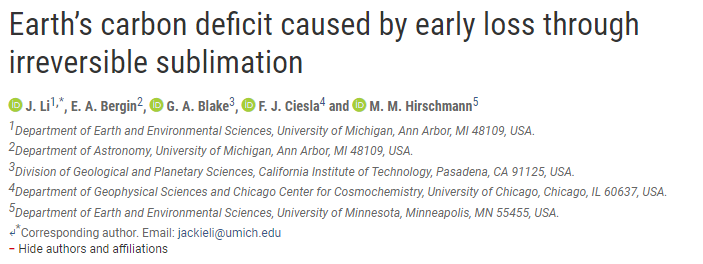
The paper “Earth’s carbon deficit caused by early loss through irreversible sublimation” has a list of authors, with Professor Li Jie as the first author.
(Image source: science advances)
Professor Ciesla from the Department of Geophysical Sciences at the University of Chicago said, “Although researchers may approach different methods and specific questions in different fields, to build a coherent story, it is essential to identify common themes of interest and find ways to bridge the knowledge gaps between them. This is challenging, but such efforts are both encouraging and exhilarating. It is very beneficial.“
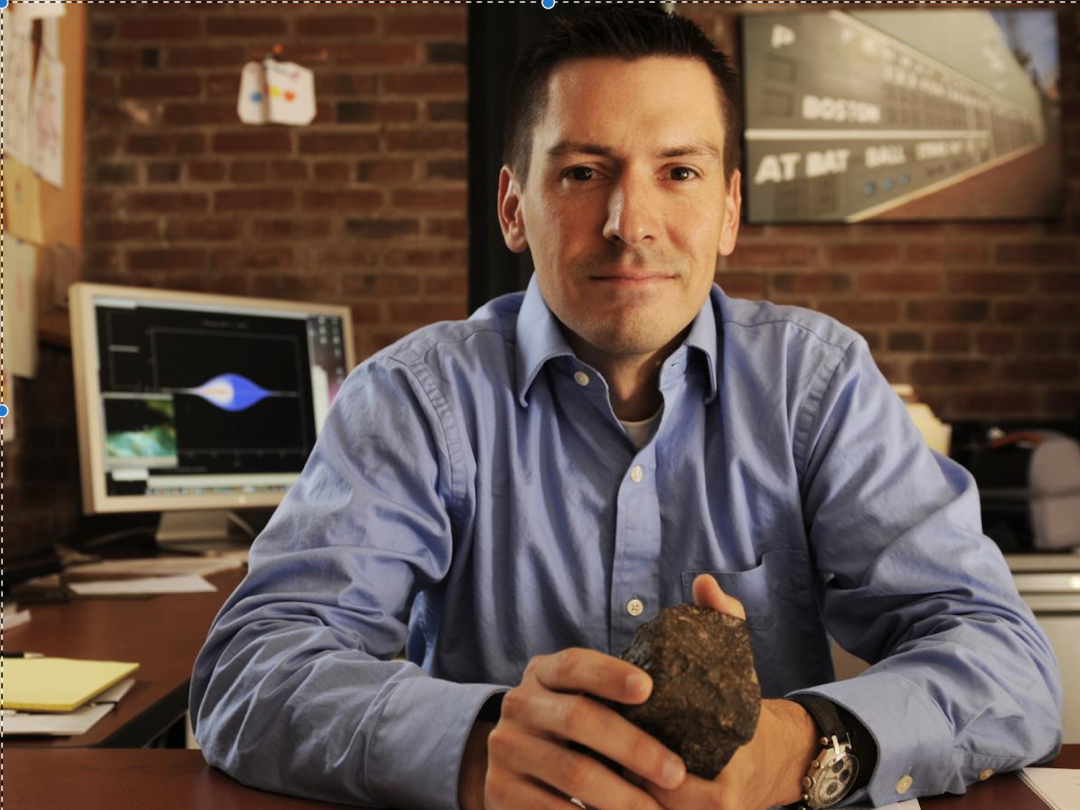
Professor Ciesla from the Department of Geophysical Sciences at the University of Chicago
(Image source: University of Chicago)
References:
[1] Science Advance: Earth’s carbon deficit caused by early loss through irreversible sublimation
Li, J., Bergin, E. A., Blake, G. A., Ciesla, F. J., & Hirschmann, M. M. (2021). Earth’s carbon deficit caused by early loss through irreversible sublimation. Science Advances, 7(14), eabd3632.