Case Highlights
-
A leading semiconductor manufacturer migrated its intelligent manufacturing platform from the public cloud to SmartX Hyper-Convergence, significantly improving performance while saving costs: latency reduced from milliseconds to microseconds, and collaboration efficiency with suppliers increased by 50%.
-
Fusion deployment of distributed block storage and file storage saved 20% on NAS hardware procurement costs and enabled daily backups of database files.
-
Avoiding VMware subscription risks, ensuring data security and business stability with domestic hyper-convergence solutions.
A leading company in the semiconductor equipment field is known for its self-developed and manufactured front-end process equipment for integrated circuit manufacturing, possessing strong competitiveness in key processes such as cleaning, coating, developing, stripping, wet etching, electroplating, and stress-free polishing.
Public cloud brings dual challenges of cost and security
The semiconductor manufacturer’s non-standard management, drawing cloud, and transparent factory intelligent manufacturing platforms were originally deployed on the public cloud. As the business scale expanded, they faced the dual challenges of rising cloud costs and data security risks.
Rising costs, performance also unsatisfactory
With the continuous growth of business volume, cloud service costs have increased significantly. Statistics show that over the past three years, user cloud service costs have grown at an annual rate of 30%, leading to rising operational costs. At the same time, the public cloud architecture struggles to meet the low-latency requirements for high-frequency data access, with data access delays reaching hundreds of milliseconds in critical business scenarios, severely restricting efficient business operations.
Data boundaries blurred, leading to security risks
The core design drawings and collaborative data with suppliers in the semiconductor industry involve the company’s core technology and business secrets. Once leaked, it could cause immeasurable losses. In a public cloud environment, data storage and management rely on third-party service providers, leading to blurred data security boundaries and risks of data leakage and tampering. Users conducting business globally face differences in data security regulations across countries and regions, further complicating data security management. Ensuring data sovereignty and achieving full lifecycle security protection for data has become a key demand for IT transformation in enterprises.
“Moving business off the cloud” faces selection difficulties
In this context, users initiated the “move business off the cloud” plan, aiming to seek high-performance, highly reliable localized IT architecture to achieve “cost reduction and efficiency increase” while ensuring data security. However, when choosing a privatized deployment solution, users faced challenges:
How to meet diverse data storage and backup needs with a streamlined architecture?
The intelligent manufacturing platform contains a large amount of unstructured data such as drawings and model files, where drawings are downloaded and uploaded by suppliers and factories through a portal platform, involving high-frequency storage and retrieval operations that require high-performance file storage to meet high concurrent access; at the same time, the portal platform also involves ERP business using MySQL databases for inventory management, requiring daily backups of a large amount of structured data. Therefore, users hope to meet various data storage and backup needs with a streamlined infrastructure to reduce investment costs and management burdens.
How to reduce VMware subscription costs?
Traditional private cloud construction solutions focus on centralized storage and VMware virtualization. However, since Broadcom acquired VMware, the licensing costs for VMware virtualization have risen sharply, and users are also concerned that as business scales expand, future licensing fee fluctuations will bring many uncertainties to enterprise IT budget management.
Based on these considerations, users plan to adopt domestic hyper-convergence platforms and impose strict requirements on the maturity of the virtualization platform, storage and backup integration capabilities, overall performance and stability, scalability, and ease of operation and maintenance.
Using SmartX Hyper-Convergence to achieve “migration from public cloud” to meet various needs such as cost, performance, and diverse storage
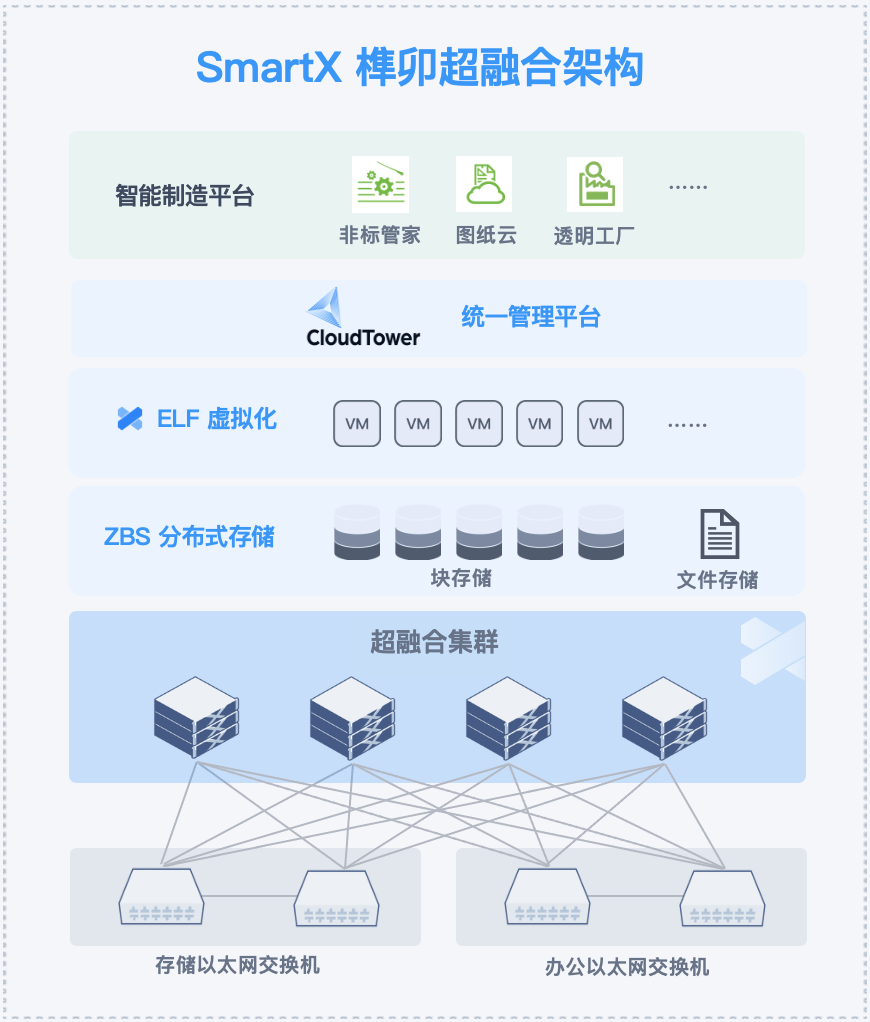
After research and verification by the operations and maintenance team, users ultimately chose SmartX Hyper-Convergence, which combines “core self-research, high flexibility, strong performance, simple maintenance, and streamlined architecture,” to support the intelligent manufacturing platform business system migrating from the public cloud. This solution uses four SMTX Halo 7200 hybrid flash hyper-converged appliances, paired with two Ethernet 10G switches to form a cluster. The software employs a combination of SMTX OS (hyper-converged software) + SFS (distributed file storage) + CloudTower (management platform), and database backups are achieved through Aisou, meeting the needs for high-performance computing, diverse storage, data backup, and unified operation and maintenance management.
Resident caching technology: Creating a high-performance “fast lane” for high-frequency data
SMTX OS has undergone numerous optimizations in storage performance, such as I/O localization, Boost mode (vhost protocol), RDMA protocol, etc. During the implementation of this project, the “resident caching” function of SMTX OS played a key role by permanently retaining the storage volume of the core MySQL database in the high-speed cache layer, effectively preventing data from sinking to low-speed hard drives, successfully reducing critical business latency by 60%, meeting the team’s needs for historical data query calls. Compared to an all-flash solution, enabling caching optimization only for high-frequency data achieved 40% cost savings, striking a balance between performance and cost.
Integrated data storage: Replacing traditional NAS, simplifying architecture
In terms of architecture simplification, the SFS module of SmartX Hyper-Convergence shows significant integration advantages: the hyper-converged environment simultaneously provides virtualization, distributed block storage, and distributed file storage functions, eliminating the procurement costs of independent NAS. Users originally planned to procure seven server nodes and a NAS storage system to run the entire business system, but based on hyper-convergence, only four nodes are needed to run workloads and databases, store drawing files, and serve as backup storage, fulfilling multiple storage needs with a single architecture. Additionally, in terms of compatibility, this solution supports NFSv3 and v4.1 protocols, allowing seamless integration with existing business systems, achieving zero transformation during migration, greatly simplifying the IT architecture and enhancing the overall operational efficiency of the system.
Currently, based on the stable use of the SmartX Hyper-Convergence product, users have recently expanded the all-flash cluster to support the performance requirements of higher BI business, further leveraging the multi-scenario support advantages of integrated data storage.
>> More information:
Learn about SmartX distributed storage and application integration platform
Complex disaster recovery needs, high construction costs? SmartX distributed disaster recovery integrated solution released
Host maintenance mode: Zero-interruption hardware expansion, ensuring business continuity
In terms of operation and maintenance management, SmartX Hyper-Convergence demonstrates excellent stability and convenience. After the platform went live, as business volume continued to grow, hyper-converged nodes faced the need for memory and solid-state drive expansion. In actual operations, through the automated migration function, before node maintenance, the system automatically checks and hot-migrates virtual machines to other nodes, ensuring that business is not affected; after maintenance, virtual machines automatically return, keeping the entire process of the business system uninterrupted. At the same time, a strict verification mechanism is in place, conducting comprehensive checks on node and service status before entering maintenance mode, and requiring a health check to return after maintenance, effectively eliminating human operation risks, simplifying processes while providing a solid guarantee for stable business operations.
User benefits: Achieving “cost reduction and efficiency increase,” architecture upgrade, and domestic substitution
-
Cost optimization: After implementing the “move business off the cloud” and adopting a hyper-converged architecture, users’ IT expenditures have significantly decreased. Among them, the integrated deployment model of file storage and virtualization directly saved 20% on hardware procurement costs, combined with significantly reduced subscription fees, effectively alleviating the cost pressure on enterprises.
-
Performance improvement: Drawing access latency has dramatically decreased from the original “milliseconds” to “microseconds,” with supplier collaboration efficiency increasing by 50%, providing strong support for efficient business operations and further enhancing the company’s competitiveness in the market.
-
Architecture upgrade: Based on the hyper-converged architecture, users efficiently integrate storage resources, simultaneously meeting the storage and backup needs of structured and unstructured data.
-
Domestic transformation: Replacing VMware architecture solutions with domestic hyper-convergence and native virtualization provides a valuable practical example for domestic substitution in the semiconductor industry.
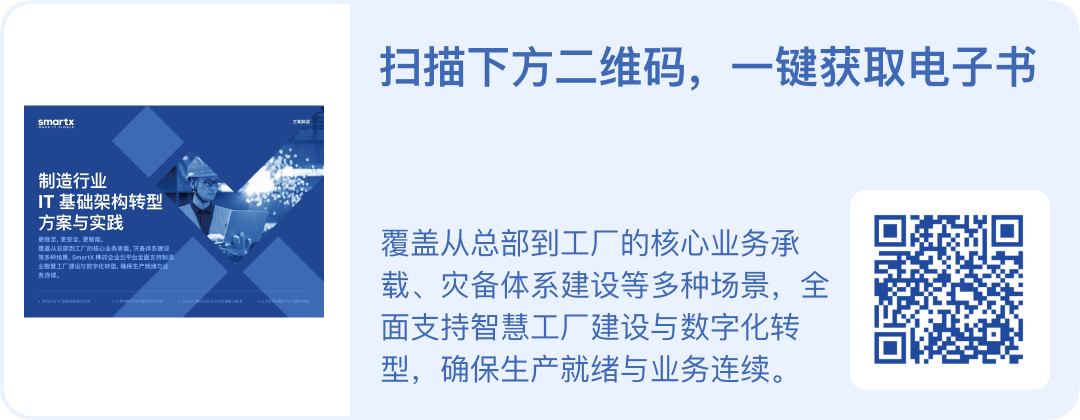
For more information on the challenges, transformation routes, specific solutions, and user practices in IT infrastructure transformation in the manufacturing industry, please scan the QR code below to obtain the latest 2025 edition of the “IT Infrastructure Transformation Solutions and Practices in the Manufacturing Industry” e-book!
Recommended reading:
The domestic cloud foundation behind high-speed rail manufacturing: Replacing VMware to support core business systems
Performance improved by 3-5 times! A Fortune 500 elevator manufacturer uses SmartX Hyper-Convergence to support key business across multiple factories
10+ leading new energy/automotive/semiconductor manufacturers’ VMware replacement practices covering core application scenarios such as MES and PLM
Tongcheng New Materials: The path of VMware migration and domestic private cloud construction for a leading new materials enterprise
A leading clothing industry group: From basic replacement to full-stack upgrade of the SmartX enterprise cloud platform
Xinyi Glass: Building active-active business across data centers to achieve enterprise cloud infrastructure transformation
A leading manufacturing enterprise: Building a new IT infrastructure based on hyper-convergence to support MES virtualization and container components