Reported by Electronic Enthusiasts (Author: Li Wanwan)Espressif stated in its latest financial report that the ESP32-P4 is the company’s first SoC without wireless connectivity, breaking into the multimedia market from its traditional focus on communications and IoT. It is designed for customers with high demands for edge computing capabilities. Driven by Espressif’s self-developed high-performance dual-core RISC-V processor, it features AI instruction extensions, an advanced memory subsystem, and integrated high-speed peripherals, fully meeting the higher demands of next-generation embedded applications for human-machine interface support, edge computing capabilities, and IO connectivity characteristics.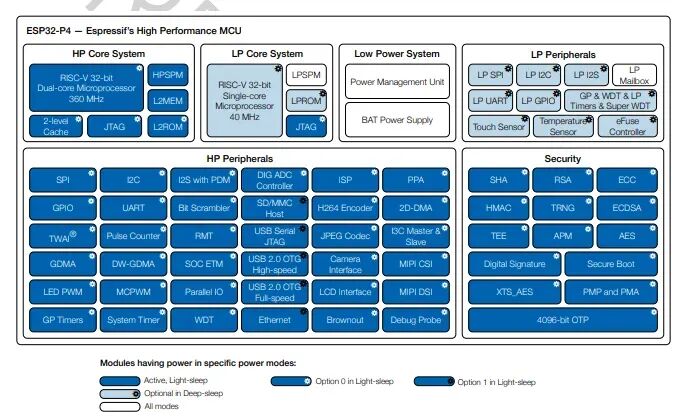 Figure:Espressif ESP32-P4 Functional Block DiagramSpecifically, the ESP32-P4 is equipped with a RISC-V 32-bit dual-core high-performance processor, with a maximum frequency of 360MHz, which can be increased to 400MHz as needed.This dual-core architecture not only provides powerful computing capabilities but also significantly enhances the overall system performance through multi-task parallel processing. Each core adopts a five-stage pipeline design, supporting branch prediction, hardware breakpoints, and other features, ensuring efficient and stable instruction execution.In addition to the high-performance dual-core processor, the ESP32-P4 also integrates a low-power RISC-V 32-bit single-core processor, with a maximum frequency of 40MHz.This processor is designed for low-power scenarios, capable of executing tasks during system sleep, thereby effectively reducing overall power consumption while ensuring system responsiveness.
Powerful Image and Voice Processing Capabilities
The ESP32-P4 features an advanced image processing subsystem, including a JPEG image codec, an image signal processor (ISP), and a pixel processing accelerator (PPA).The JPEG codec supports static image compression and decompression at resolutions up to 4K and dynamic images at 1080P@40fps, greatly reducing image transmission bandwidth and storage requirements. The ISP module provides various image processing functions such as Bayer domain noise reduction, demosaicing, and color correction, ensuring the clarity and color accuracy of output images. The PPA module supports image rotation, scaling, and layer overlay, further enhancing the flexibility of image processing.In terms of voice processing, the ESP32-P4 integrates a voice activity detection module that can monitor voice activity in audio signals in real-time, providing hardware support for multimedia applications such as voice wake-up.The VAD module employs advanced algorithms to accurately identify voice signals, effectively reducing false wake-up rates and enhancing user experience.
Outstanding AI Processing Capabilities
The high-performance processor of the ESP32-P4 supports custom AI and DSP extension instructions (XespV), which are specifically designed to accelerate AI algorithms and digital signal processing tasks.By utilizing these extension instructions, developers can significantly enhance the inference speed of AI models and reduce power consumption, enabling complex AI applications on resource-constrained IoT devices. These hardware acceleration modules can significantly improve data processing speed and lighten the CPU load, making the ESP32-P4 more efficient in handling tasks such as encryption, decryption, and digital signal processing.Additionally, the ESP32-P4 offers a rich set of communication interfaces, including UART, SPI, I2C, I3C, I2S, USB2.0 OTG, Ethernet MAC, and Dual Wire Automotive Interface (TWAI).These interfaces not only support high-speed data transmission but also provide good compatibility and expandability, meeting the needs of various IoT application scenarios.The ESP32-P4 also supports stacking 16MB or 32MB of PSRAM within the chip package and offers various high-speed external memory interfaces, such as OPI and HPI.These interfaces support high-speed connections with external Flash and RAM, providing strong assurance for the storage and processing of large data volumes.

Statement:This article is original from Electronic Enthusiasts, please indicate the source above when reprinting. For group communication, please add WeChat elecfans999, for submission of interview requests, please send an email to [email protected].
More Hot Articles to Read
-
Five Mergers in Six Months Shake the Industry! Qualcomm and Amlogic Enter the AIoT Chip Race
-
Listed on the Entity List by the US! What is Fudan Micro’s Strong Response Based On?
-
Breaking Through 10Gbps Bandwidth! New Onboard Optical Communication Products Are Coming, “Optical Fiber on Board” Becomes a New Trend
-
Setting a Crowdfunding Record of $3.46 Million, Snow Removal Robots Become a Phenomenon Product, Battery and Motor Are Key
-
Breaking News! Storage Prices Are Rising Across the Board!
Click to Follow and Star Us
Set us as a star to not miss any updates!