When Secretary Zhang Li emphatically declared on the ICChina2025 stage that “the semiconductor industry is entering a new round of transformation,” the flashing lights in the venue seemed to reflect the most complex technological game of this era. This is not just a technological upgrade, but a reconstruction of industrial philosophy—how do we find a balance between autonomy and openness, innovation and application?
Driving Forces of Change: From “Technology-Driven” to “Application-Driven” Paradigm Shift
Structural Fracture of Computing Power Demand
The computing power required for training large AI models is doubling every three months, far exceeding the historical trend of Moore’s Law. Meanwhile, embodied intelligence requires real-time processing capabilities that compress latency to the millisecond level, and smart connected vehicles need to achieve breakthroughs in both functional safety and computing power density.
Rigid Constraints of Energy Efficiency Bottlenecks
Data shows that if the current level of computing energy efficiency is maintained, by 2030, the global data center’s power consumption will exceed 10% of the world’s total power generation. This is the deep logic behind Zhang Li’s emphasis on “energy efficiency”—the semiconductor industry must confront the fundamental contradiction between “growth in computing power and control of energy consumption.”
Expanding Dimensions of Reliability
Based on traditional automotive-grade chip requirements, smart connected vehicles are pushing reliability standards to new heights:
Functional Safety Level:Upgraded from ASIL-B to ASIL-D
Lifecycle:Extended from 5 years/100,000 kilometers to 15 years/500,000 kilometers
Failure Rate Requirements:Reduced from one in a million to one in a billion
System Thinking: Breaking the “Island Dilemma” of the Industry Chain
The Pain of Broken Innovation Chains
The Chinese semiconductor industry has long faced structural contradictions of “strong design, weak manufacturing” and “broad application, thin foundation.” The “system thinking” proposed by Zhang Li aims to solve this dilemma:
Practical Path of Full-Chain Collaboration
Vertical Integration:Coordinated optimization of chip design and manufacturing processes, such as the specialized process platform jointly developed by SMIC and Huawei
Horizontal Integration:Joint laboratories established by equipment, materials, and EDA tool companies to tackle common technical challenges
Ecological Co-Building:Linking innovation elements through industrial investment funds, with the third phase of the large fund already driving over a trillion yuan in social capital
Typical Case: Breakthroughs in New Energy Vehicle Chips
BYD Semiconductor has achieved a shift from “following” to “running alongside” by deeply participating in vehicle definition, coordinating the design of power semiconductors and battery management systems, resulting in an IGBT module efficiency improvement to 98.5%.
Application-Driven: Strategic Value of China’s Market Advantages
Logic of Releasing Scenario Dividends
China has the world’s largest new energy vehicle market, the richest AI application scenarios, and the most extensive intelligent manufacturing base. These application scenarios are becoming “catalysts” for technological innovation:
Demonstration Effect of Smart Connected Vehicles
Chip Demand Characteristics:High computing power + high reliability + low latency + low cost
Progress in Localization:The Horizon Journey 5 chip has been mass-produced in models from Changan, Li Auto, and others
Ecological Effects:Driving progress across the entire chain, including testing and verification, toolchains, and software development
New Opportunities with Embodied Intelligence
Service robots and industrial robots have significantly different chip demands, providing niche market opportunities for specialized chip design. This reflects the deeper meaning of Zhang Li’s statement about “grasping opportunities for industrial transformation through application-driven approaches.”
Open Collaboration: Seeking Win-Win Spaces in Competition
Pressure of Global Industrial Restructuring
In the context of the U.S. CHIPS Act and the EU CHIPS Act being implemented, the global semiconductor industry is forming a “multipolar” structure. Zhang Li emphasizes “open collaboration,” reflecting the wisdom of maintaining composure amid the tide of de-globalization.
Innovative Exploration of Cooperation Models
Technical Level:Participating in the construction of open-source architecture ecosystems like RISC-V
Industrial Level:Deepening cooperation with European and Japanese/Korean companies in the field of equipment and materials
Standard Level:Promoting the integration of Chinese solutions into international standard systems
The Art of Balancing Autonomy and Openness
The development path of Zhongwei Company is quite enlightening: while insisting on independent research and development of etching equipment, it has established a technical exchange mechanism with international giants like Lam Research and Applied Materials, achieving breakthroughs in certain niche areas.
The Future Path: Strategic Thinking from Three Dimensions
Technical Dimension: Beyond Single-Process Competition
Balancing advanced processes with specialized techniques
Coordinating hardware architecture with software algorithms
Balancing chip performance with system energy efficiency
Industrial Dimension: Building a Resilient Supply Chain
Ensuring autonomy and control over key links
Efficient allocation of global resources
Optimizing regional layout adjustments
Innovation Dimension: Exploring New Models and Paths
Building new types of R&D institutions
Deep integration of industry, academia, research, and application
Continuously optimizing the innovation ecosystem
Conclusion: Finding Certainty Amidst Change
Secretary Zhang Li’s speech outlines a new vision for the development of the semiconductor industry: this is no longer a simple technological catch-up, but a comprehensive upgrade of development concepts. When system thinking replaces point breakthroughs, when application-driven approaches replace technology-driven ones, and when open collaboration supplements independent innovation, the Chinese semiconductor industry is exploring a more resilient and sustainable development path.
In this era full of uncertainty, the only certainty is that those who can grasp the essence of the industry, respect technological laws, and adhere to open collaboration will gain the initiative in the new round of transformation. The competition in the semiconductor industry ultimately boils down to competition in innovation systems, ecological construction capabilities, and strategic composure.
At this new crossroads of the semiconductor industry, China is learning how to become a participant and even a rule-maker. This path is fraught with challenges but also contains unprecedented opportunities.
Selected Past Articles


@Everyone! How can industrial connectivity + waterproof technology break through in harsh environments? Amphenol live disassembly

The U.S. automotive industry faces the crisis of electric vehicle battery surplus

Improving electric vehicle motor efficiency through innovative magnetic wire termination
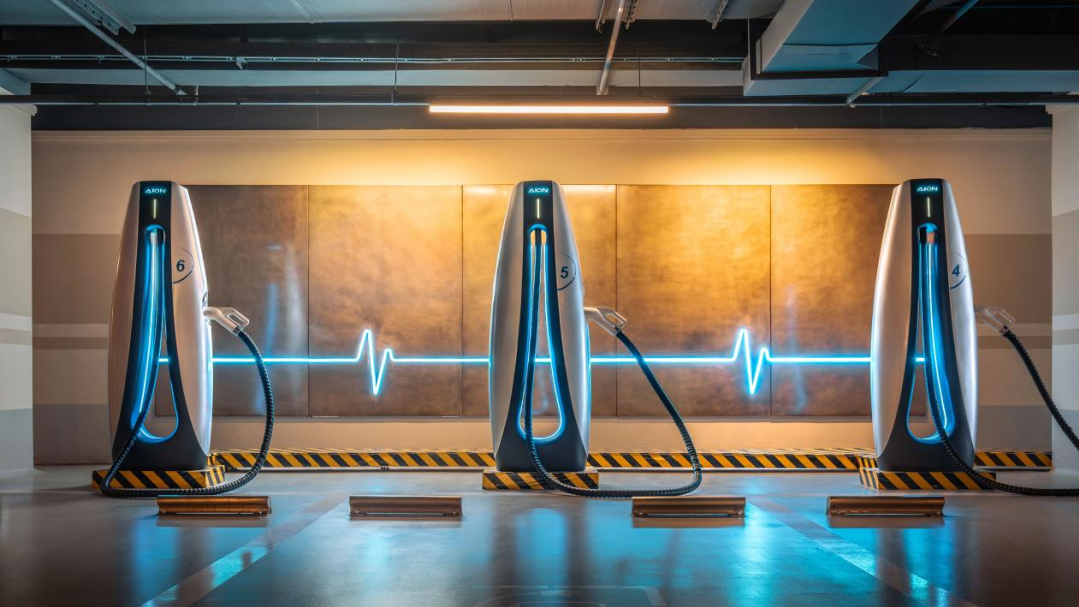
In the first ten months, China’s electric vehicle charging infrastructure increased by 5.827 million, with a pile-to-car ratio of 1:1.9