👇Click to enter, quickly analyze CAN logs👇
This article focuses on the estimation of the state of charge (SOC) of individual cells in a series-connected heterogeneous lithium-ion battery pack, conducted under the stringent constraint of only obtaining the total terminal voltage of the battery pack. To address the bottleneck of real-time computational efficiency, the Dense Extended Kalman Filter (DEKF) algorithm significantly reduces algorithm complexity compared to the traditional Extended Kalman Filter (EKF) by optimizing the computational architecture. This study establishes a physical verification platform, forming three groups of series-connected heterogeneous cell samples, collecting data under a constant current discharge condition of 1A, and using a genetic algorithm to identify and complete model parameters while simultaneously optimizing DEKF algorithm parameters. Experimental results show that under the dual challenges of limited hardware resources and uncertain environmental parameters, the DEKF algorithm can still achieve high-precision SOC estimation for individual cells, with the maximum estimation error controlled within 1% even when the initial SOC deviation is large, providing an effective technical solution for the development of low-cost real-time battery management systems.
1. Introduction
The inherent differences in lithium battery production processes result in discrete characteristics between the voltage and state of charge (SOC) of individual cells, which can accelerate the performance degradation of the battery pack and directly affect the driving range of electric vehicles and the operational stability of energy storage systems. To enhance the overall efficiency of the battery pack, balancing circuits and model predictive control algorithms work in tandem, but the reliable operation of these algorithms heavily relies on the accurate estimation of the SOC of individual cells. Once the estimation is inaccurate, the risk of overcharging and over-discharging increases significantly, greatly shortening the lifespan of the battery pack. However, the complex electrochemical characteristics and strong nonlinear dynamic responses of lithium batteries make accurate SOC estimation a recognized technical bottleneck in the industry.
The traditional coulomb counting method is widely used due to its simple computational logic, but its cumulative integration error amplifies over time, leading to a gradual decline in estimation accuracy. The Extended Kalman Filter (EKF) algorithm effectively suppresses error drift by combining the nonlinear dynamic model of the battery with real-time voltage data, becoming a mainstream estimation method. However, in the application of multi-cell heterogeneous battery packs, EKF faces challenges of high computational complexity and large memory requirements, making it difficult to adapt to hardware environments with limited embedded system resources. On the other hand, data-driven overall SOC estimation methods are limited in engineering practice due to a lack of interpretability and predictive certainty.
To address these challenges, the Dense Extended Kalman Filter (DEKF) algorithm has emerged. This algorithm breaks through the independent modeling mode of traditional EKF, abstracting the battery pack as an “average cell” model, whose state space dimension does not expand with the number of cells. By introducing a Relative Adaptation Factor (RFF) to quantify the differences between individual cells, it achieves reverse calculation from the average state to individual SOC. Simulation data shows that in a system with 100 cells, DEKF reduces over 16 million floating-point operations compared to traditional EKF, while maintaining similar estimation accuracy; as the number of cells increases, its performance advantage becomes more pronounced, with the root mean square error of SOC estimation in a 200-cell system reduced to 0.0040, approximately 27% optimized compared to a 2-cell system.
Although DEKF demonstrates excellent performance in theory and simulation, its practical engineering applicability still needs verification. This study builds a heterogeneous lithium battery pack experimental platform using an Arduino microcontroller and voltage sensors to collect total terminal voltage data at a sampling frequency of 1Hz, constructing a real-world data set aimed at verifying the computational efficiency and estimation accuracy of the DEKF algorithm through physical experiments.
2. Dense Extended Kalman Filter for SOC Estimation
2.1 Dynamic Characteristics of Cells
This study employs a first-order equivalent circuit model to describe the dynamic characteristics of each cell in a multi-cell battery pack. This model utilizes parameters such as open-circuit voltage (), ohmic internal resistance (), terminal voltage (), cell current (), polarization resistance (), and polarization capacitance () to detail the internal chemical reaction processes of the battery. This equivalent circuit model is applicable for both single-cell characteristic analysis and can be extended to multi-cell battery packs, with the detailed system dynamic equations as follows:
Where represents the state of charge (SOC) of cell , is the coulomb efficiency constant, represents the polarization voltage, is the cell capacity, and is the discharge current.
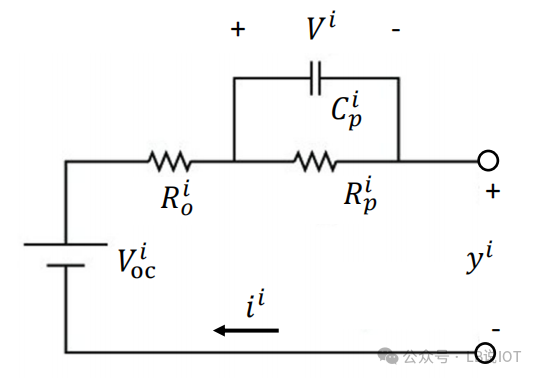
Define the state vector , the linear characteristics of a single cell can be further transformed into a discrete state equation:
Where
In the equation, is the sampling time. It is noteworthy that the open-circuit voltage has a nonlinear functional relationship with SOC, which makes the measurement equation also exhibit nonlinear characteristics.
By integrating the state update equations of all cells, a sparse state vector can be defined:
The complete state vector at time is denoted as , and the complete input vector is . Based on the above definitions, the dynamic characteristics of the entire battery pack can be uniformly described as:
It should be particularly noted that this study considers practical application scenarios, assuming that the currents of each cell may differ (especially in cases where balancing circuits are equipped); while in series battery packs without balancing circuits, the currents of all cells remain equal, at which point the input vector degenerates into scalar form.
2.2 Dense Extended Kalman Filter
This section provides a brief overview of the DEKF algorithm proposed in related research (for detailed content, please refer to the original literature). In the field of state estimation for multi-cell batteries, the traditional Extended Kalman Filter (EKF) needs to handle a large covariance matrix formed by series-connected cells, with a computational complexity as high as , posing a significant challenge to computational resources. The DEKF algorithm successfully reconstructs the estimation problem through a low-rank approximation strategy, reducing the computational complexity to , effectively solving this issue.
Consider the following system model:
Where represents process noise, and is measurement noise. Since DEKF only uses a single total terminal voltage signal, here is scalar.
The dense model adopted by DEKF is as follows:
Where , , are the relative adaptation factor (RFF) matrices, expressed as:
Where is the RFF related to the SOC of the cell, and is the RFF related to the polarization voltage, with specific calculation formulas as:
The above RFF quantifies the degree of deviation between each cell’s internal state ( and ) and the average cell’s dynamic characteristics. Based on these RFFs, the state changes of each cell can be reconstructed through the changes in the average state ( and ), with the update equation as:
In the covariance prediction phase, DEKF establishes a correspondence between the dense covariance matrix and the complete sparse covariance matrix :
It is worth noting that regardless of how the number of cells changes, the covariance matrix of DEKF always maintains a fixed size of , which significantly reduces computational load and storage requirements.
3. Experimental Setup
To construct a battery pack with real heterogeneous characteristics, this study designed a customized series circuit containing three “cell groups”. To introduce heterogeneity into the battery pack, Cell1 consists of two Sanyo 18650 lithium-ion cells connected in parallel, Cell2 also uses a configuration of two parallel cells, while Cell3 is composed of three parallel cells. Each 18650 cell has a nominal voltage of 3.6V, a fully charged voltage of up to 4.2V, and a capacity of 3.5Ah; this cell supports a maximum continuous discharge current of 10A, with approximately 300 charge cycles, after which its performance will significantly degrade.
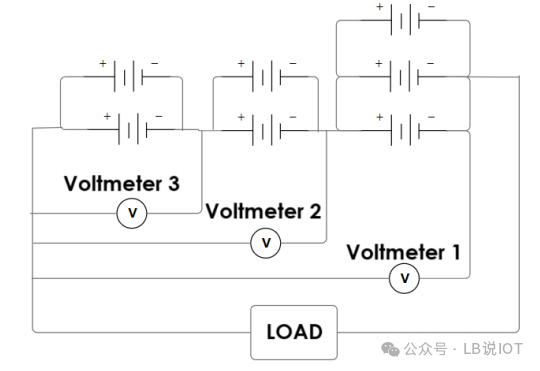
Although the DEKF algorithm only requires measuring the total terminal voltage of the battery pack, this study also measured the voltage of each cell group to complete battery parameter identification. Considering the common ground design requirements of the Arduino development board, a phased measurement scheme was adopted in the experiment: the first voltage sensor measures the total voltage of the entire battery pack; the second sensor measures the combined voltage of Cell1 and Cell2; the third sensor is responsible for measuring the voltage of Cell3. By processing the above measurement data, the independent voltages of each cell group can be obtained.
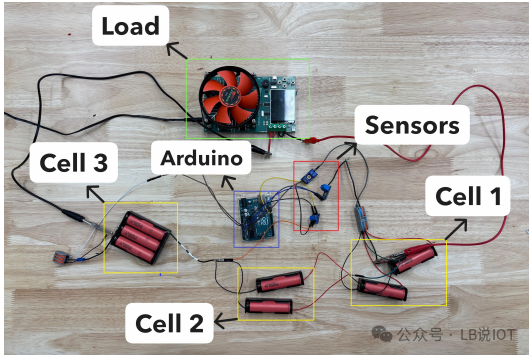
The experimental data acquisition system is centered around the Arduino development board, enabling real-time recording of voltage data, with each cell group monitored as an independent “cell”. Data recording is performed using the open-source serial terminal tool PuTTY, saving the data collected by Arduino as text files via serial connection. After the experiment, all measurement data is imported into the Matlab environment, where the DEKF algorithm is run to complete the estimation of the SOC of the cells (choosing to run the DEKF algorithm in Matlab can effectively shorten the experimental cycle). Additionally, a programmable current load is used to provide a stable user-defined discharge current, simulating steady-state discharge conditions in real scenarios.
Before the formal testing, all cells are pre-charged to 100% SOC to ensure the repeatability of the experimental results. This operation is particularly critical because the SOC cannot be obtained through direct measurement; without full charging, the initial SOC of the cells would have uncertainty, which would affect the accuracy of the experimental results. The experiment sets the load to a constant current discharge mode of 1A, with the discharge current measured in real-time by the load, serving as a key input parameter during the DEKF algorithm estimation process.
4. Results and Discussion
4.1 Parameter Identification
The cell model includes four key parameters: polarization resistance (), polarization capacitance (), ohmic internal resistance (), and cell capacity (). Among these, the cell capacity can be directly provided by the manufacturer, while the other three parameters need to be estimated. This study conducts parameter identification using the genetic algorithm (GA) from the Matlab global optimization toolbox. GA searches for optimal parameter values by minimizing a user-defined cost function, which aims to quantify the error between the measured battery voltage and the model-predicted voltage. Specifically, this study sets the cost function to minimize the root mean square error (RMSE) between the DEKF simulation output and the experimental voltage data.
The parameter configuration for GA is as follows: the population size is set to 50, the maximum number of iterations is 12,000 generations, the stagnation limit is 1,500 generations, and parallel computing is enabled to improve optimization efficiency. The algorithm flow is as follows:
-
Input the measured battery terminal voltage trajectory, discharge current trajectory, OCV-SOC lookup table, and initial estimates of the parameters to be optimized;
-
Call the cost function and pass in the above input parameters;
-
Evolve the population through selection, crossover, mutation, etc., until the optimal parameter combination that minimizes the cost function is found.
Table 1 summarizes the estimated parameters for each cell group, and Figure 4 compares the model-predicted voltage based on the estimated parameters with the measured voltage. These charts show the comparison of measured voltages and calculated voltages for all cell groups over a simulation period of 3600 seconds: the green solid line represents the calculated voltage after GA optimization, while the red dashed line represents the measured voltage from the low-cost voltage sensor. The results indicate that the calculated voltage can accurately track the core variation trend of the measured voltage data, with all simulation errors controlled within 1.5%. This highly consistent result fully demonstrates that even in the presence of sensor noise interference, GA can effectively identify the parameters required for accurate model prediction. It is worth mentioning that although there are many methods for estimating cell parameters, this study chooses GA due to its excellent noise resistance and ability to stably find the global optimal solution.
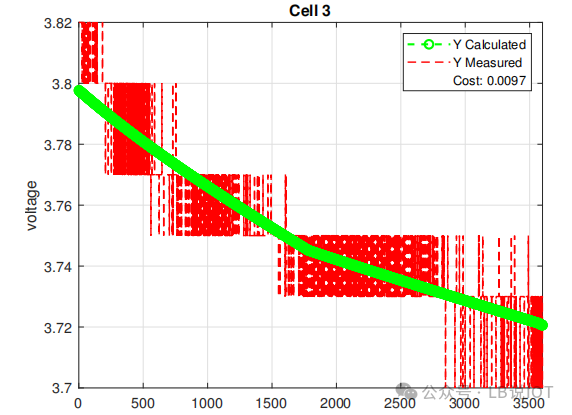
Table 1. Rₚ, Cₚ, and Rₒ parameters estimated by the genetic algorithm
| Parameter | Cell1 | Cell2 | Cell3 |
|---|---|---|---|
| Rₚ (Ω) | 0.0063 | 0.0100 | 0.0095 |
| Cₚ (F) | 90610 | 80199 | 81940 |
| Rₒ (Ω) | 0.2465 | 0.2451 | 0.3473 |
| Cost Value | 0.01311 | 0.01319 | 0.009674 |
4.2 DEKF Results with Manual Parameter Tuning
This section focuses on the performance of DEKF in estimating the SOC after manual parameter optimization. As mentioned earlier, all missing parameters have been identified through relevant estimation techniques. For DEKF, the process noise covariance and measurement noise covariance are key parameters, and their tuning process plays a decisive role in the performance of the filter.
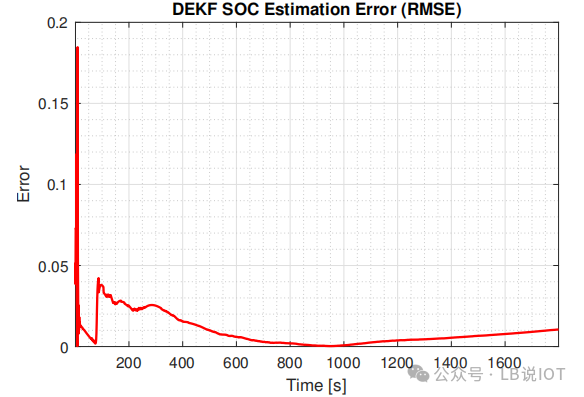
In the first experimental setup, the initial SOC estimate is set to 98%, and the initial value of the polarization voltage is set to 0V, at which point DEKF exhibits excellent performance. Experimental data shows that the filter converges quickly, and its predicted SOC values closely match the actual measured data. To further explore the robustness of the algorithm, the initial SOC estimate is adjusted to 90%, which deviates more from the true value. The results show a significant decline in DEKF’s estimation performance compared to the experimental condition with an initial estimate of 98%. This phenomenon fully illustrates that the current DEKF parameters obtained through manual tuning still have room for optimization. Based on this, subsequent research introduces the genetic algorithm (GA) for automatic parameter optimization.
4.3 DEKF Results with Automatic Parameter Tuning
This section presents the SOC estimation results of the Differential Extended Kalman Filter (DEKF) after automatic parameter tuning. The study employs the genetic algorithm (GA) to optimize the process noise covariance matrix and measurement noise covariance matrix , with the algorithm flow similar to the parameter identification process: using measured voltage data, open-circuit voltage – state of charge (OCV-SOC) curve, physical parameters of the battery pack, and DEKF structure and initial parameters as inputs, initializing the GA population; iteratively calculating the cost function (the mean square error between estimated SOC and actual SOC) and driving population evolution to ultimately obtain the optimal parameter combination.
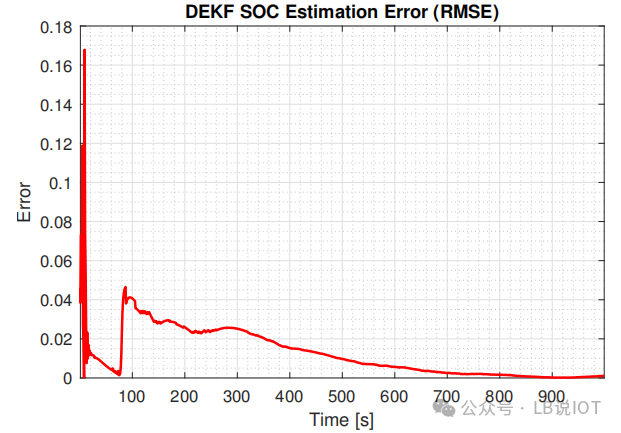
Experimental results indicate that compared to manual tuning, the GA-optimized DEKF exhibits significant advantages in parameter performance: the algorithm’s convergence speed is greatly improved, and it tracks the actual SOC variation trend more accurately; the root mean square error (RMSE) curve shows a significantly accelerated error decay rate, maintaining a lower fluctuation level during long-term operation. When the initial SOC estimate is set to 90%, the GA-tuned DEKF can stabilize the RMSE below 1% within 1000 seconds, fully validating the robustness and engineering practicality of this method, while significantly reducing the labor costs and time expenditures of traditional calibration processes.
5. Conclusion
This study completes the physical verification of the SOC estimation method for individual cells in heterogeneous lithium-ion battery packs based on limited voltage sensor measurements, proposing an engineering solution with significantly improved computational efficiency. The research employs an equivalent circuit model for detailed modeling of each cell in the battery pack and systematically verifies the applicability of the Dense Extended Kalman Filter (DEKF) algorithm under practical conditions. Specifically, by constructing a physical battery pack containing heterogeneous cells and collecting cell voltage data under constant current discharge conditions, combined with a Matlab 2024b programming framework that adapts to the differences in cell parameters, the efficient deployment of the DEKF algorithm is achieved.
Experimental results show that the DEKF algorithm exhibits excellent performance in convergence speed, SOC estimation accuracy, and adaptability to the computational resources of embedded systems. For future research, plans are to deepen the study in three aspects: first, to expand the experimental scenarios by introducing aged cells and increasing the number of cells to simulate more complex battery pack operating environments; second, to focus on performance optimization of embedded platforms, quantifying the impact of current sampling deviations on estimation accuracy; and third, to conduct special tests for low SOC conditions (SOC ≤ 10%) and evaluate the robustness of the algorithm through statistical methods.
Core Source:Ogdeh, O.; Nuculaj, L.; Irshayyid, A.; Zhou, Z.; Chen, J. Cell State-of-Charge Estimation with Limited Voltage Sensor Measurements. Appl. Sci.2025, 15, 10127.doi.org/10.3390/app151810127