The team of Christina M. Woo from Harvard University’s Department of Chemistry and Chemical Biology has developed an enzyme activation strategy by integrating O-GlcNAc modifications into the ligands of cyclimids recognized by cereblon (CRBN). These sugar-coated PROTACs (SCPs) were designed based on structural analysis of representative cyclimids that degrade CRBN and the target protein BRD4.

Protein-targeted degradation technology utilizes the ubiquitin-proteasome system to degrade pathogenic proteins, showing potential for treating various diseases. Protein degradation-targeting chimeras (PROTACs) are emerging degraders that promote the ubiquitination and degradation of target proteins by simultaneously binding to the target protein and E3 ligase. However, the commonly used E3 ligases CRBN and von Hippel-Lindau (VHL) are widely expressed in vivo, which may lead to off-target toxicity. O-GlcNAcylation is a post-translational modification characterized by the addition of a single GlcNAc moiety to serine or threonine residues of nuclear and cytoplasmic proteins. O-GlcNAc acts as a nutrient sensor, associated with various cellular functions, and is often dysregulated in disease states. O-GlcNAc hydrolase (OGA) is overexpressed in various cancers, where dysregulation of the O-GlcNAc cycle promotes glycosylation imbalance, driving tumor progression. Changes in the expression levels of OGA in different biological contexts provide opportunities to enhance the cellular selectivity of other broadly acting ligands.
In this study, the researchers utilized O-GlcNAc as a metabolically triggered factor for degrader activation, as a strategy to achieve context-dependent protein degradation in cells. By integrating O-GlcNAc into JQ1-ScQ, a cyclimids-based degrader of bromodomain protein 4 (BRD4), they produced sugar-coated PROTACs (SCPs) that conditionally activate BRD4 degradation in an OGA-dependent manner, guided by the cryo-electron microscopy structure of representative cyclic degraders with CRBN, damage-specific DNA binding protein 1 (DDB1), and BRD4 bromodomain 1 [BRD4 (BD1)]. O-GlcNAcylation impairs the binding of CRBN to BRD4 and the formation of the ternary complex. This inhibitory effect is relieved after OGA-mediated deglycosylation, restoring activity in vitro and in cells.
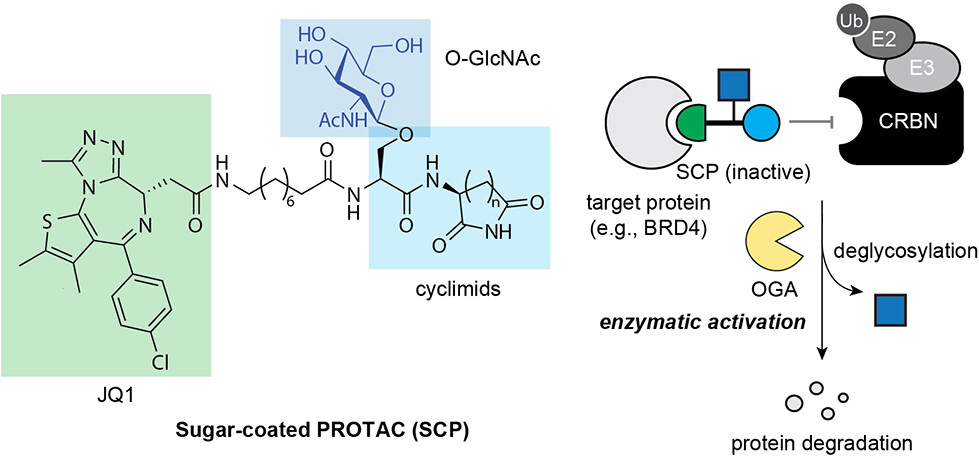
The results of this study indicate that the degradation activity of SCPs depends on the expression of OGA and can be regulated by OGA inhibitors. In cell lines with high OGA expression levels, SCPs effectively degrade BRD4 and inhibit cell proliferation, while in cell lines with lower OGA expression, there is no significant degradation activity. This suggests that SCPs have good selectivity and hold promise for application in the treatment of various diseases.
Original link:
https://doi.org/10.1021/jacs.5c09843
Written by: GPX Proofread by: ZTHEdited by: ZTH