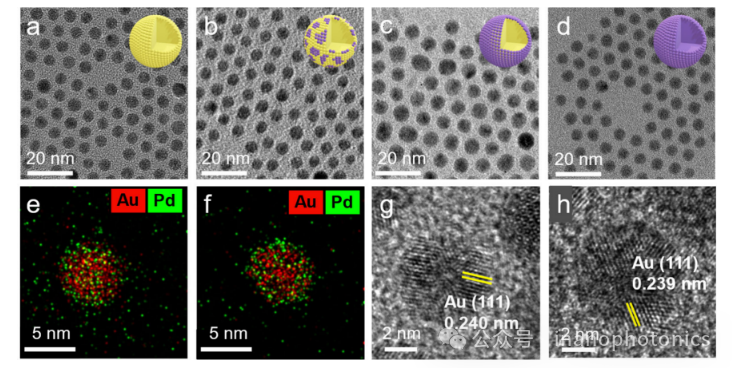
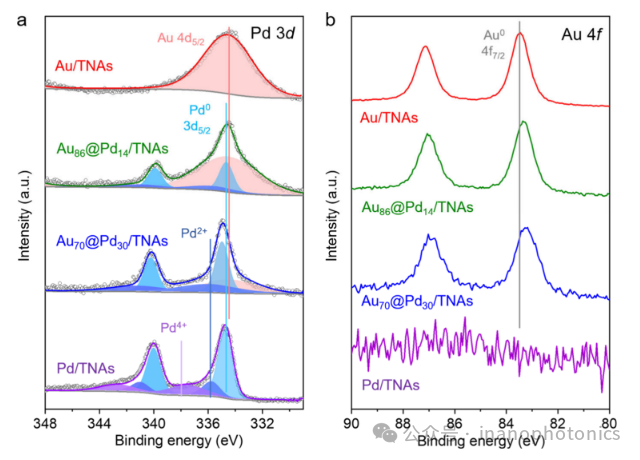
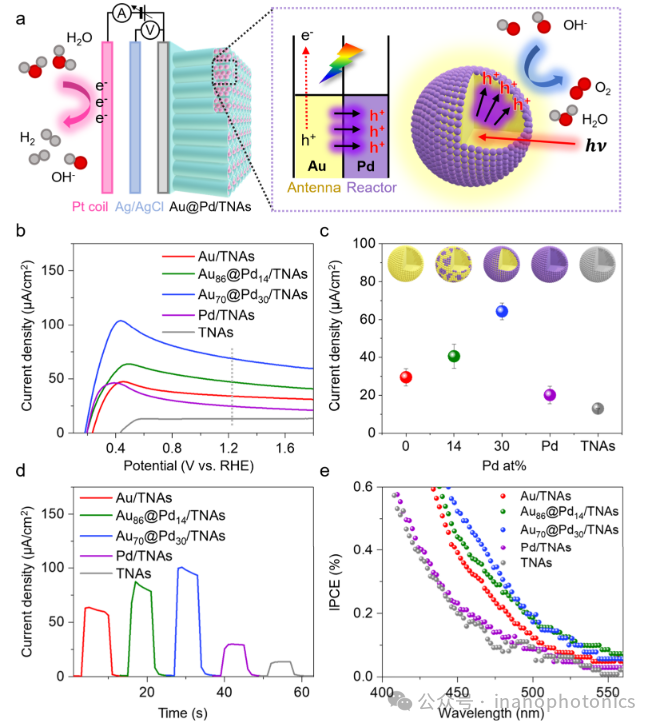
 Hot carriers generated by the decay of surface plasmons on noble metal nanoparticles play a crucial role in the process of green hydrogen production through visible light-driven photoelectrochemical (PEC) water splitting. To optimize the utilization efficiency of hot carriers, the Korea Advanced Institute of Science and Technology Hyewon Park, Hyotcherl Ihee, Jeong Young Park, Jeong Hoon Lee professors, along with Seunghyun Chun and Hyosun Lee from Seoul National University, employed a plasmonic antenna-reactor model based on core-shell structured Au@Pd nanoparticles (NPs) with an ultra-thin Pd shell. This study demonstrates that TiO₂ nanotube arrays (TNAs) modified with Au@Pd NPs exhibit outstanding performance: the Pd shell acts as a catalytic reactor, effectively extracting hot carriers from the plasmonic Au antenna. The PEC tests show that the photocatalytic performance improves with increasing Pd coverage, with the photocurrent intensity of Au70@Pd30/TNAs reaching 2.2 times that of bare Au/TNAs. The enhanced oxygen evolution reaction (OER) activity of Au70@Pd30/TNAs is attributed to the increased concentration of hot holes on the surface of Au@Pd NPs, thereby strengthening the oxidative ability interacting with the electrolyte. Femtosecond transient absorption (fs-TA) spectroscopy reveals that, compared to Au NPs, the hot electron lifetime in Au70@Pd30 NPs, influenced by electron-phonon scattering, is shorter, indicating effective suppression of charge recombination and increased surface hot hole concentration. Therefore, this study confirms that the plasmonic antenna-reactor model, significantly influenced by hot carrier dynamics, provides an important design framework for constructing efficient photoelectrocatalytic systems.
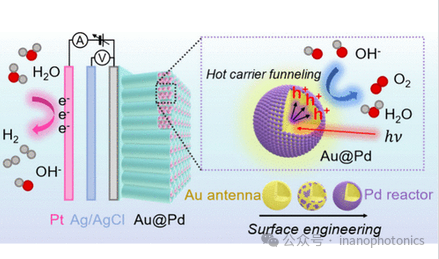 Hydrogen, as a sustainable alternative to fossil fuels, has gained widespread attention, especially in the context of the escalating global energy and environmental crisis. Its production methods include fossil fuel reforming and water splitting. To ensure the production of truly green hydrogen, a comprehensive assessment of the ecological footprint throughout the production and consumption process is necessary, as unexpected carbon dioxide emissions may occur during hydrogen production, exacerbating global warming. In this regard, water electrolysis does not produce pollutants from the reactants and can incorporate solar energy into the production process, significantly reducing external energy consumption. Therefore, the photoelectrochemical (PEC) water splitting reaction is an important pathway for producing green hydrogen using renewable solar energy. This process converts solar energy into the chemical energy of hydrogen. Semiconductor materials capable of generating charge carriers (such as TiO₂, Fe₂O₃, and Cu₂O) are ideal candidates for photoelectrodes. To achieve efficient reactions, the band structure of the semiconductor must match the redox potentials of the hydrogen evolution reaction (HER) or oxygen evolution reaction (OER) to ensure effective charge carrier transfer to the electrolyte. These semiconductors generate hot electrons and holes with energy exceeding the catalyst bandgap under sunlight. Among various semiconductors, TiO₂ is recognized as a classic photocatalyst for this reaction due to its band position aligning perfectly with the potential range required for water splitting. However, TiO₂ has significant limitations: its relatively high bandgap energy of about 3.2 eV prevents it from absorbing approximately 47% of the visible light spectrum. To address this issue, various strategies have been developed in the field of photocatalysis, including doping, composite plasmonic nanoparticles (NPs), constructing heterojunctions, surface modifications, nanostructure design, and interface optimization to enhance visible light absorption and improve charge carrier dynamics.
Plasmonic photocatalysts have become an effective strategy to enhance catalytic activity, with the potential to break through the theoretical limits of solar energy conversion efficiency. When incident light excites the electrons on the surface of noble metal NPs such as gold, silver, and copper, it triggers localized surface plasmon resonance (LSPR), which decays through non-thermal and thermal pathways, including light scattering, near-field electromagnetic enhancement, hot carrier generation, and local thermal effects. Among these, Landau damping is particularly critical, as the hot carriers generated can interact with adsorbed molecules to initiate chemical reactions on the catalyst surface. Furthermore, the formation of Schottky barriers at the metal-semiconductor interface is an effective means to regulate the transport of hot carriers between the semiconductor and metal. When hot electrons (or holes) generated by plasmonic metal NPs successfully cross the Schottky barrier, their return to the metal NPs is suppressed, thereby avoiding recombination with photogenerated hot holes (or electrons). In recent years, various enhancements in catalytic activity have been reported in different plasmonic metal-semiconductor configurations.
To further enhance catalytic activity by maximizing the utilization of hot carriers, researchers have proposed a multi-atom catalyst strategy, which involves co-loading concentrating plasmonic metals with catalytically active metals on the surface of semiconductors. (30−32) In particular, core-shell or core-satellite structures, such as antenna-reactor configurations, have been confirmed to simultaneously maximize plasmonic effects and catalytic performance. (33−41) In core-shell structures, the thickness and composition of the shell layer have been identified as key factors significantly affecting overall catalytic performance. (39−41) Further research indicates that configurations with partial coverage of catalytic metal atoms on the plasmonic core surface or core-shell NPs can achieve a good balance, minimizing light absorption losses caused by catalytic metals while promoting catalytic activity. (42−44) Our previous studies validated this viewpoint, revealing that a single atomic layer ultra-thin shell with a coverage of 20.6% achieved optimal catalytic performance in the benzyl alcohol oxidation reaction. (43) However, the rapid transfer of hot carriers to the shell surface and the synergistic effects of electronic characteristics at alloy shell sites, combined with the technical challenges of directly detecting hot carriers in catalytic systems, pose significant challenges to revealing precise mechanistic details.
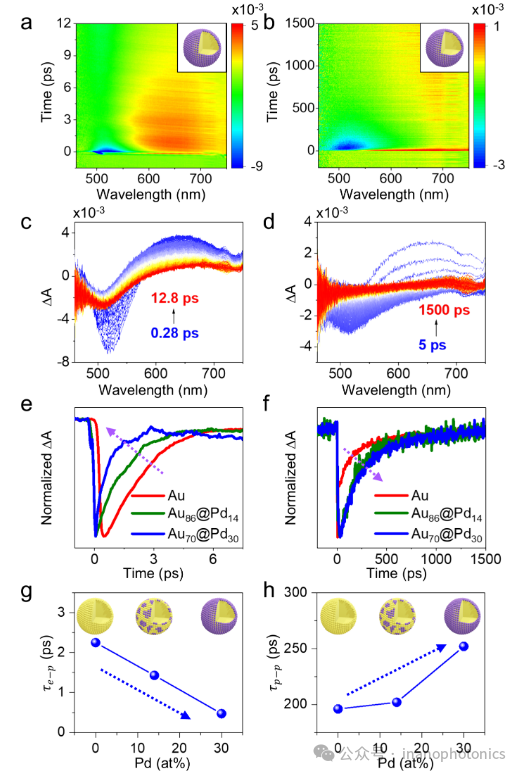
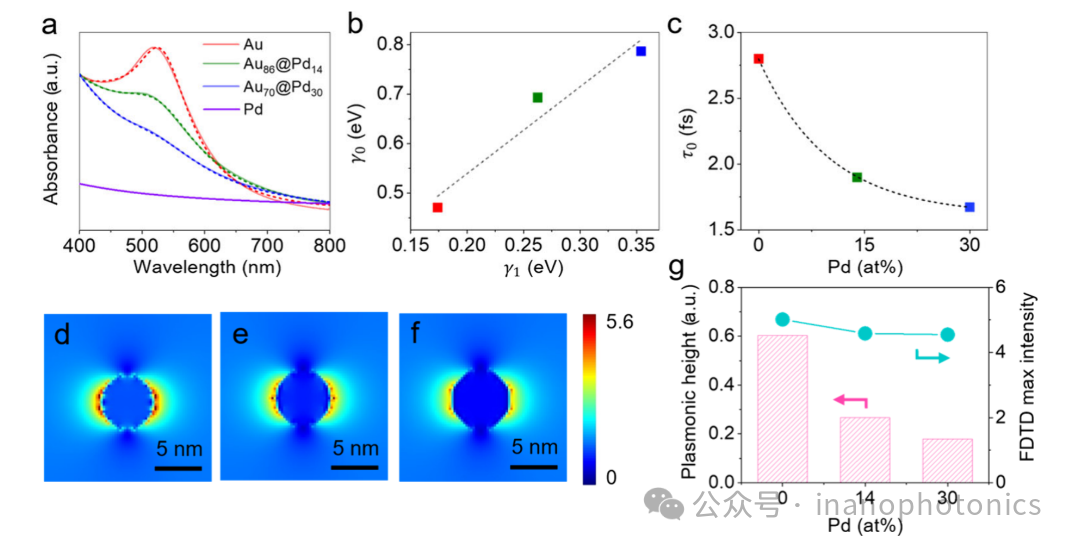 (Images and content are sourced from J. Am. Chem. Soc.)
Article Information:
Impact of Hot Carrier Dynamics on Photoelectrocatalytic Activity on Au@Pd Antenna-Reactor Nanoparticles
Hyewon Park,∥ Seunghyun Chun,∥ Jeong Hoon Lee,∥ Jihan Son, Sookyung Kim, Jungkweon Choi, Hyotcherl Ihee,* Hyosun Lee,* and Jeong Young Park*
Cites: J. Am. Chem. Soc. 2025, DOI: 10.1021/jacs.5c12825
————————————————————
Submissions are welcome, submission email:
Frontiers in Nanophotonics
Founded by
Guan Chao Zheng
Associate Professor, School of Physics, Zhengzhou University