Hello everyone, today I would like to share an article published in JACS titled “Probiotic–Drug Conjugates Achieve Synchronized Site-Specific Probiotic Colonization and On-Demand Drug Release against Ulcerative Colitis and Its Complications.” The corresponding authors are Professors Gao Huiyuan, Sun Jin, and Sun Mengchi from Shenyang Pharmaceutical University, who study active substances from traditional Chinese medicine, nano-drugs, and drug delivery systems. In this article, the authors developed a triggerable probiotic-drug conjugate that can achieve synchronized site-specific colonization and drug release for the treatment of ulcerative colitis and its complications.

Ulcerative colitis is a chronic intestinal disease that poses a significant threat to human health. However, current treatment strategies for ulcerative colitis are limited by uncontrolled drug release and non-specific drug distribution, leading to poor clinical outcomes. An emerging therapeutic strategy is the oral administration of engineered probiotics, which can effectively maintain the activity and adhesion of probiotics under gastrointestinal conditions, modulate gut microbiota, and competitively inhibit pathogenic bacteria. However, existing surface-modified probiotics have poor selective colonization capabilities and limited synchronous delivery of other drugs.
This article developed a triggerable probiotic-drug conjugate that can achieve synchronized site-specific colonization and drug release for the treatment of ulcerative colitis and its complications. First, tannic acid-Fe(III) was used to in situ encapsulate probiotics to form an adhesive inner layer. Tannic acid can form hydrogen bonds and π-π interactions with intestinal epithelium to promote colonization, thereby modulating gut microbiota and competitively inhibiting pathogenic bacteria. Then, a ROS-responsive thioether bridge phospholipid-berberine was used to form an outer coating. After oral administration, these coatings protect the probiotic activity under harsh gastrointestinal conditions, while the high levels of ROS at the lesion site can trigger thioether cleavage, releasing berberine, which exhibits anti-inflammatory activity, effectively improving the inflammatory microenvironment of the lesions, and showing a synergistic therapeutic effect with probiotics.
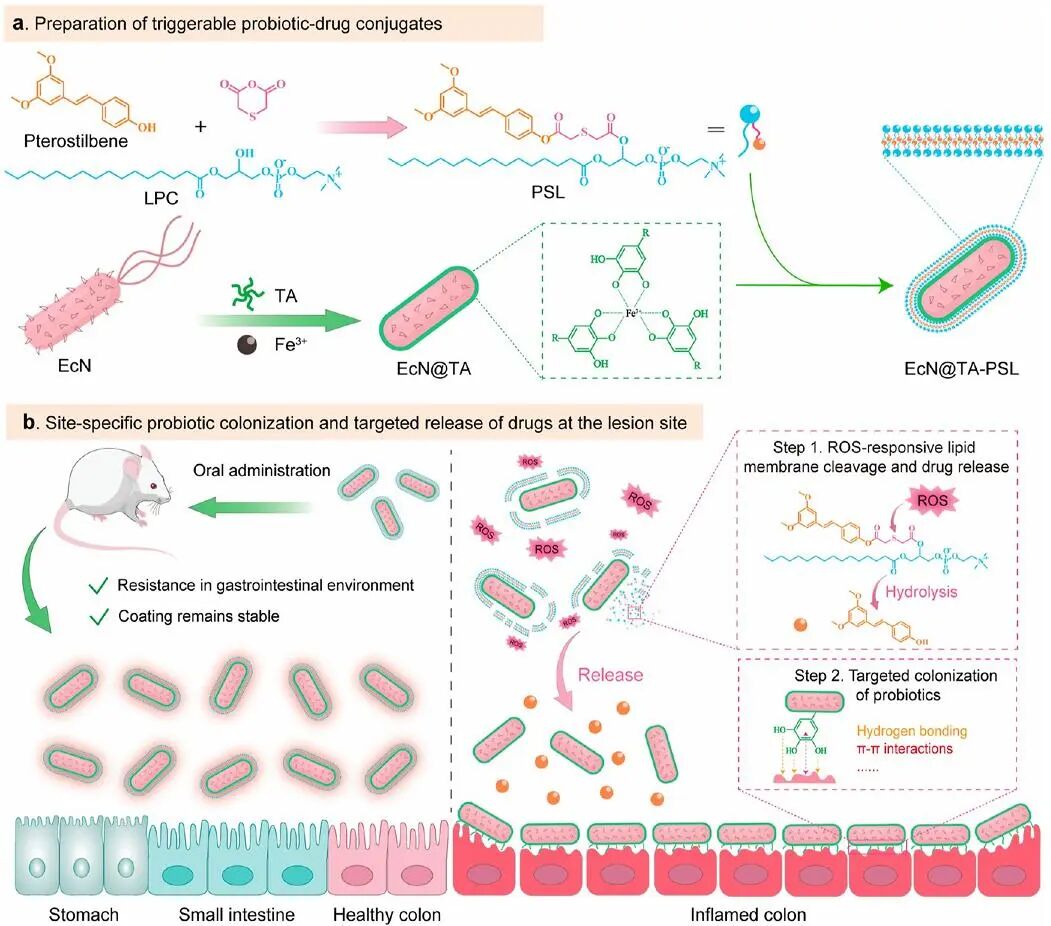
In mouse models of ulcerative colitis and related complications, this probiotic-drug conjugate demonstrated significant therapeutic and preventive efficacy.
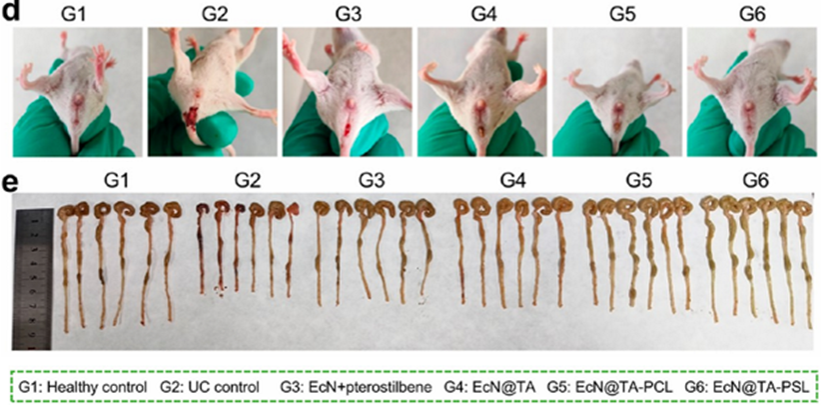
In conclusion, this article develops a triggerable probiotic-drug conjugate that can achieve synchronized site-specific colonization and drug release for the treatment of ulcerative colitis and its complications.
Article Author: WYJ
Editor: LYC
DOI: 10.1021/jacs.5c08094
Original link: https://doi.org/10.1021/jacs.5c08094