Inspired by the interaction between metal porphyrins (such as hemoglobin) and gas molecules in nature, the Zhang Tong team at Jilin University has successfully developed a conductive polymer composite material (PANI/PEDOT:PSS) functionalized with copper tetraphenylporphyrin (CuTPP) for high selectivity NO₂ detection at room temperature.
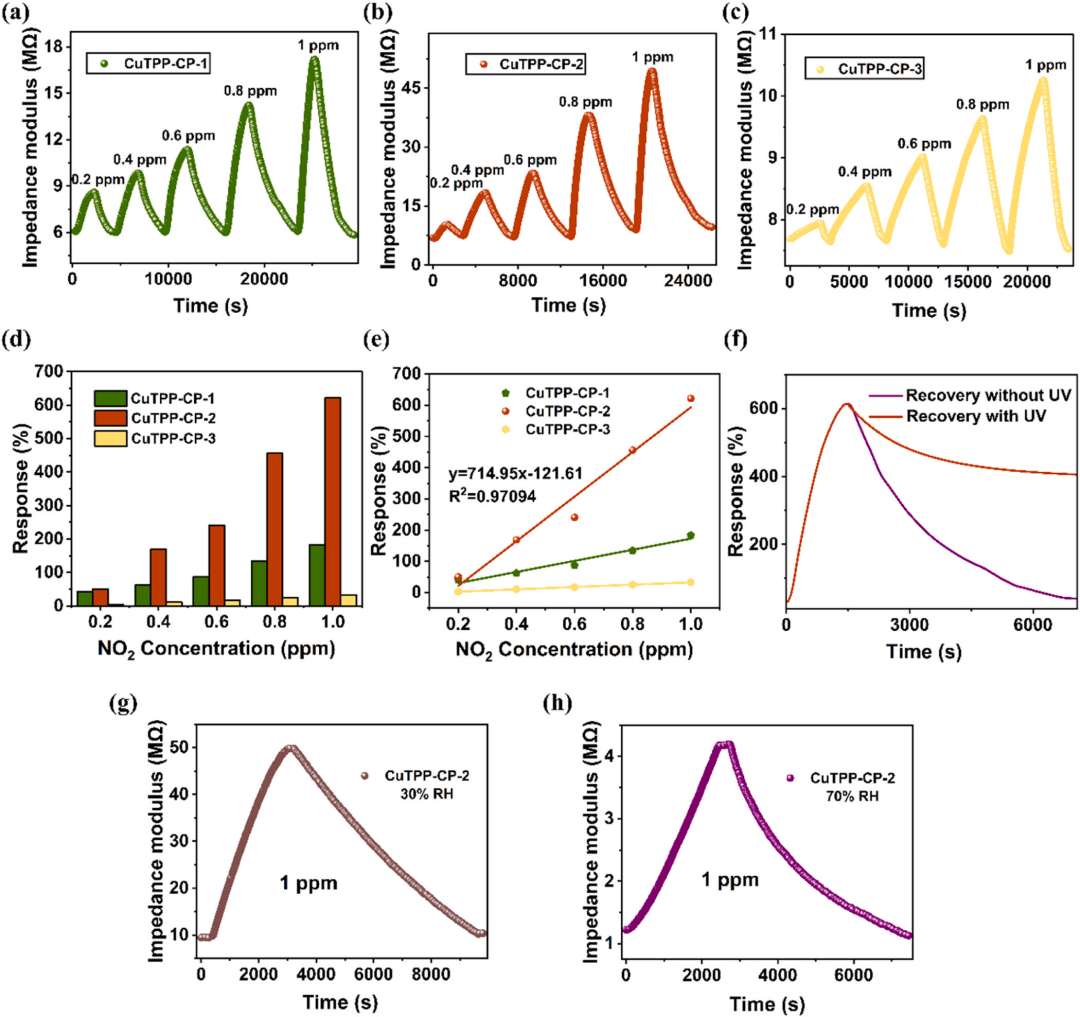
This sensor utilizes the unique π-back bonding mechanism between CuTPP and NO₂, achieving not only extremely high selectivity but also significantly promoting the charge transfer pathway centered on CuTPP, greatly enhancing the efficiency of electron extraction from polyaniline (PANI). The sensor exhibits excellent linearity (R² > 0.97) in the NO₂ concentration range of 0.2–1 ppm, with a theoretical detection limit as low as 0.4 ppb, and achieves complete recovery of the sensor using ultraviolet (UV) light assistance.
01
Research Background
As one of the six major air pollutants recognized by the World Health Organization, NO₂ primarily originates from traffic emissions and industrial activities. It can induce respiratory diseases such as asthma, irritate the mucous membranes of the eyes and nose, and contribute to acid rain and ground-level ozone formation, posing risks to human health and the ecological environment.
Existing detection technologies have significant shortcomings: gas chromatography-mass spectrometry is complex and costly; electrochemical sensor electrodes are prone to aging; semiconductor metal oxide sensors require high operating temperatures and have poor selectivity; traditional conductive polymer sensors face issues such as insufficient reversibility and low sensitivity at low concentrations. Therefore, developing a high-sensitivity, high-selectivity, and repeatable NO₂ detection technology at room temperature has become an urgent need.
02
Research Highlights
Bio-inspired Design:By mimicking the specific binding mechanism of metal porphyrins with gases in nature, CuTPP is introduced to construct targeted recognition sites, breaking through the selectivity bottleneck of traditional sensors.
Innovative Mechanism of Action:Through the π-back bonding interaction between CuTPP and NO₂, both adsorption specificity is ensured and an efficient charge transfer channel is constructed, significantly enhancing sensor sensitivity.
Efficient Operation at Room Temperature:No high-temperature heating is required, reducing energy consumption while simplifying device structure, making it suitable for various application scenarios.
UV-Assisted Recovery:This addresses the common issue of baseline recovery in NO₂ detection by catalytically decomposing the byproduct NO₃⁻ through UV light, enabling reversible use of the sensor.
03
Material Design
Core Material Combination
-
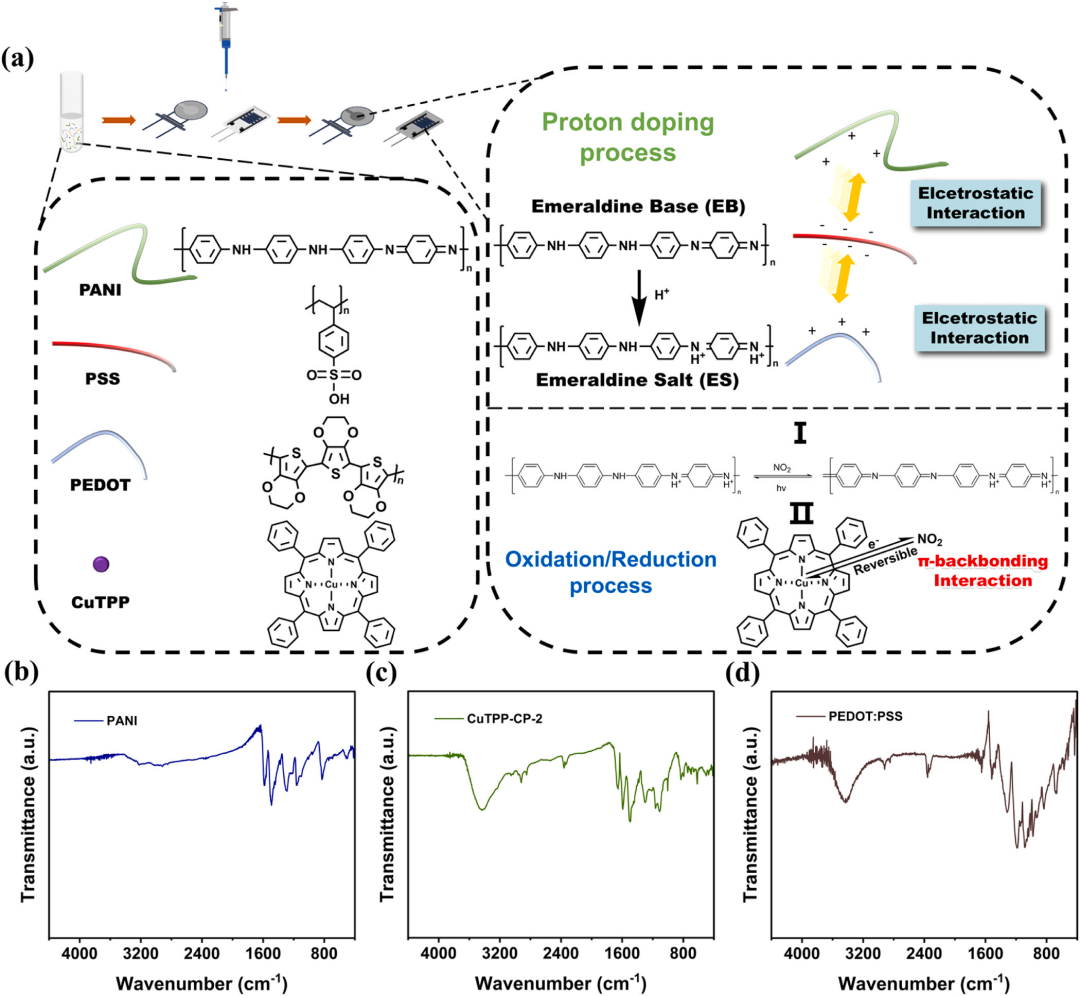
Substrate Material:PANI and PEDOT:PSS form a composite conductive polymer matrix, ensuring structural stability through electrostatic interactions. The sulfonic acid groups in PSS serve as a proton reservoir to assist PANI in redox transitions.
-
Sensitive Component:CuTPP serves as the NO₂-specific recognition unit, with its Cu²⁺ ions selectively adsorbing NO₂ through π-back bonding while forming π-π stacking with the polymer aromatic rings to promote charge transfer.
Preparation Process
-
PANI, PEDOT:PSS, and varying proportions of CuTPP are dispersed in N-methylpyrrolidone (NMP), and after ultrasonic treatment to form a uniform solution, it is drop-coated onto a high surface area alumina substrate (with graphite interdigitated electrodes), heated at 80°C for 20 minutes to form the sensitive layer, optimizing sensor performance by adjusting the CuTPP content.
04
Performance Testing
Sensitivity:At 1 ppm NO₂, the response value reaches 625%, with a sensitivity of 715%/ppm, which is 5.77 times that of pure PANI/PEDOT:PSS composite materials and 4.02 times that of low CuTPP content formulations.
Detection Range:At a concentration of 0.2 ppm, the response value reaches 50%, covering the environmental trace monitoring needs, with a theoretical detection limit as low as 0.4 ppb.
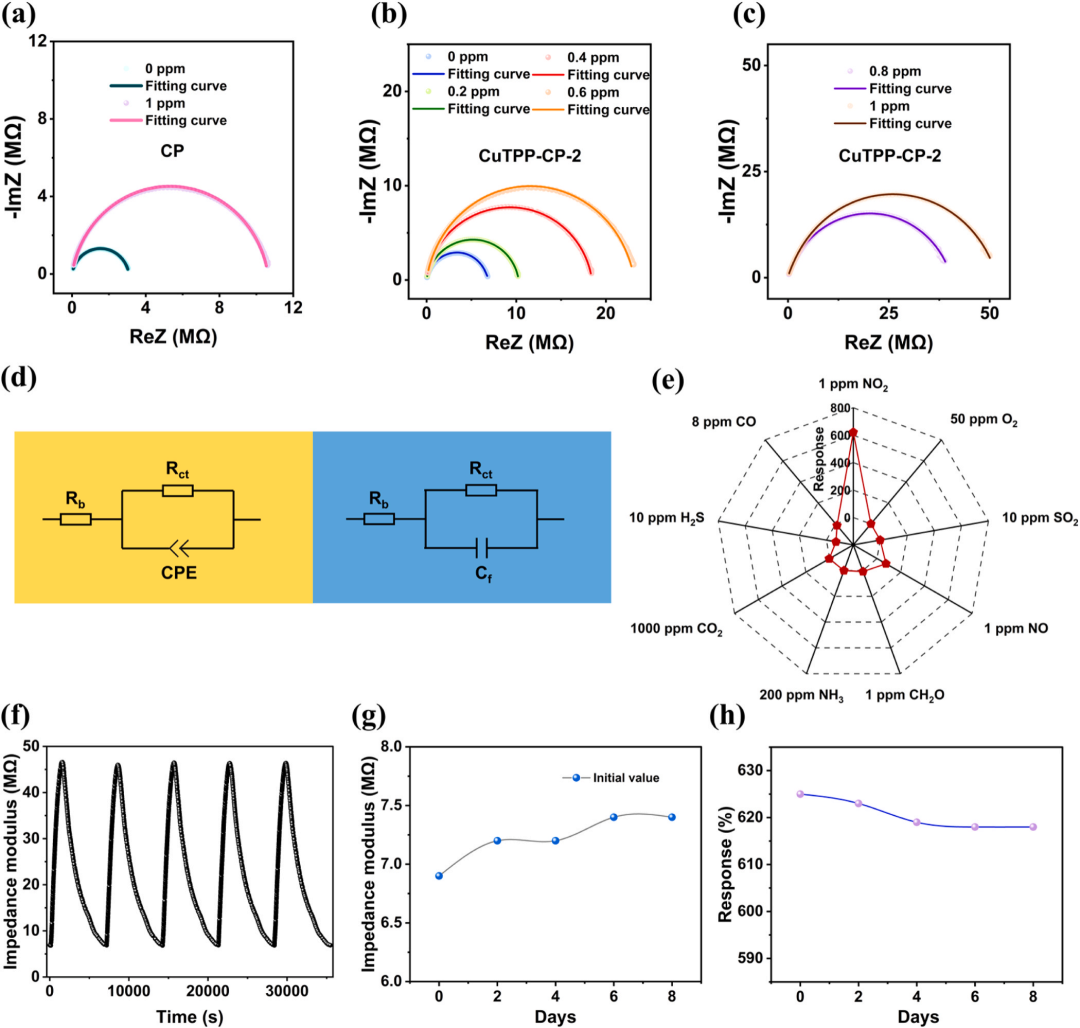
Selectivity:The response to 1 ppm NO₂ is significantly higher than that of interfering gases such as formaldehyde, ammonia, hydrogen sulfide, and carbon monoxide, with a response to 200 ppm ammonia being only 0.07%.
Stability:Response stability is maintained over 5 consecutive cycles, with only a 1.1% performance change after 8 days of long-term testing, and good structural integrity.
Humidity Adaptability:Stable operation is maintained within a relative humidity range of 30%-70%, with optimal performance at 50% RH.
05
Working Mechanism
Charge Transfer Pathway:The introduction of CuTPP constructs an efficient charge transfer channel (PANI (π)→CuTPP (π-d)→NO₂(π*)), where Cu²⁺ transfers d-orbital electrons to the anti-bonding orbitals of NO₂, lowering the energy barrier for electron extraction and enhancing the oxidation state of PANI, resulting in significant impedance changes.
π-Back Bonding Verification:UV-Vis spectroscopy shows that after exposure to NO₂, the Soret band of CuTPP undergoes a blue shift (416 nm→413 nm), confirming the specific coordination interaction between CuTPP and NO₂, rather than mere physical adsorption.
Recovery Mechanism:UV light excitation generates photogenerated carriers, which, under the catalysis of Cu²⁺, decompose the byproduct NO₃⁻, while the proton reservoir effect of PSS assists PANI in completing the redox reversible transition, achieving complete baseline recovery.
Impedance Mechanism:EIS analysis indicates that the sensing response is dominated by interfacial charge transfer, with the addition of CuTPP increasing the charge transfer resistance under 1 ppm NO₂ by 5 times, validating the effectiveness of the constructed charge transfer channel.

06
Application Prospects
Environmental Monitoring:Real-time monitoring of urban air quality, compliance testing of industrial waste gas emissions, and monitoring of indoor air pollutants.
Health Protection:NO₂ concentration warning in office/residential environments to protect sensitive populations (asthma patients, the elderly, children).
Mobile Detection Devices:Integrated into portable gas analyzers, suitable for mobile monitoring scenarios in transportation hubs, industrial parks, etc.
Sensor Arrays:Expanded to simultaneous detection of various harmful gases, providing comprehensive data support for environmental assessment.
07
Paper Information
Jiyuan Xue, et al. Highly selective room temperature NO2 detection via π-back bonding in CuTPP-functionalized conductive polymer sensors. Sensors and Actuators: B. Chemical, 448 (2026) 138991.
https://doi.org/10.1016/j.snb.2025.138991

“Frontiers in Intelligent Sensing Research” is committed to sharing valuable research information through academic sharing. We strictly respect intellectual property rights. If any copyright disputes arise during the dissemination of information, please contact us promptly. We will make corrections or deletions as soon as verified, to jointly maintain a good academic exchange environment.