Click the blue text
Follow us
CANopen and CAN communication are two commonly used technologies in industrial automation and embedded systems, but they belong to different levels of concepts. Below is a detailed analysis of the core differences and their relationship:
1. Basic Definitions and Protocol Levels

Key Differences:
-
CAN is a low-level communication protocol that only addresses the issue of “how to reliably transmit data”.
-
CANopen is a high-level protocol built on top of CAN, addressing the issues of “what data to transmit and how to interact”.
2. Application Scope and Target Scenarios
CAN Communication
Application Scenarios:
-
Automotive electronics (communication between ECUs, such as engine control and ABS).
-
Simple control of industrial equipment (direct communication between sensors and actuators).
Characteristics:
-
Only provides basic communication capabilities, requiring users to define data formats and interaction logic.
-
Suitable for point-to-point or simple master-slave architectures, but requires additional protocol development for complex multi-device systems.
CANopen
Application Scenarios:
-
Industrial automation (PLC, servo drives, I/O modules).
-
Medical devices, elevator control, robotic joint communication.
Characteristics:
-
Predefined standardized communication objects (PDO/SDO), device profiles (DS-4xx).
-
Supports complex network topologies (master-slave, multi-master), enabling plug-and-play and device interoperability.
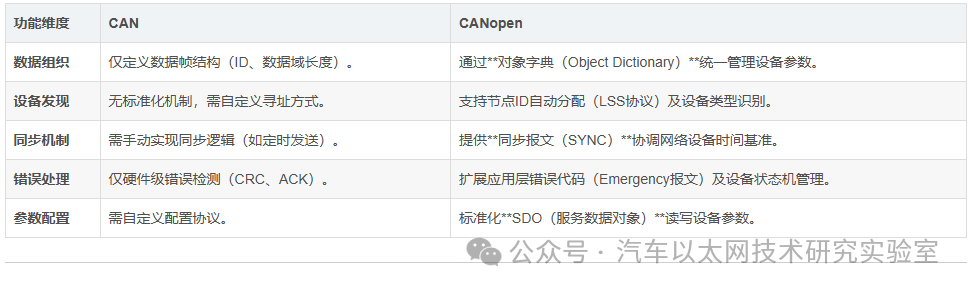
3. Core Functionality Comparison
4. Data Interaction Methods
CAN Communication
-
Free definition: Users must design the ID and data field meanings of the data frames themselves.
-
For example: A frame with ID=0x100, where data byte 0 represents temperature, and bytes 1-2 represent pressure.
-
High flexibility but poor compatibility: Different vendor devices need to agree on proprietary protocols to communicate.
CANopen
-
Standardized interaction:
-
PDO (Process Data Object): Real-time transmission of control data (such as speed, position), supporting event-triggered or periodic sending.
-
SDO (Service Data Object): Configuring device parameters (such as modifying motor acceleration), using a client-server model.
-
NMT (Network Management): Unified control of device states (start/stop/reset).
-
Unified interface through the object dictionary: All device parameters are defined in index-subindex form, for example:
-
Index 0x6040: Control word (start/stop command).
-
Index 0x6064: Actual position value.
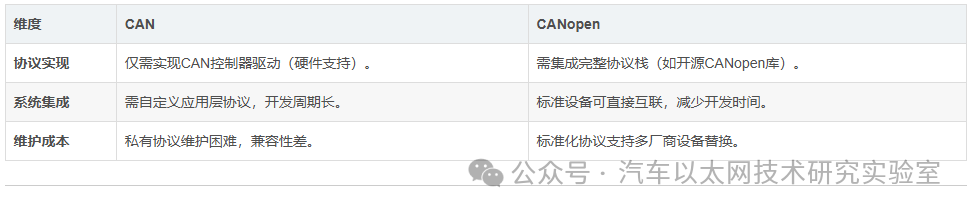
5. Development Complexity and Cost
6. Typical Application Examples
CAN in Automotive Electronics
-
Engine Control Unit (ECU): Sends throttle position via CAN frame (ID=0x200, data byte 0 is percentage).
-
Dashboard: Receives vehicle speed (ID=0x300, data bytes 0-1 are RPM values).
-
Disadvantage: Different vehicle models require redefining IDs and data formats.
CANopen in Industrial Robots
Servo Drives:
-
Periodically sends actual position via PDO (ID=0x201) (index 0x6064).
-
Receives PDO (ID=0x181) to set target position (index 0x607A).
PLC Master:
-
Uses SDO to configure drive parameters (such as index 0x6083 to set maximum speed).
-
Sends NMT command to start all slave devices.
7. How to Choose?
Choose CAN:
-
For simple systems, proprietary device communication, cost-sensitive projects.
-
For example: Connecting a single sensor to a controller.
Choose CANopen:
-
For integration of multi-vendor devices, complex control logic, and rapid development.
-
For example: A PLC controlling servo motors from multiple brands in an automated production line.
Summary
-
CAN is the “highway” of communication, defining how vehicles drive (electrical rules, data frame formats).
-
CANopen is the traffic rules, clarifying how vehicles interact (who goes first, how to yield, destination identification).
-
The combination of both allows CANopen to build a standardized application ecosystem on top of the physical/data link layer of CAN, significantly reducing the complexity of networking industrial devices.


*Disclaimer: This article is original or forwarded by the author. If it inadvertently infringes on someone’s intellectual property, please inform us for deletion.
The above images and text are sourced from the internet. If there is any infringement, please contact us promptly, and we will delete it within 24 hours.
The content of the article represents the author’s personal views. The Automotive Ethernet Technology Research Laboratory reprints it only to convey a different perspective and does not represent the laboratory’s endorsement or support of this view. If there are any objections, please contact the Automotive Ethernet Technology Research Laboratory.
Original link:
https://blog.csdn.net/K11mvp/article/details/145915001