3D printed metals are often limited by fatigue. A research team from the Chinese Academy of Sciences has overcome technical bottlenecks, achieving super fatigue resistance in titanium alloys under various stress environments, paving the way for high-end manufacturing.
Phosphorus is an essential element for life, but excess can lead to disease. Chinese scientists, in collaboration with an international team, have revealed for the first time how the key protein responsible for expelling excess phosphate from cells is precisely regulated, providing new insights into diseases such as brain calcification.
Based on the weekly technology memory formed by the daily rankings of the International Science and Technology Innovation Center’s network service platform, we present the “Weekly Technology Review” column. Today, we bring you the 158th issue.
1
Science Advances | New Micro-Pore Free Process Enhances Metal 3D Printing Durability
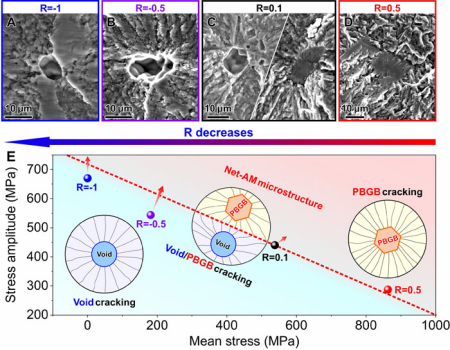
Net-AM organization of Ti-6Al-4V alloy under different stress ratios showing typical fatigue fracture surfaces and corresponding fatigue crack initiation mechanisms.
The team from the Institute of Metal Research, Chinese Academy of Sciences, has made a key breakthrough in addressing the poor fatigue performance of 3D printed metal components under complex service conditions. Traditional additive manufacturing suffers from defects such as micro-pores, leading to insufficient fatigue performance, especially under varying stress ratios (i.e., changes in load), where the fatigue cracking mechanisms are diverse and difficult to comprehensively resist damage, severely limiting its application in high-end fields such as aerospace.
Previously, the team developed the NAMP process, significantly enhancing the tensile fatigue performance of 3D printed Ti-6Al-4V titanium alloy, breaking world records. Building on this, they further focused on the variable stress ratio issues in practical conditions, systematically identifying three types of “shortcomings” and their sensitive ranges in titanium alloy fatigue cracking. The study found that the near micro-pore free “Net-AM” structure obtained through the NAMP process can synergistically optimize these three types of defects, thus exhibiting excellent fatigue resistance under different stress ratios.
Experiments show that the fatigue strength of Net-AM structured Ti-6Al-4V alloy exceeds all known titanium alloys across the entire stress ratio range, with fatigue strength (fatigue strength per unit density) superior to all metal materials. This not only overturns the traditional perception that “3D printed materials are not fatigue resistant” but also reveals the inherent advantages of additive manufacturing in complex structural load-bearing components, laying a solid foundation for the large-scale application of 3D printing technology in aerospace and other fields, while also providing new directions for optimizing the fatigue performance of traditional forged titanium alloys.
Original link:
https://www.science.org/doi/10.1126/sciadv.ady0937
2
Molecular Cell | Unveiling the Mechanism of Key Proteins Preventing Brain Calcification
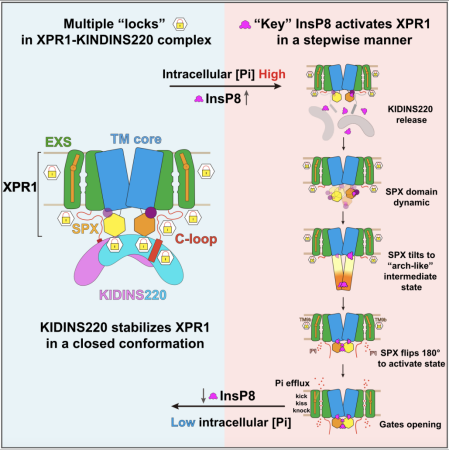
Model of KIDINS220 and InsP8 regulating XPR1 phosphate transport activity.
A research team led by Zhang Yixiao from the Shanghai Institute of Organic Chemistry, Chinese Academy of Sciences, in collaboration with Ben Corry from the Australian National University, Sun Yadong from ShanghaiTech University, and Stephen Shears from the National Institute of Environmental Health Sciences in the USA, has systematically revealed the regulation and transport mechanism of the only known phosphate export protein XPR1 in humans. XPR1 is crucial for maintaining intracellular phosphate balance, and its dysfunction is associated with various diseases, including primary basal ganglia calcification and tumors. Intracellular inositol pyrophosphate (InsP8) can activate XPR1, while the scaffolding protein KIDINS220 forms a complex with it to participate in regulation, but the specific mechanism has long been unclear.
This study elucidates for the first time the activation and phosphate export mechanism of XPR1 through cryo-electron microscopy structural analysis, functional experiments, and molecular dynamics simulations. The research proposes a “key-to-locks” model: InsP8 acts like a key, gradually relieving the multiple inhibitions imposed by the structures of KIDINS220 and XPR1 itself, leading to protein activation; it also proposes a “knock-kiss-kick” model, describing how phosphates are expelled through “collision—binding—kicking out” within the channel. The study also analyzes several XPR1 mutants associated with brain calcification, revealing their pathogenic mechanisms and discovering the evolutionary conservation and differences of XPR1 and its homologous proteins.
This achievement not only clarifies the core mechanism of phosphate homeostasis regulation at the molecular level but also provides a theoretical basis for understanding the pathogenesis of diseases such as brain calcification and tumors, potentially promoting the development of diagnostic and therapeutic strategies for related diseases.
Original link:
https://doi.org/10.1016/j.molcel.2025.08.003
3
IEEE T Wirel Commun | New Algorithm Makes 6G Networks Smarter in Spectrum Acquisition
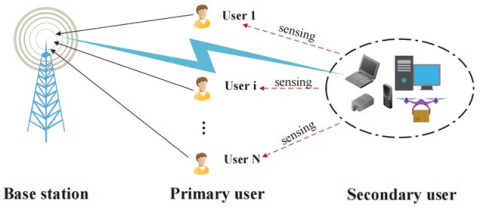
Spectrum sensing model for multi-user uplink transmission in IoT scenarios.
A research team from the Shanghai Advanced Research Institute, Chinese Academy of Sciences, in collaboration with Shanghai University, Beijing University of Science and Technology, and the University of British Columbia in Canada, has proposed a novel multi-track spectrum sensing method for 6G IoT, effectively addressing the challenge of efficient spectrum resource utilization in non-orthogonal multiple access (NOMA) systems. 6G will connect massive devices, but spectrum resources are limited. Traditional sensing technologies are prone to interference and misjudgment of spectrum idle states in scenarios where multiple users share frequency bands, making it difficult to meet high-precision management needs.
To address this, the research team innovatively introduced the concept of “track modeling,” abstracting each user’s signal transmission characteristics in power-frequency space into a “track,” enabling structured analysis of complex non-orthogonal signals. Based on this, a two-stage sensing framework is proposed: the first stage enhances user feature distinguishability through signal processing for preliminary track estimation; the second stage combines track coverage and channel state to accurately detect spectrum holes and adaptively adjust judgment thresholds, ensuring stable operation under varying user densities and interference environments. The team also derived an optimal sensing threshold formula suitable for multiple users, demonstrating good scalability.
Simulation results show that at a 5dB signal-to-noise ratio, the new method increases the system’s average throughput by 30%, maintains a false alarm rate below 10%, and remains efficient and robust even in dense user scenarios. This technology achieves a deep integration of spectrum sensing and non-orthogonal access, offering low complexity and high adaptability advantages, providing key technical support for resilient spectrum management and large-scale IoT access in 6G networks.
Original link:
https://ieeexplore.ieee.org/document/11026813
4
Advanced Materials | Combining Flexibility and Conductivity: Biomimetic Aerogels Solve Electromagnetic Shielding Challenges
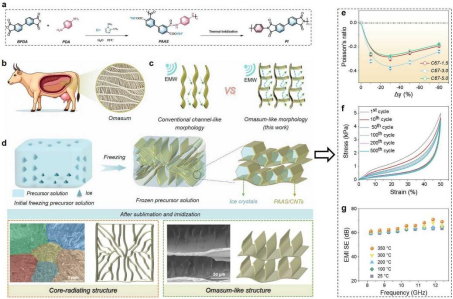
Structural design and performance of polyimide/carbon nanotube aerogels: (a) synthesis route of polyimide; (b) schematic of cow stomach microstructure; (c) comparison of conventional pore morphology of porous electromagnetic shielding materials and the proposed cow stomach-like morphology in this work; (d) preparation process of polyimide/CNT aerogels; (e) negative Poisson’s ratio of the aerogels; (f) cyclic compression performance of the aerogels; (g) high-temperature electromagnetic shielding performance of the aerogels.
A research team led by researcher Yan Jingling and associate researcher Chen Haiming from the Ningbo Institute of Materials Technology and Engineering, Chinese Academy of Sciences, has proposed a new multi-level morphology control strategy, successfully fabricating polyimide/carbon nanotube composite aerogels that exhibit high electromagnetic shielding performance, excellent mechanical properties, and high-temperature resistance. Traditional metal shielding materials face issues such as high density, corrosion susceptibility, and poor flexibility, while polymer-based porous composite materials, although lightweight and flexible, struggle to balance conductivity and porosity, along with poor mechanical performance.
The team based their work on a water dispersion of polyimide precursors and carbon nanotubes, combined with anisotropic freeze-drying technology to precisely control the material structure. The high content of carbon nanotubes not only enhances conductivity but also increases solution viscosity, suppressing ice crystal growth, resulting in a cow stomach-like micro-wrinkled structure during the freeze-drying process. The final material exhibits a biomimetic multi-level structure of “macro-center radiation + micro cow stomach wrinkles,” significantly enhancing structural stability. Experiments show that the aerogel maintains over 98.2% structural retention after 500 compressions and exhibits negative expansion behavior and good elasticity.
Simultaneously, carbon nanotubes are well-dispersed in the matrix, forming an effective conductive network, allowing the material to maintain excellent conductivity even at high porosity. The multi-level pore structure can reflect electromagnetic waves multiple times, greatly enhancing shielding effectiveness, achieving 71dB at room temperature, and even improving shielding performance at high temperatures of 350°C. This material combines lightweight, flexibility, high-temperature resistance, and strong shielding capabilities, making it suitable for harsh environments in aerospace and electronic devices, providing new ideas for the design of high-performance high-temperature aerogels.
Original link:
https://advanced.onlinelibrary.wiley.com/doi/10.1002/adma.202513423
5
Nature | First Confirmation! Mars Also Has a “Solid-State Heart”
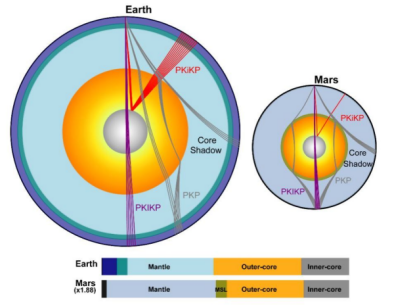
Comparison diagram of the deep structures of Earth and Mars.
A research team led by Sun Daoyuan and Mao Zhu from the University of Science and Technology of China, in collaboration with foreign scholars, has utilized seismic data from the InSight Mars lander to confirm for the first time the existence of a solid inner core with a radius of approximately 600 kilometers on Mars, revealing that its composition may be a nickel-iron alloy rich in light elements such as sulfur, oxygen, and carbon. This discovery marks the first confirmation of a solid inner core on a planet other than Earth, which is of milestone significance for understanding the evolution of terrestrial planets.
Studying the deep structure of planets is extremely challenging. Although the InSight lander has recorded thousands of marsquakes, the weak signals have limited research progress. To address this, the research team innovatively employed a marsquake array analysis method, systematically analyzing 23 high-quality seismic events, successfully identifying key seismic phases that traverse Mars’ core. They found that the core-mantle boundary reflection waves (PKKP) arrive 50 to 200 seconds earlier than predicted by models containing only a liquid core, indicating a layered structure in Mars’ core—an outer layer that is liquid and an inner layer that is a solid core with higher wave speeds. More importantly, the team captured the PKiKP seismic wave, regarded as a “solid inner core signature,” on Mars for the first time, providing direct evidence for their conclusion.
The study measured that Mars’ solid inner core occupies about 1/5 of its radius, a proportion similar to that of Earth. There is about a 30% wave speed jump and a 7% density difference between the outer core and inner core. Composition analysis shows that the inner core is not pure metal but contains 12%-16% sulfur, 6.7%-9.0% oxygen, and a small amount of carbon. The presence of these light elements helps explain the mystery of Mars’ early magnetic field activity and its current disappearance.
This achievement not only reveals a similar core-mantle structure between Mars and Earth but also provides methodological references for future seismic detection of celestial bodies such as the Moon, highlighting China’s international leading position in planetary science.
Original link:
https://www.nature.com/articles/s41586-025-09361-9
6
Science Advances | How Does Chromatin Line Up in the Cell Nucleus? New Tool for Precise Localization

Principle and basic process of the Radial-C method.
Researchers from the Beijing Institute of Genomics (National Center for Bioinformation), Chinese Academy of Sciences, have developed a new chromatin conformation capture technology called Radial-C, achieving precise localization of chromatin’s radial position (from the nuclear edge to the center) within the cell nucleus for the first time, overcoming the limitations of traditional Hi-C technology, which can only detect interaction frequencies between fragments without providing physical spatial information.
This technology utilizes the characteristic gradual diffusion of micrococcal nuclease within the cell nucleus over time, obtaining chromatin interaction data from different regions of the nucleus by precisely controlling digestion times (1, 5, 20 minutes), constructing a high-resolution interaction map along the radial axis. Researchers established a “radial score” system to locate the higher-order structure of chromatin in specific physical spaces. The results show that silent heterochromatin is enriched at the nuclear periphery, while active chromatin structures, such as chromatin loops and nuclear speckles, are concentrated internally, and the direction of compression of chromatin loops is related to their radial position.
The study also found that previously considered “forbidden zones” of inter-chromosomal interactions, when radially adjacent, exhibit the same active (A) and silent (B) compartmentalization characteristics as within chromosomes, indicating that A/B compartment separation is a conserved rule of chromatin organization. By interfering with transcription factor binding, the research further reveals that chromatin interactions themselves can influence their spatial localization—interaction weakening is often accompanied by the radial separation of two loci.
This achievement not only maps the first chromatin interaction map anchored to physical coordinates but also reveals new mechanisms by which multiple transcription factors collaboratively regulate chromatin spatial conformation, providing powerful tools and theoretical support for understanding gene regulation, disease occurrence, and the three-dimensional dynamic changes of gene groups during developmental processes.
Original link:
https://www.science.org/doi/10.1126/sciadv.adw8040

For more cutting-edge technology developments,
consider following
the International Science and Technology Innovation Center Network Service Platform
(www.ncsti.gov.cn)
Science and Technology Innovation Hot List
Scan the QR code
for quick access
to the International Science and Technology Innovation Center Network Service Platform

Supplementary Reading:
About the “Science and Technology Innovation Hot List – Cutting-Edge Technology”
The International Science and Technology Innovation Center Network Service Platform (www.ncsti.gov.cn) publishes research results from nearly 200 research institutions and units, including the Chinese Academy of Sciences, the Academy of Engineering, the Academy of Medical Sciences, the Academy of Agricultural Sciences, 985 universities, and new R&D institutions, dynamically extracting multi-source data and forming recommended lists based on various dimensions such as field, journal level, innovation carrier, scholar information, and time gradient, updated daily.
Previous Recommendations

Yin Li and Yin Yong investigate the transformation and development work in the new Shougang area, calling for the integration of industrial heritage with modern vitality to create a new landmark for the capital’s urban revival in the new era.
Bohr Knowledge Base Workshop is now open for registration! Hands-on guidance to build your exclusive AI knowledge base.
The State Council Information Office holds a press conference to introduce the first national science popularization month activities.
Industry and research synergy, creating the future! A meeting was held to connect major scientific and technological facilities platforms with industry users.