Companies can have their own technological routes, but it is important to ensure that consumers have the right to be informed. Companies need to clearly define the applicable scope of consumer-grade solutions versus automotive-grade standards, promote transparently, avoid concept substitution, and honestly explain the differences, allowing consumers to make informed choices. This is a basic respect for consumers.
The automotive industry seems to be caught in a strange cycle: whenever a new technology brings enticing cost advantages, there are always those willing to challenge existing rules.
Recently, the Xiaomi YU7 has sparked a huge controversy due to its smart cockpit featuring the Qualcomm Snapdragon 8 Gen 3 consumer-grade mobile chip. An executive from FAW Audi even stated, “Cars are not fast-moving consumer goods; Audi will never experiment with users.” This statement has brought a technical route dispute hidden deep in the supply chain into the public eye.
Xiaomi is not the first to use consumer-grade chips in automotive applications. Nearly a decade ago, Tesla boldly adopted non-automotive-grade chips in its vehicles, leading to large-scale recalls due to chip overheating issues.
Today, as competition intensifies in the automotive industry and the race for intelligence heats up, the debate over “consumer-grade” versus “automotive-grade” is not merely a simple technical selection issue, but a game concerning corporate strategy, cost control, and user experience.
What lies behind this is an irresistible temptation or a short-sighted choice?
Deep Logic Behind the Replacement of Automotive-Grade Chips with Consumer-Grade Chips
Putting a chip designed for mobile phones into a car sounds like a reckless gamble. However, for car manufacturers in fierce competition, this choice is backed by meticulously calculated business logic.
The “Dual Temptation” of Performance and Cost
The most direct driving force comes from the twin brothers of performance and cost. Today’s consumers have been spoiled by smartphones; they expect car systems to be as smooth, intelligent, and responsive as their phones. Consumer-grade chips are designed to meet this extreme experience. For example, the Snapdragon 8 Gen 3 used in the Xiaomi YU7 has CPU and GPU performance far exceeding that of contemporaneous automotive-grade chips, easily driving high-definition large screens, achieving complex 3D rendering, and enabling smooth multitasking, providing a “smartphone-level” cockpit experience.
Even more enticing is the cost. A top-tier consumer-grade SoC may have a procurement cost that is only half or even lower than that of a performance-comparable automotive-grade chip. In today’s fiercely competitive new energy market, when the manufacturing cost of a vehicle is pushed to the extreme, the savings can be directly converted into a more competitive selling price or invested in other features that consumers can perceive. For models with annual sales in the tens of thousands, this saved expenditure can amount to hundreds of millions.
The “Tesla Effect”: Breaking the Chains of a Century-Old Supply Chain
If cost and performance are the “techniques,” then challenging the traditional supply chain is the “principle.” The traditional automotive industry follows a pyramid-like, stable but extremely slow supply chain system. A single automotive-grade chip, from design and wafer fabrication to passing through lengthy certification, often takes years to install in a vehicle. This results in the “brain” of the car being several generations behind consumer electronics by the time it leaves the factory.
Tesla is the disruptor of this rule. It was the first to introduce the rapid iteration thinking of the consumer electronics industry into automotive manufacturing, from the early NVIDIA Tegra and Intel Atom to the later AMD Ryzen chips, Tesla has always armed its products with the latest “brains,” achieving the myth of “continuous hardware superiority” in automobiles. This approach not only brings an excellent cockpit experience but also grants Tesla stronger bargaining power and flexibility in the supply chain during chip shortages. While traditional automakers struggle due to the discontinuation of a small MCU, Tesla can navigate the crisis smoothly with its more flexible chip choices and strong software capabilities. This “dimensionality reduction attack” has opened up possibilities for all “agile-minded” automakers.
The Trojan Horse: Paving the Way for Self-Developed Chips
For cross-industry players like Xiaomi, which have a strong background in consumer electronics, adopting consumer-grade chips has even deeper strategic intentions. This is not just simple procurement; it resembles a carefully planned “Trojan Horse” strategy.
First, using the familiar Snapdragon platform allows Xiaomi’s software team to develop the car system in its area of expertise, maximizing the reuse of experience and ecosystem accumulated in mobile operating systems (MIUI/HyperOS), thus significantly shortening the development cycle. Secondly, this is also a rehearsal for integrating their own chips into vehicles. Xiaomi has announced plans for self-developed mobile chips, and if its self-developed consumer-grade chips can successfully replace Qualcomm chips in the future, costs will further decrease, completely eliminating dependence on external suppliers and achieving autonomous control over core technologies. This is an irresistible ultimate temptation for any company aspiring to gain a voice in the era of smart vehicles.
Is There a Problem with Using Consumer-Grade Chips in Vehicles?
However, behind this seemingly perfect choice lies significant risks that cannot be ignored. Commercially savvy calculations cannot mask the harsh laws of the physical world. Automotive-grade chips are expensive and iterate slowly precisely because they must meet nearly “obsessive” reliability and safety requirements in a completely different dimension, safeguarding the safety of drivers and passengers.
Comparing the usage scenarios of cars and phones reveals the stark differences in chip design. The AEC-Q100 automotive electronic component reliability testing standard has a typical requirement regarding the operating temperature of chips. The normal design operating temperature range for consumer-grade chips is 0°C to 70°C; exceeding this range can lead to a sharp decline in performance, lifespan, and reliability, while automotive-grade chip temperature requirements are -40°C to 125°C (Grade 1). Why do phones overheat and black out in summer?Replacing automotive chips with consumer-grade chips would struggle to pass the first hurdle of temperature.
Next, consider the lifespan. A smartphone typically has a lifecycle of 3-4 years, while a car’s design lifespan is at least 10-15 years, with mileage reaching hundreds of thousands of kilometers. This means that every electronic component in a vehicle must possess exceptional durability and stability.Consumer-grade chips prioritize rapid iteration, while automotive-grade chips focus on “long-term companionship”.
The most critical issue is the failure rate. The allowable defect rate (PPM value) for consumer-grade chips can be as high as 500, while automotive-grade chips commonly require <10 PPM, and safety-critical areas (ADAS, dashboards) typically demand ≤1 PPM. The difference is hundreds of times! A phone can be rebooted if it crashes; however, if a car traveling at high speed experiences a black screen on the central display due to chip overheating, showing driving gear, reversing images, or control commands, the consequences could be disastrous.This is not alarmism; information from the National Market Supervision Administration indicates that Tesla recalled over 100,000 Model 3 and Model Y vehicles in 2022 due to overheating issues with the AMD chip during fast charging, causing delays or restarts of the central screen.
In reality, consumer-grade chips have fundamental differences from automotive-grade chips from the very beginning of their design. Consumer-grade chips prioritize cost, with area, power consumption, and yield always being the first KPIs. When defects occur on a wafer, they often use software algorithms to mask them rather than implementing redundancy at the hardware level. Therefore, the most fundamental differences between consumer-grade and automotive-grade chips occur during the design process, and later attempts to compensate with heat sinks or system-level testing cannot bridge the gap.
Xiaomi’s “Clever Idea”: Is System-Level Certification a Shortcut or a Side Door?
In the face of these high walls, Xiaomi proposed a “curve-saving” solution. They did not claim that the Snapdragon 8 Gen 3 chip itself passed the AEC-Q100 test, but emphasized that the “cockpit core board” equipped with this chip passed the AEC-Q104 test.
AEC-Q104 is a testing standard for multi-chip modules (MCMs). In simple terms, Xiaomi integrated consumer-grade chips, memory, power management, and other components onto a single circuit board, adding liquid cooling, electromagnetic shielding, and other enhancements to this “module,” and then sent the entire module for reliability testing. This is a clever system-level solution aimed at compensating for the shortcomings of individual consumer-grade components.
However, this approach has also drawn industry skepticism.
First, AEC-Q104 does not have any so-called “official certification,” nor is there any organization operated by AEC that issues certificates for multi-chip modules (MCMs).
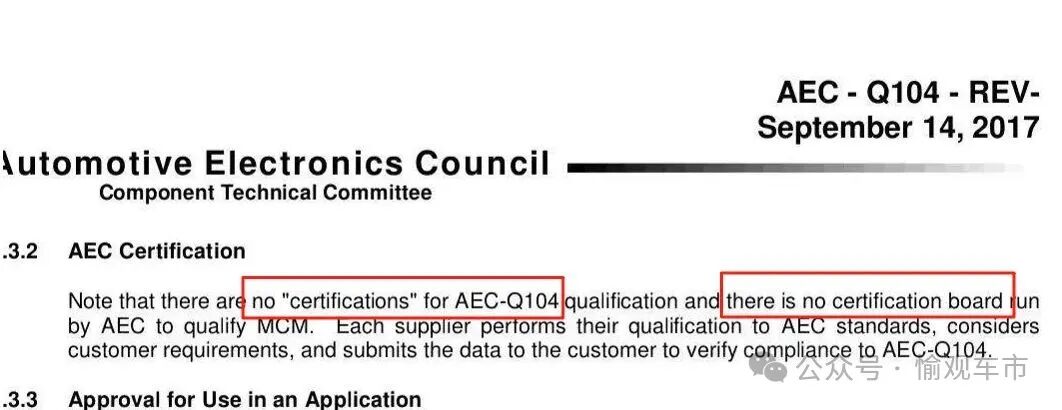 Thus, Xiaomi’s automotive division only states that it has passed testing, rather than having obtained certification.This point is still quite rigorous. No certification body can issue such a vehicle-grade certification to Xiaomi’s automotive division.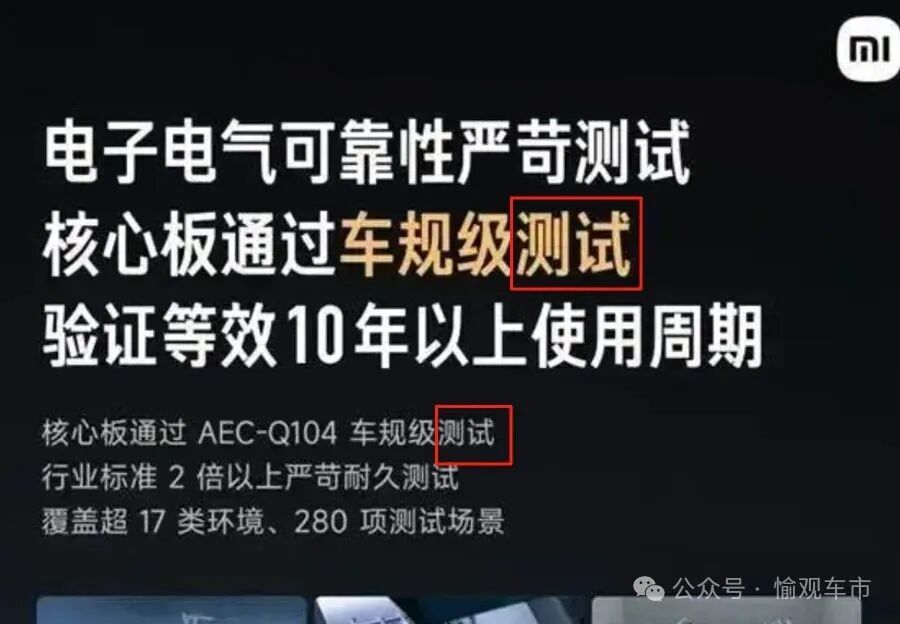
Secondly, according to AEC-Q104 testing requirements, if any non-automotive-grade components are used in the entire module, the reliability testing must increase from 7 items to 49 items, essentially repeating all the AEC-Q100 testing items for individual components.
Xiaomi’s automotive division has not publicly stated whether it has completed these 49 tests or only a portion of them. The external promotional materials repeatedly emphasize that many tests have been conducted and that the requirements are stringent. However, the specific testing content and results have yet to be disclosed.
The Blurred Boundaries: Where is the “Safety Zone” for Consumer-Grade Chips?
This debate actually reflects the understanding and attitude of automotive manufacturers towards safety concepts. Should every component adhere to the principle of absolute reliability, or should we embrace a “system safety” concept centered on system redundancy and software definition?
Not all chips in a vehicle are critical to life. A common consensus is that in non-safety-critical areas, such as pure audio-visual entertainment systems, using reinforced consumer-grade chips carries relatively controllable risks. For example, cockpit systems can be divided into dashboards using automotive-grade chips and entertainment screens that may use consumer-grade chips.
However, the danger lies in the fact that as the electrical and electronic architecture of vehicles evolves from distributed to centralized systems, the boundaries of functionality are becoming increasingly blurred. In the smart cockpit of 2025, the central display will not only serve as a navigation and music player but will also integrate reversing images, air conditioning control, driving mode selection, and even gear display. When these functions, closely related to driving safety, rely on a screen driven by a consumer-grade chip, the reliability of that chip is directly linked to driving safety.
Returning to the initial question, the choice of consumer-grade chips by automakers under intense competition is a carefully calculated business decision, trading perceivable short-term experience and cost advantages against a long-term reliability risk with potentially severe consequences.
For consumers, they enjoy a smoother, smarter vehicle at the initial delivery stage, which may also be more affordable. However, at the same time, they may unknowingly bear potential risks regarding long-term reliability and safety in extreme situations that should not be their responsibility.
Yuguan Automotive Market believes: Not all consumer-grade technologies should be kept out of the automotive door, nor should all automotive standards become shackles to innovation. What companies need is to draw a clearer line between “user experience” and “life safety”—which functions can embrace flexible consumer-grade solutions and which core systems must adhere to automotive-grade standards.
In the product promotion process, responsible automakers should clearly communicate to consumers, transparently introduce, avoid generalizations, and not substitute concepts. Consumer-grade chips should be clearly labeled, and system-level testing should explain the scope and differences from automotive-grade chips. They must not use “passing certain tests” to replace the concept of “meeting automotive-grade standards,” nor can they cover up long-term reliability questions with “smooth experience.” Allowing consumers to choose with full knowledge is the most basic respect for them.