

Recently, the team led by Academician Zhang Weihong from the Key Laboratory of Aerospace Structure Technology at Northwestern Polytechnical University collaborated with Academician Lui Kin from City University of Hong Kong and Professor Wang Zuankai from the Hong Kong Polytechnic University to achieve new advancements in the field of soft robotics. They successfully developed a multi-functional robot based on a novel electroactive polymer, which is expected to meet the application needs in complex structures and extremely cold environments. This research was published online in the internationally renowned journal Advanced Science under the title “Vinyl Acetate-Enhanced Polyvinyl Chloride Gel with High Electroadhesion and Self-Heating-Tunability for Soft Robots in Freezing Environments.”
Electroactive polymers are a class of smart materials that can undergo significant deformation under an electric field, widely used in cutting-edge fields such as artificial muscles and soft robots. As application scenarios continue to expand, the integration capability of robots has higher demands. Traditional electroactive polymers often only possess electroactive deformation functions, making it difficult to meet environmental adaptability and system integration requirements. Therefore, developing smart materials with multi-modal response behaviors and achieving functional integration is a pressing issue in current soft robotics research.
In this study, the team developed a novel polyvinyl chloride-based electroactive polymer with low voltage drive, high electro-adhesion, and controllable self-heating. By introducing vinyl acetate into the polyvinyl chloride gel, they effectively suppressed the heating and electrical breakdown issues caused by plasticizer migration, while significantly enhancing the dielectric and mechanical properties of the material. Compared to existing materials, the new material’s heat generation is reduced by over 50%, its lifespan is extended by more than 15 times, the output force is increased by 1.75 times, and the electro-adhesion force is improved by 2.15 times, achieving a strong adhesion force of 30 kPa under a low electric field of 2 V/μm, far superior to traditional electrostatic adhesion structures. Additionally, the study proposed various voltage control strategies to achieve on-demand self-heating or further heating suppression of the material.
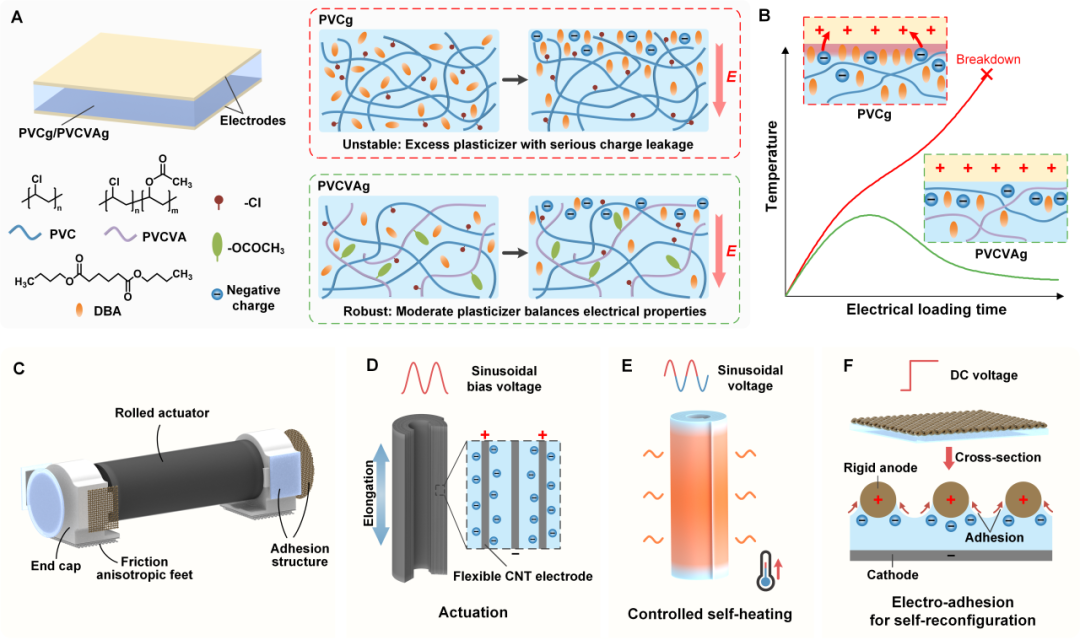
Material design and schematic of the multi-functional soft robot.
Based on this, the research team developed a micro soft robot capable of rapid crawling, self-heating in low-temperature environments, modular assembly, and collaborative operation. The robot has a compact structure and a quick response, capable of being driven at a low voltage of only 72.5V, significantly lower than existing similar systems. Through the integrated electro-adhesion structure, the robot swarm can achieve rapid connection and detachment at the millimeter scale, completing autonomous reconfiguration in confined spaces, demonstrating excellent collective cooperation capabilities.
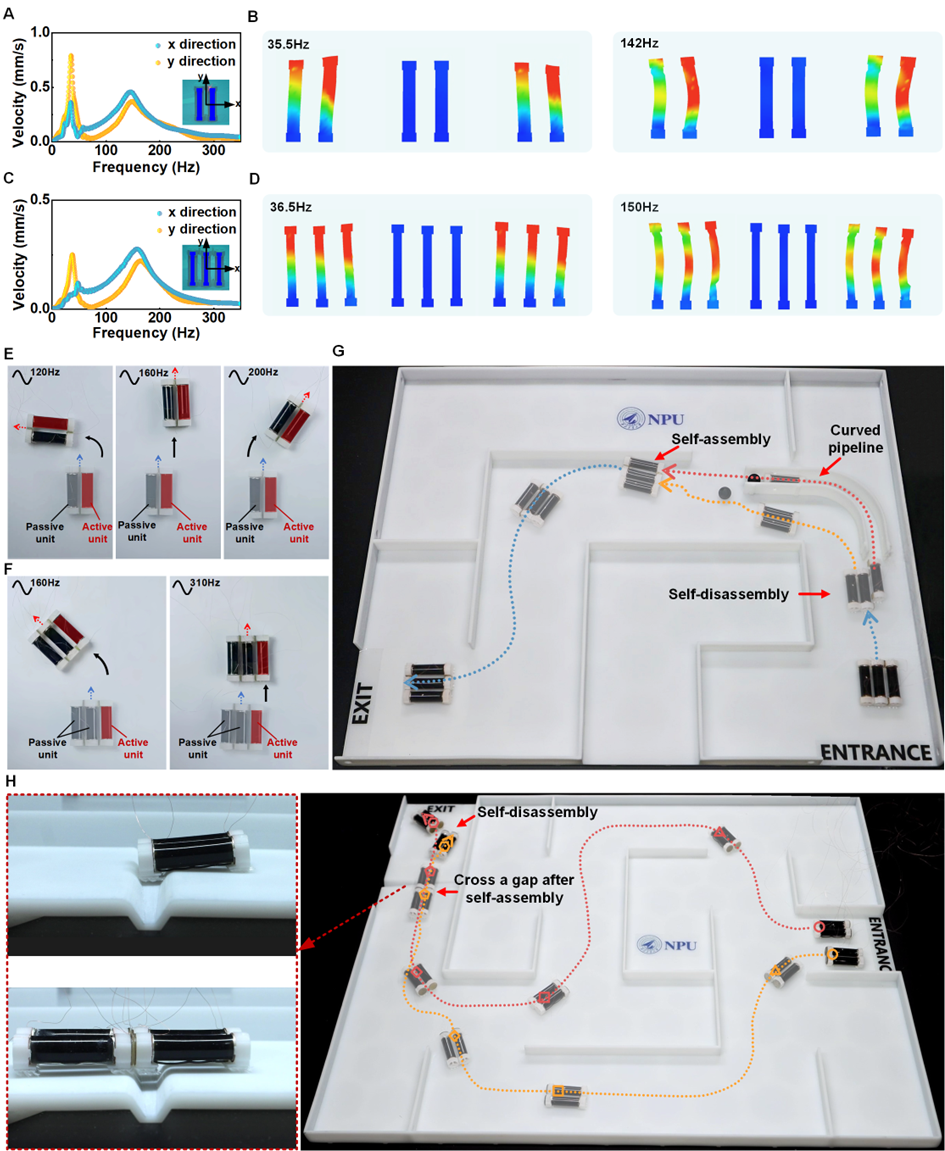
The movement and self-reconfiguration of the swarm robots. (A-F) The dynamic response and movement of the swarm robots; (G-H) Self-reconfiguration of the robots in complex spaces.
In extreme cold environment tests, the robot can perform autonomous heating, inspection, and ice melting tasks in an environment of -50°C. It shows significant advantages in application scenarios such as aircraft engine blade inspection, gap detection, and operations in cold regions. The related results provide new ideas for the development of small intelligent robotic systems in extreme environments and demonstrate the broad application prospects of such materials in electronic devices, bionic systems, and intelligent manufacturing.
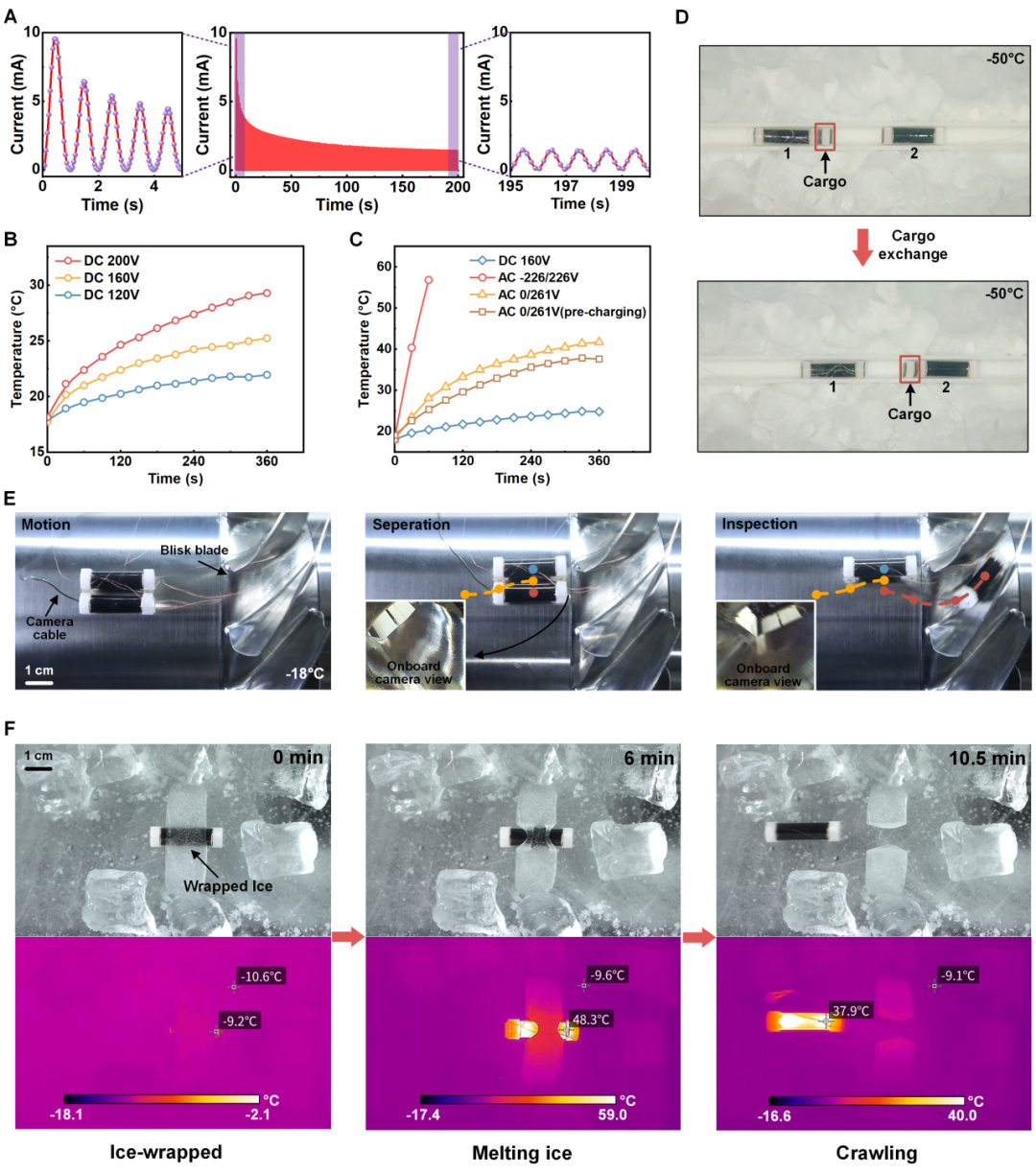
Controllable heating and movement of the robot in freezing environments. (A-C) The controllable heating performance of the robot; (D-F) The robot performing different tasks in cold freezing conditions.
Professor Zhang Junshi, Associate Professor Liu Lei, Professor Zhu Jihong from Northwestern Polytechnical University, and Academician Lui Kin from City University of Hong Kong are the corresponding authors of this paper, with doctoral student Wei Chang from Northwestern Polytechnical University as the first author. This research work was supported by the National Key Research and Development Program, the National Natural Science Foundation, and the Basic Scientific Research Business Fee of Central Universities.
Full text link:
https://advanced.onlinelibrary.wiley.com/doi/10.1002/advs.202507757

★
Previous Highlights
★

Collective appearance! Outstanding mentors of Northwestern Polytechnical University for 2025 graduate students!

Focus! Over 500 experts and scholars from more than 30 countries gathered at Northwestern Polytechnical University!
Deep-sea fish results published in Cell! He is Northwestern Polytechnical University doctoral student Xu Wenjie!
Produced by | Party Committee Propaganda Department
Source | School of Mechanical and Electrical Engineering
Text | Zhang Junshi
Editor | Wang Qing
Proofreader | Fu Yi
Review | Luo Ming, Ma Xiping


Like
Recommend
Share