Introduction
High-Performance Resin Laboratory

Paper Information
In 2025, the journal Composites Communications published a paper on a high glass transition temperature (Tg) 3D printed continuous carbon fiber reinforced polymer composite, titled 3D printing of continuous carbon fibre reinforced high-temperature epoxy composites.

Background Significance
Using high-viscosity thermoplastic matrices for 3D printing samples often results in internal voids and makes it difficult to achieve high fiber volume fractions. In contrast, continuous carbon fiber reinforced epoxy resins have lower viscosity, allowing for excellent fiber impregnation, and typically exhibit better wettability and stronger interfacial adhesion. However, the solid epoxy resins studied previously by researchers were sourced from commercial suppliers and exhibited relatively low Tg, around 127.84°C, which does not meet the requirements for aerospace applications, which typically require Tg above 200°C. Therefore, this study aims to develop a Tg above 200°C, exceeding current high-end thermoplastics (including PEEK and PPS), for high-temperature applications of 3D printed continuous carbon fiber reinforced polymer composites.

Content Summary
Materials: Continuous carbon fiber tows (3K); solid epoxy resin formulated in the laboratory.
As shown in Figure 1a, the DSC heating curve of the solid epoxy powder mixture shows that the first heating curve has an endothermic peak at 51.43°C. As the temperature increases, the curing process begins at 190°C, with an exothermic peak at 231.08°C. The curing exothermic value of this solid epoxy system (240 J/g) is lower than that of standard liquid epoxy systems (500 J/g), reducing the risk of thermal runaway in the composite materials. Figure 1b shows that a glass transition peak is observed at 263.73°C, and no thermal degradation occurs below 300°C, confirming the excellent thermal stability of the epoxy resin system. Figure 3c indicates that Tg is very high, at 279.24°C.
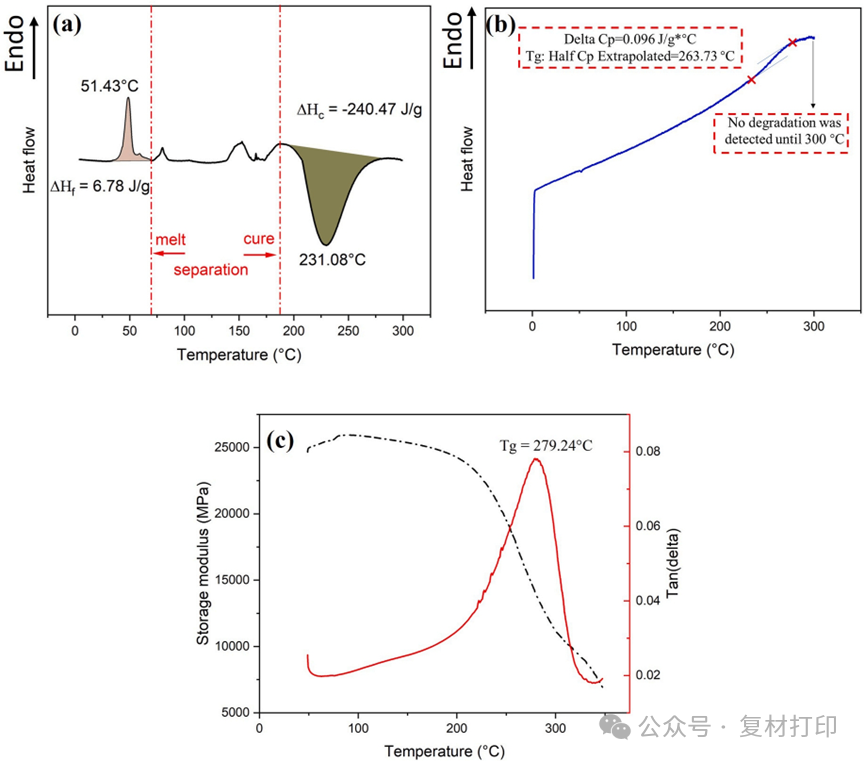
Figure 1. (a) First heating curve in the DSC characterization of the epoxy resin system and (b) Second heating curve;(c) DMA of the cured CCF/epoxy composite
Figure 2 shows the mechanical properties of the printed unidirectional CCF/epoxy composite samples. Figures 2a and b show that the longitudinal tensile strength reaches 1006 MPa, comparable to titanium alloys. This value is lower than the tensile strength of composites in previous studies, attributed to the higher viscosity of the epoxy resin and lower-grade carbon fibers used in this study. This resin was chosen for its superior high-temperature resistance, but its higher viscosity resulted in poorer fiber impregnation, leading to a slight reduction in mechanical strength. The results indicate that the average flexural strength and flexural modulus are 431.8 MPa and 30.9 GPa. Figure 4d shows that its performance surpasses many existing materials, including short carbon fiber and continuous carbon fiber reinforced thermoplastic composites. Although traditional composites exhibit higher mechanical performance, the 3D printed continuous carbon fiber reinforced thermosetting system has made progress in thermal performance.
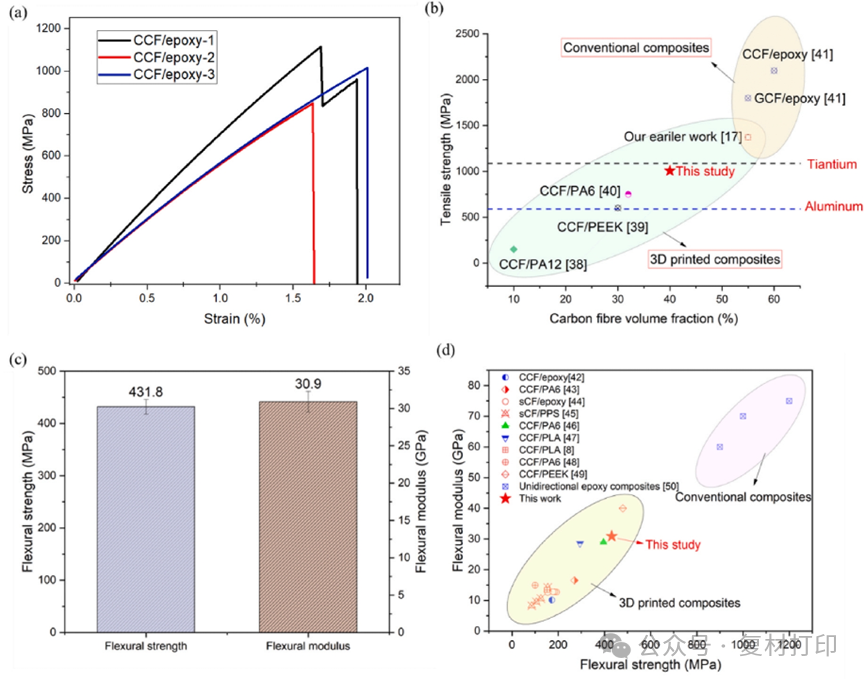
Figure 2. (a) Tensile stress-strain curve; (b) Tensile performance compared to previous literature; (c) Flexural strength and modulus of unidirectional CCF/epoxy composite; (d) Flexural performance compared to previous literature
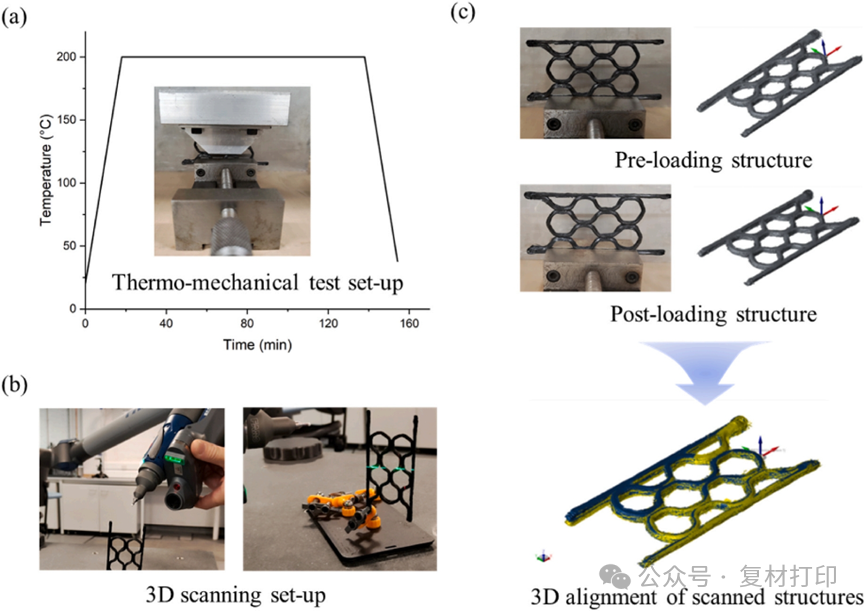
As shown in Figure 3, to explore the potential applications of high-performance CCF/epoxy materials in this study, a printed honeycomb structure demonstration case was designed. Their structures were aligned, showing excellent consistency, with no significant deviations observed. These results confirm that under isothermal loading conditions, the honeycomb structure did not undergo significant deformation. The post-cured composites made from this novel epoxy powder exhibited outstanding thermal stability at high temperatures.

Main Results
This work studied a novel epoxy powder system for continuous carbon fiber reinforced thermosetting composites for 3D printing. The conclusions are as follows:
(1) The post-cured parts exhibit a high glass transition temperature of about 280 °C, with no thermal degradation detected below 300 °C.
(2) The flexural strength of the printed composites is 431.8 MPa, and the flexural modulus is 30.9 GPa, comparable to other 3D printed composites.
(3) The honeycomb structure was successfully printed, and it was tested under isothermal loading at 200 °C, showing no significant deformation, confirming its excellent heat resistance.
Source: Composite Printing, Edited by Mai Aide
Editor: Yoyo | Reviewer: Kevin

Disclaimer

The articles originally published by this WeChat public account only represent the views of the public account, for communication and sharing purposes, and do not bear any responsibility: The copyright of the articles reprinted by this WeChat public account belongs to the original author, and the copyright of the original author is respected: If there are any citations of other data, images, and videos, they have been noted. If there are any doubts about copyright infringement or the authenticity and accuracy of the content, please contact us: 176-0218-3601, and we will handle it.