In previous installments of the “Gene Chip Sample Submission Secrets Column,” we introduced the submission requirements for blood samples (click to read the “Gene Chip Sample Submission Secrets Column | The ‘Magical Drift’ of Blood Samples”), focusing on whole blood. So, can the components separated from whole blood be submitted? For PBMCs separated by ficoll or leukocytes obtained from hemolysis, the submission requirements for cell samples can be referenced (click to read the “Gene Chip Sample Submission Secrets Column | The ‘Time-Space Journey’ of Cell Precipitates”). However, the situation with serum and plasma components (cfDNA, ctDNA) is slightly more complex, and in this issue, we will discuss it in detail.
01
Precautions
DNA in serum/plasma samples exists in a free state (cell-free DNA, cfDNA), and samples from cancer patients also contain circulating DNA (circulating tumor DNA, ctDNA) derived from tumors. Due to its unique molecular characteristics, special attention must be paid to sample characteristics, chip design compatibility, and chip product selection during genetic testing to ensure accuracy and reliability of the results.
(1) Sample Characteristics: The amount of DNA in serum and plasma samples is low and fragmented, posing a high risk for the samples.
① The amount is low, which may be insufficient for normal experimental input (click to read the “Gene Chip Sample Submission Secrets Column | Excellent DNA Looks Like This!”); ② Fragmentation, especially after the bisulfite treatment in methylation detection processes, results in shorter fragments, which may affect probe binding. These two aspects increase the risk from an experimental perspective and affect detection efficacy.
(2) Chip Design Compatibility:
cfDNA in serum and plasma may not completely cover all regions of the genome, meaning that some of the loci designed for detection on the chip may not exist in the sample DNA at all, making detection impossible. This leads to a lower QC index for chip results compared to normal cell groups, which is a very normal phenomenon. Therefore, one should not expect the call rate results of serum and plasma samples to match those of conventional samples.
(3) Chip Product Selection:
① SNP Genotyping Chips:
Note that it is not recommended to use serum or plasma SNP genotyping chips for detection. The principle of SNP genotyping chips is to detect genetic mutations (germline mutations), which are not suitable for detecting somatic mutations (tumor or ctDNA) with variant frequencies that may not be close to 0 (homozygous), 50% (heterozygous), or 100% (homozygous). Since genetic mutations do not necessarily require the high-risk serum or plasma, it is advisable to use whole blood or blood cells unless absolutely necessary.
② Methylation Chips
In recent years, DNA methylation profiling has made significant progress in cancer research (article collection | High-quality articles to help you understand the latest research progress in DNA methylation). However, due to the sample characteristics and chip design compatibility, serum and plasma samples may exhibit the aforementioned low call rate phenomenon during detection, and results expectations should be adjusted according to experimental purposes.
02
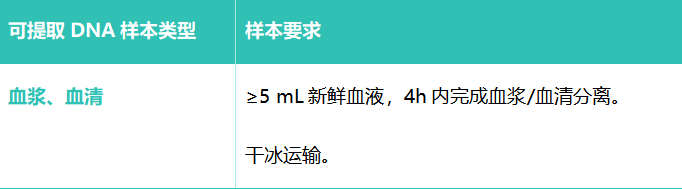
Sample Volume
03
Sample Processing
(1) Plasma: Use an EDTA anticoagulant tube to collect ≥5mL of fresh blood, gently invert 5-8 times after removing the needle to mix thoroughly and avoid clotting. Within 2 hours of blood collection, centrifuge the peripheral blood sample in the collection tube at 1600g for 10 minutes at 4°C. After centrifugation, transfer the supernatant plasma to a new centrifuge tube, taking care not to aspirate the middle white membrane layer (Buffy Coat, containing nucleated cells); then centrifuge the transferred plasma at 16000g for 10 minutes at 4°C to remove residual cells, transferring the supernatant to a new centrifuge tube, ensuring not to aspirate the cells at the bottom of the tube. Plasma separation must be completed within 4 hours.
(2) Serum: Blood is collected in a centrifuge tube and allowed to stand at 37°C (or room temperature) for 1 hour to allow clotting. Then centrifuge at 3000rpm at room temperature for 10 minutes, transferring the supernatant to a clean centrifuge tube. Next, centrifuge at 12000rpm at 4°C for 10 minutes, transferring the supernatant into 1.5ml centrifuge tubes, with 0.2mL per tube, and store at -80 degrees. Ensure sufficient dry ice for shipping.
04
Storage and Transportation
Store the separated plasma or serum at -80°C, ensuring shockproof and secure packaging for dry ice transportation.
05
Interesting Knowledge Point: Characteristics of ctDNA
Short-lived: ctDNA has a half-life of only 16 minutes to 2.5 hours in the blood, and can easily be degraded by nucleases or cleared by the kidneys. Therefore, samples must be processed quickly after blood collection, or the “evidence” will disappear.
Short: The average length of ctDNA is about 130-150 bp, which is shorter than other normal cfDNA.
Interactive Egg: Which of the following statements about ctDNA is false?

A. Fetal DNA in the blood of pregnant women also belongs to cfDNAB. A ctDNA strand may be 100,000 times thinner than a hairC. Healthy individuals have absolutely no ctDNA in their blood
Next Issue Preview
We have introduced the requirements for various samples. Finally, we will provide detailed recommendations for sample packaging solutions. Stay tuned for the “Gene Chip Sample Submission Secrets Column | (Tertiary Packaging)”. See you next time!
01
Previous Issues Review