
With the rapid development of AI and big data applications, the demand for computing power in data centers is gradually increasing, especially the power consumption (TDP) of high-performance computing devices such as GPUs is rising at an astonishing rate. Traditional air cooling systems are increasingly unable to meet this demand, leading to the emergence of liquid cooling technology as the mainstream choice for thermal management in data centers. From single-phase liquid cooling to two-phase liquid cooling, and then to immersion cooling, the evolution of liquid cooling technology not only enhances cooling efficiency but also brings numerous technical and commercial challenges.

(Trends in data center liquid cooling: left is rack-level cooling; right is room and facility-level cooling)
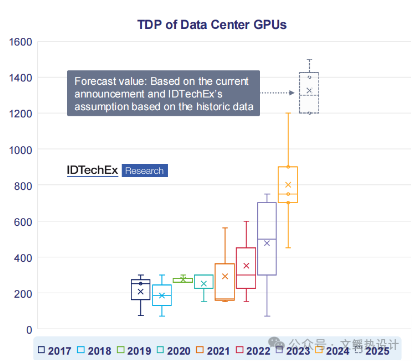
Trend of GPU TDP
Thermal Management Challenges: As CPU TDPs increase, advanced cooling solutions (such as liquid cooling) become crucial to prevent overheating and maintain system efficiency.
Two-Phase Cooling Roadmap: A TDP between 1500 watts and 2000 watts may mark the threshold where single-phase direct-to-chip (D2C) cooling is no longer sufficient, leading to the rise of two-phase cooling.
Impact on Data Centers: Effective heat dissipation is critical for GPU performance and longevity, and higher TDP complicates energy cost management, making thermal management a key focus in data center design. Due to the more complex internal structure of packaging, silicon has lower tolerance for high junction temperatures, thus requiring better cooling.
Development of Liquid Cooling Technology: Transition from Single-Phase to Two-Phase
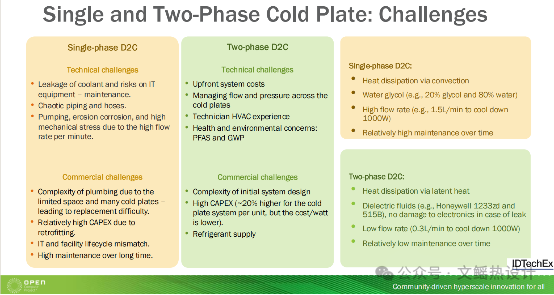
Single-Phase Liquid Cooling: Traditional Cooling Solution
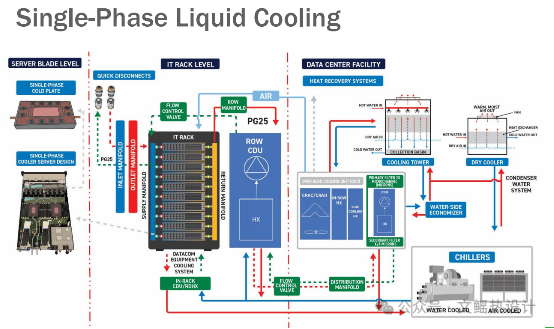
(Single-phase liquid cooling diagram))
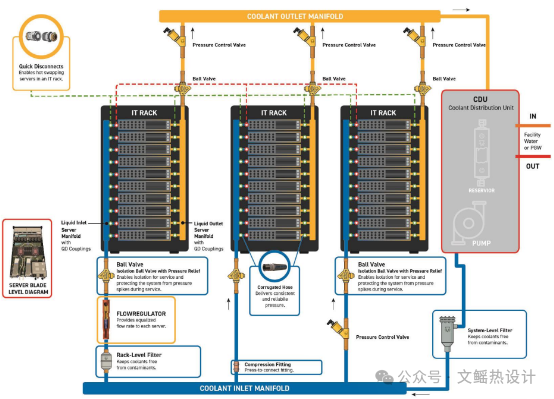
(Data center cooling pipeline diagram – Single-phase direct-to-chip liquid cooling)
Single-Phase Liquid Cooling (Single-Phase Direct-to-Chip Cooling,D2C) is currently one of the most commonly used liquid cooling technologies. It utilizes water or a water-glycol mixture to transfer heat through a cold plate, relying on convection to dissipate heat, making it simple and efficient. For devices with lower power consumption, single-phase liquid cooling has been sufficient, but asGPU and other hardware power consumption rapidly increases, single-phase liquid cooling is gradually becoming inadequate.
Technical Challenges:
The risk of coolant leakage: If a leak occurs in a liquid cooling system, it can cause direct damage to the equipment and even lead to failure. This poses a continuous challenge for maintenance.
Complexity of the system: The liquid needs to flow through the cooling system at extremely high speeds, which requires pumps with stronger performance, and the pipeline design must minimize pressure loss and mechanical stress as much as possible.
Commercial Challenges:
High retrofit costs: Integrating a liquid cooling system into existing infrastructure requires complex modifications to the data center, which can be costly.
High frequency of maintenance requirements: Liquid cooling systems require regular checks over time, especially for coolant replacement and pipeline maintenance, which increases long-term operational expenses.
(Liquid Cooling Summit)
Two-Phase Liquid Cooling: A More Efficient Cooling Method
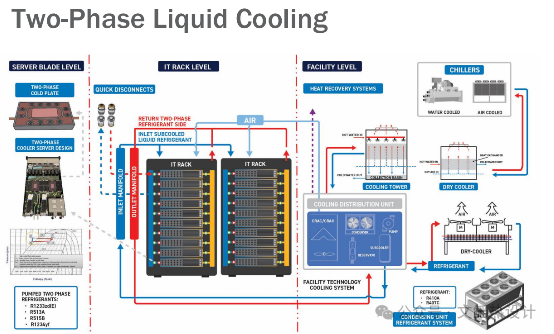
(Two-phase liquid cooling diagram)
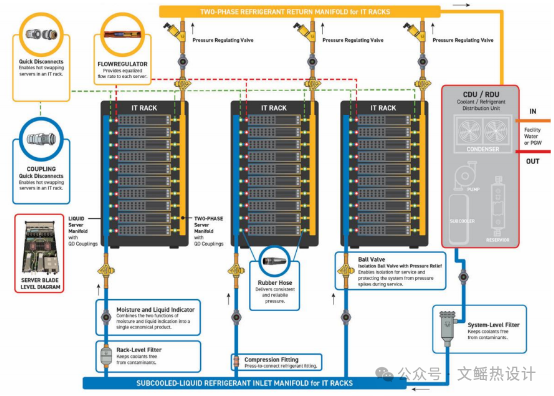
(Data center cooling pipeline diagram – Two-phase direct-to-chip liquid cooling) When the TDP of a GPU approaches 2000W, single-phase liquid cooling can no longer effectively dissipate heat. At this point, two-phase liquid cooling (Two-Phase Direct-to-Chip Cooling) technology becomes a significant breakthrough for data centers. Two-phase liquid cooling dissipates heat through the phase change of the liquid (from liquid to gas and back to liquid), achieving higher efficiency and significantly reducing flow rate requirements.
Technical Challenges:
Higher initial investment: The design of two-phase liquid cooling systems is more complex, with higher technical requirements for cold plates and fluid management, resulting in initial investment costs about20% higher than single-phase liquid cooling.
Increased difficulty in system management: Managing the flow and pressure of the coolant requires specializedHVAC technicians, and due to the phase change of the liquid at different temperatures, the system must ensure stable temperature control and pressure regulation.
Commercial Challenges:
High capital expenditure: Although the cooling cost per watt is lower, the high initial capital expenditure remains one of the biggest challenges for two-phase liquid cooling.
Coolant supply: Specific two-phase liquid cooling coolants, such as Honeywell 1233zd and 515B, do not damage electronic equipment when leaked.
Immersion Cooling: A New Thermal Management Model
In addition to direct-to-chip liquid cooling technology, immersion cooling (Immersion Cooling) technology is also gradually being applied in data centers. This technology immerses equipment directly in coolant, allowing for heat exchange through direct contact with the component surfaces, greatly improving cooling efficiency.
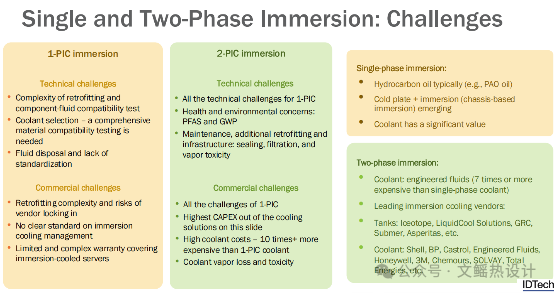
Single-Phase Immersion Liquid Cooling (1-PIC):
Technical Challenges: Strict component fluid compatibility testing is required to ensure that the coolant does not react adversely with the hardware. When retrofitting existing equipment, hardware compatibility must also be assessed.
Commercial Challenges: The complexity of retrofitting is high, and due to the lack of standardized management systems, companies may face the risk of vendor lock-in.
Two-Phase Immersion Liquid Cooling (2-PIC):
Coolants: Coolants: Shell, BP, Castrol, Engineered Fluids, Honeywell, 3M, Chemours, Solvay, TotalEnergies, etc.
Technical Challenges: The coolant used in two-phase immersion liquid cooling is more than7 times more expensive than single-phase liquid cooling, and it also needs to address issues of coolant evaporation and potential toxicity.
Commercial Challenges: Although the cooling efficiency is high, the high cost of the coolant and the complexity of the system remain major obstacles for companies adopting this technology.
Commercialization Trends of Liquid Cooling Technology: The Market is Expanding
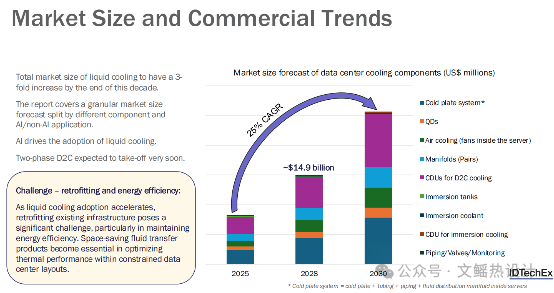
With the growth of AI and high-performance computing demands, the market prospects for liquid cooling technology are promising. It is expected that by 2030, the market for liquid cooling components will triple, especially driven by AI workloads and the retrofitting of existing infrastructure, making liquid cooling technology more widespread. Despite facing high costs and complex management challenges in the short term, as technology matures and the market expands, the cost-effectiveness of liquid cooling systems will gradually improve.
Liquid cooling technology is rapidly evolving from single-phase to two-phase, from direct-to-chip to immersion cooling. In the future, as GPU TDP continues to rise, two-phase liquid cooling and immersion cooling will become mainstream. Initial high costs, complex system management, and unstable coolant supply remain the main obstacles faced by liquid cooling technology.
Market Trends: With the increase in AI computing demands, the market demand for liquid cooling technology will continue to grow, and the liquid cooling components market is expected to experience rapid development in the coming years.
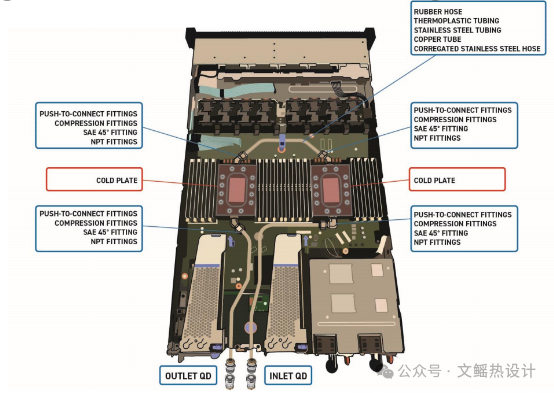
(Single-phase server (blade) diagram))
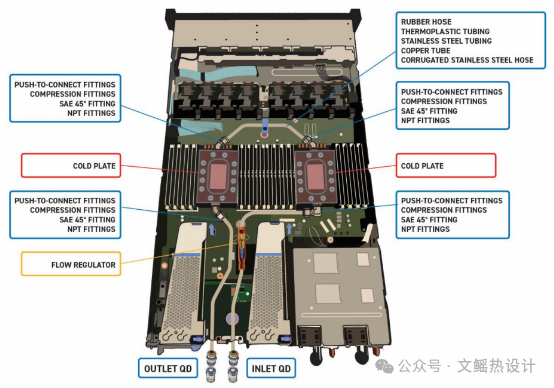
(Two-phase server (blade) diagram))
Liquid cooling technology is not only key to enhancing thermal management efficiency in data centers but also one of the trends in future data center design. As technology continues to develop, liquid cooling will become an important infrastructure supporting large-scale data centers and AI computing loads.
For more industry news, please follow the “Wenyao Thermal Design” public account
Copyright Statement: We respect originality and are happy to share. If there are any copyright issues, please contact 18702120901 for processing, thank you!