CHAIN NEWS
Click the image to read the full article
Introduction
Recently, Professor Huang Yong’an from Huazhong University of Science and Technology and Zhou Yunlei from Xi’an University of Electronic Science and Technology published an article titled “Flexible Sensor-Driven Smart Vehicles: Opportunities and Prospects” in Chain, summarizing the applications of flexible sensors in smart cockpit interaction, chassis obstacle detection, and vehicle health diagnostics, while briefly discussing the challenges and future of flexible sensors in intelligent driving.
Research Background
Visual Summary
Summary and Outlook
01.
Research Background
In the rapidly developing era of flexible electronics, flexible sensors have never received as much attention as they do now. The inherent flexibility of flexible sensors allows them to easily adapt to curved or soft surfaces while simultaneously detecting various external stimuli. In the field of intelligent driving, they utilize novel conductive materials, including conductive polymers, carbon-based nanomaterials, and liquid metals, to construct multifunctional flexible sensor networks, achieving seamless integration with the curved surfaces of vehicles and comprehensive state monitoring. Their advantages lie in dynamic deformation adaptability through flexible materials and manufacturing, enhanced system redundancy/robustness/real-time performance through sensor network deployment, and improved perception accuracy through multimodal fusion. Therefore, flexible sensors show great potential in smart cockpit interaction, chassis obstacle detection, and vehicle health diagnostics. However, large-scale commercialization still faces challenges in automotive-grade integration, weather resistance, data security, and power supply. In the future, flexible sensors are expected to combine with artificial intelligence models, lightweight architectures, and self-healing smart materials to promote the development of autonomous driving, facilitate vehicle-road-cloud collaboration, and fundamentally change travel modes.
✦ Research Highlights ✦
Highlight 1
Flexible sensors address the “physical incompatibility” issue between rigid devices and complex vehicle bodies through material flexibility, networked deployment, and multimodal fusion, systematically elaborating on their innovative applications and potential in three key scenarios: smart cockpit interaction, chassis obstacle detection, and vehicle health diagnostics;
Highlight 2
Confronting core commercialization challenges such as automotive integration, environmental durability, data security, and power supply. It particularly points out practical issues like material aging, interface reliability, and liquid metal leakage, emphasizing the need to meet functional safety standards such as ISO 26262, providing clear targets for collaborative research between industry and academia;
Highlight 3
Proactively proposes that flexible sensors will deeply integrate with AI edge computing, self-healing materials, and shape memory alloys, ultimately developing vehicles with adaptive, self-repairing, and even cognitive capabilities, laying the core technological foundation for achieving high-level autonomous driving (L4/L5) and vehicle-road-cloud collaboration.
Research Background
Visual Summary
Summary and Outlook
02.
Visual Summary
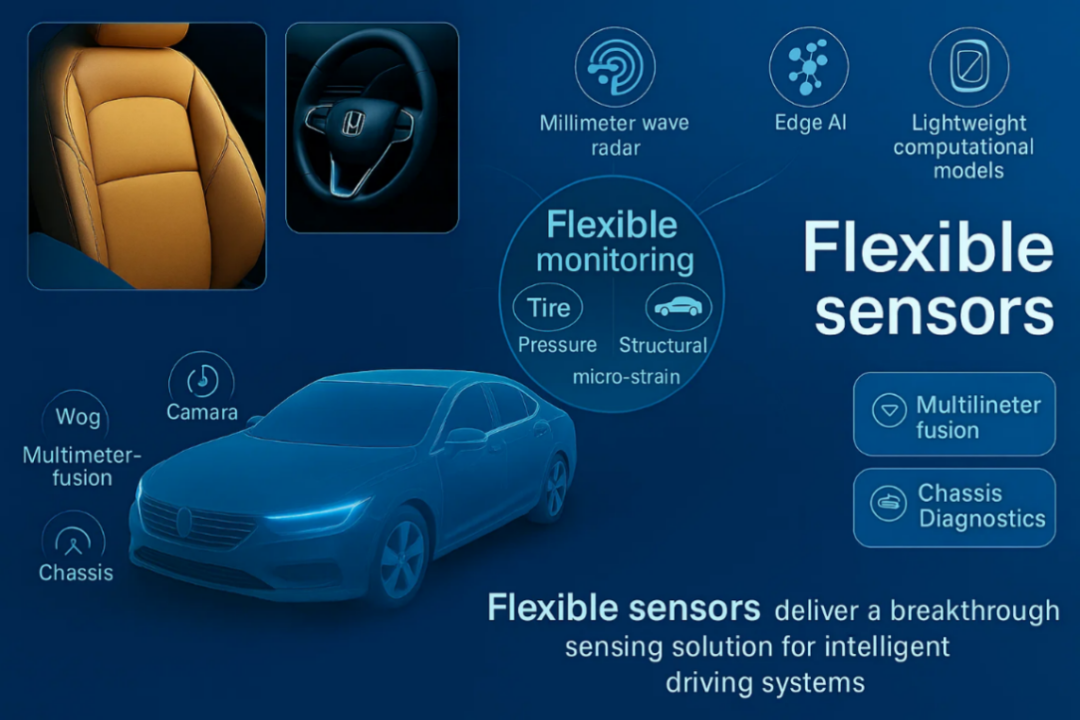
Figure 1 Concept diagram of the flexible sensor system for intelligent driving, which achieves distributed multimodal perception through conformal deployment on complex vehicle surfaces.
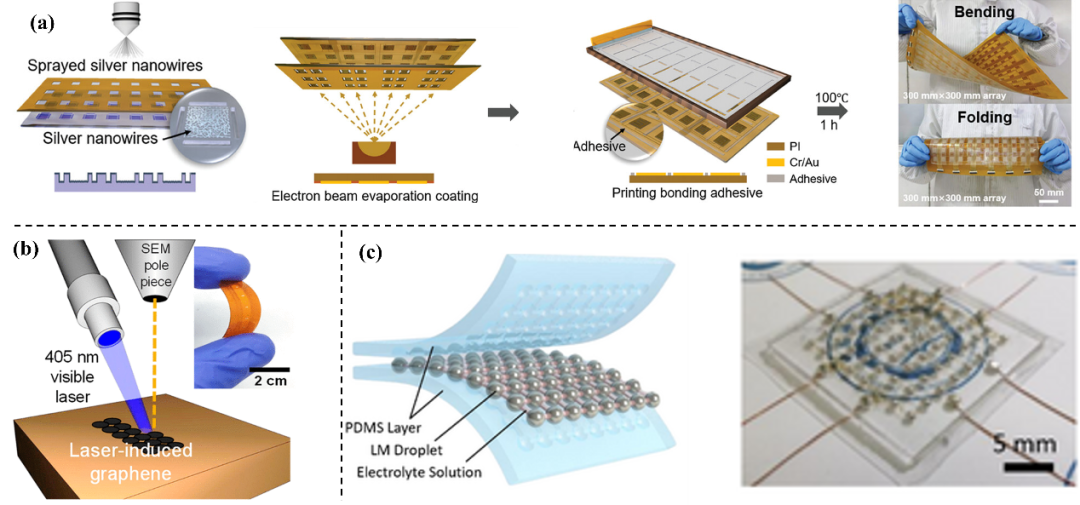
Figure 2 Material basis of flexible sensors: (a) Flexible tactile sensor array based on silver nanowire/polydimethylsiloxane composites, enabling distributed grasping/humidity monitoring; (b) LIG network patterned directly on polyimide for structural health monitoring; (c) Liquid metal (LM) microchannels with electrolyte connections for distributed pressure sensing.
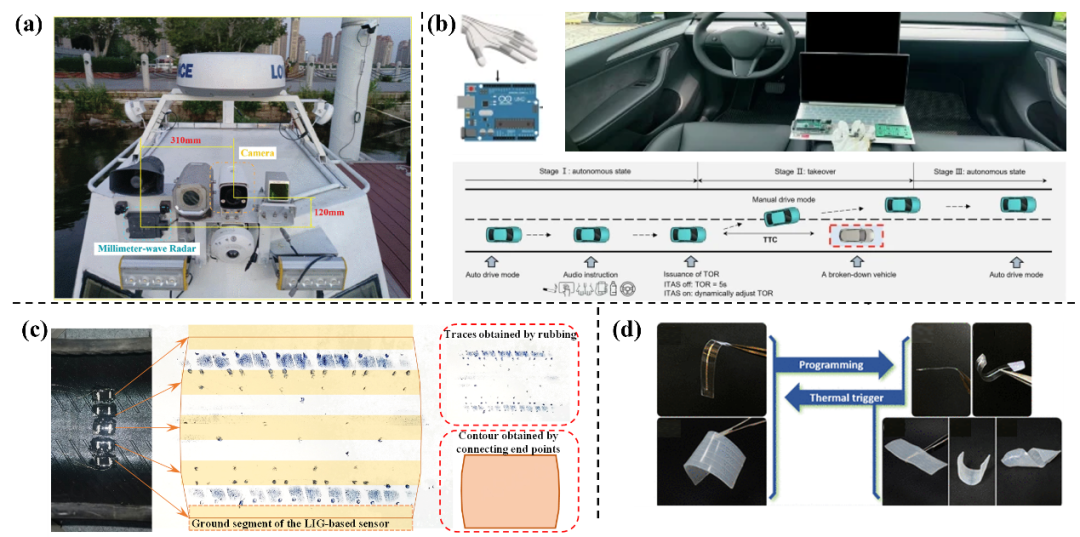
Figure 3 Integration and application of flexible sensors: (a) Achieving multimodal fusion through coordinated millimeter-wave radar arrays and distributed cameras; (b) Omnidirectional sensing gloves with triboelectric sensors for non-driving behavior recognition; (c) High-density sensor networks printed inside vehicle tires for structural monitoring; (d) Flexible liquid metal composites, integrating perception and response for intelligent collision adaptive systems.
Research Background
Visual Summary
Summary and Outlook
03.
Summary and Outlook
1. Flexible sensors are the core enabling technology for achieving comprehensive intelligent perception and interaction in vehicles, with their inherent flexibility, stretchability, and conformal integration characteristics providing a fundamental path to solve the “physical incompatibility” problem between rigid sensors and complex vehicle surfaces;
2. There is an urgent need to overcome industrial bottlenecks such as automotive-grade integration, environmental durability, data security, and stable power supply, promoting the scaling and cost control of advanced manufacturing processes like laser direct writing and roll-to-roll printing to meet the stringent requirements of automotive functional safety (e.g., ISO 26262);
3. Future efforts should focus on the deep integration of flexible sensing with edge AI and lightweight deep learning models, offloading some computational tasks to perception nodes to reduce system latency and enhance real-time performance; while optimizing system packaging processes and electromagnetic compatibility;
4. Promote the deep integration of flexible sensing with self-healing smart materials, vehicle health management, and vehicle-road-cloud collaborative systems, developing an “intelligent skin” with integrated perception-response capabilities, ultimately providing key technological support for achieving high-level autonomous driving (L4/L5) and revolutionizing future travel paradigms.
✦ Article Information ✦
Title
Flexible Sensor-Driven Smart Vehicles: Opportunities and Prospects
Authors
Yuan Jiangnan, Zhao Wei, Zhou Yunlei, Huang Yong’an
Affiliations
Xi’an University of Electronic Science and Technology Hangzhou Research Institute; Xi’an University of Electronic Science and Technology School of Mechanical and Electrical Engineering; Huazhong University of Science and Technology School of Mechanical Science and Engineering; Huazhong University of Science and Technology National Key Laboratory of Digital Manufacturing Equipment and Technology, Flexible Electronics Research Center
Keywords
Flexible Electronics, Intelligent Driving Systems, Stretchable Sensor Networks, Multimodal Fusion, Automotive Integration
Citation
J. Yuan, W. Zhao, Y. Zhou and Y. Huang, “Flexible Sensor-Driven Smart Vehicles: Opportunities and Prospects,” in CHAIN, vol. 2, no. 3, pp. 227-235, September 2025, doi: 10.23919/CHAIN.2025.000016.
✦ Author Biography ✦

Zhou Yunlei
Associate Professor at Xi’an University of Electronic Science and Technology Hangzhou Research Institute/School of Mechanical and Electrical Engineering, PhD from Nanjing University of Modern Engineering, followed by postdoctoral research at Huazhong University of Science and Technology National Key Laboratory of Intelligent Manufacturing Equipment and Technology. Serving as Academic Associate Editor for Rare Metals, Deputy Editor for Green Technologies and Sustainability, and Editorial Board Member for Soft Science. Engaged in research on flexible sensor design and manufacturing, with several articles selected as highly cited papers, and related research results widely reported by media such as the American Chemical Society News Weekly, Daily Science, American Physical Society website, and American Optical Society website.
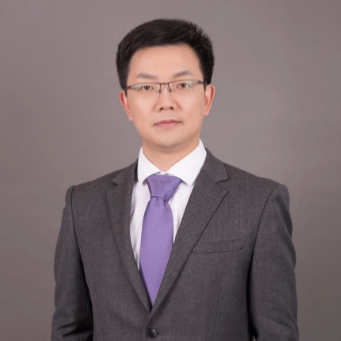
Huang Yong’an
Professor at Huazhong University of Science and Technology School of Mechanical Science and Engineering, Deputy Director of the National Key Laboratory of Intelligent Manufacturing Equipment and Technology; recipient of the National Outstanding Youth Science Fund, continuation of the National Outstanding Youth Science Fund, and Tencent “Scientific Exploration Award”; leading national major instrument projects, national key R&D projects, GF key projects, etc.; responsible for the “Flexible Electronics Manufacturing Innovation Group” in Hubei Province and the “Flexible Electronics Manufacturing Technology Innovation Team” in Hubei Province; established an advanced flexible electronics manufacturing laboratory. Committed to research on emerging flexible electronic technologies, including flexible electronic devices and systems, and flexible electronic manufacturing and equipment. Published nearly 200 SCI papers in top international journals such as PNAS, Sci. Adv., Nature Comm., authored 4 books, and obtained over 100 authorized national invention patents, 5 US patents, with results successfully transformed; awarded the National Technology Invention Second Prize, Hubei Province Natural Science First Prize, Hubei Province Technology Invention First Prize, International Geneva Invention Gold Medal/Special Gold Medal, etc.
Journal Introduction
✦ Journal Homepage ✦
https://ieeexplore.ieee.org/xpl/RecentIssue.jsp?punumber=10419381
https://chain.cbpt.cnki.net/portal/
✦ Submission URL ✦
https://mc03.manuscriptcentral.com/chain
Chain the World
Editing & Proofreading丨Quan Xiaoyun
Review丨Ma Wen