Click to follow ▲ “Banner” and start your journey of intelligent manufacturing
In the automation production and packaging printing industries, the feeding process of materials such as paper, plastic sheets, and metal sheets is often carried out in the form of “sheets”. If the feeding system experiences double sheets, overlaps, or missing sheets phenomena, it can lead to equipment jams, printing ghosting, material waste, and even damage to downstream mechanical structures. To address this pain point, ultrasonic single and double sheet detection sensors have emerged.
Ultrasonic single and double sheet detection sensors utilize the strong penetration capability of ultrasonic waves, which are insensitive to color and transparency, to quickly and accurately detect the number of layers of materials, achieving single sheet, double sheet, or no sheet status recognition, making them an ideal solution in modern automated feeding detection.
Banner
Basic Components
A typical single and double sheet ultrasonic sensor usually consists of two parts:
-
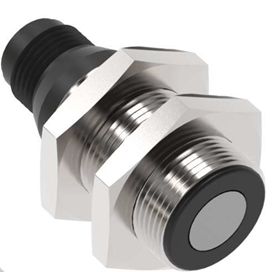
Transmitter Probe (Ultrasonic Emitter): Generates high-frequency mechanical waves (ultrasonic waves) at a specific frequency (usually from tens of kHz to hundreds of kHz).
-
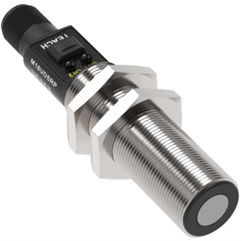
Receiver Probe (Ultrasonic Receiver): Receives the ultrasonic signals that penetrate the measured object and converts them into electrical signals.
Based on structural design, they can be divided into:
-
Through-beam: The emitter and receiver are separated and located on opposite sides of the material being measured. This is the most common form.
-
Reflective: The emitter and receiver are located on the same side, with the ultrasonic wave penetrating the material and reflecting back from a reflective plate below, which is then received by the receiver.
Banner
Working Principle
Taking the most common through-beam sensor as an example, we will explain its working principle step by step:
Step 1: Emit Ultrasonic Waves
After powering on, the transmitter probe continuously emits a fixed frequency and intensity of ultrasonic beam.
Step 2: Ultrasonic Waves Penetrate the Medium
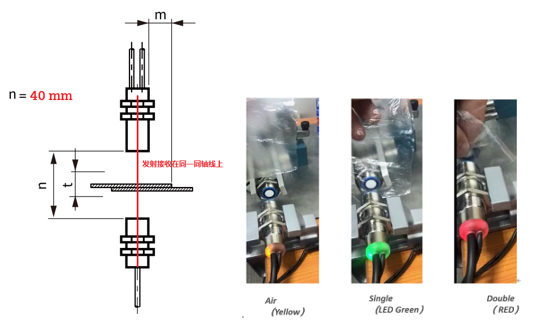
As ultrasonic waves propagate through the air, they encounter the material being measured. At this point, they need to pass through three interfaces and two media:
1. Air → First Material
2. First Material → Second Material (if it is a double sheet)
3. Last Material → Air
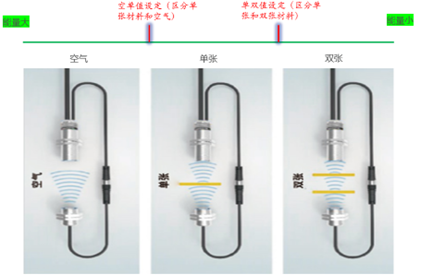
At each interface, two physical phenomena occur:
-
Reflection: A portion of the ultrasonic energy is reflected back at the interface.
-
Transmission: Another portion of the ultrasonic energy penetrates the interface and continues to propagate forward.
Meanwhile, as ultrasonic waves propagate within the material, their energy will also attenuate due to absorption and scattering by the material.
Step 3: Receive and Analyze Signals
The receiver probe is responsible for receiving the ultrasonic energy that successfully penetrates all media and interfaces, converting it into a voltage signal. The key point is:
When detecting a single sheet:
-
Ultrasonic waves need to penetrate 2 interfaces (entering one material, leaving one material) and 1 layer of material.
-
Due to relatively small energy loss caused by the interfaces and within the material, the receiving end can receive a strong signal.
-
The internal circuit of the sensor detects this high-level signal and determines it as “single sheet”.
When detecting double sheets:
-
Ultrasonic waves need to penetrate 4 interfaces (entering the first sheet, between the first and second sheets, leaving the second sheet) and 2 layers of material, as well as any small air gaps that may exist between the two layers of material.
-
Each reflection at the interface and absorption within the material causes energy loss. Especially the air gap between the two layers of material, due to the significant difference in acoustic impedance between air and solid, will cause most of the ultrasonic waves to be reflected back, with only a small amount of energy able to penetrate.
-
Therefore, the receiving end can only receive a very weak signal, or may not receive any signal at all.
-
The sensor detects this low-level signal and determines it as “double sheet”.
Banner
Installation and Debugging Points
-
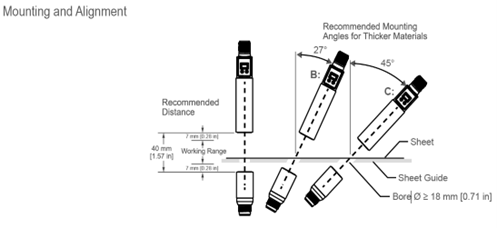
Keep the transmitter and receiver coaxially aligned to ensure there are no obstructions in the sound wave propagation path.
-
Set the sensitivity knob or use buttons to learn the single and double sheet states.
-
Keep the detection area clean to avoid dust or oil affecting ultrasonic wave propagation.
-
After debugging, real-time monitoring of detection status can be done through LED indicators.
Banner
Core Advantages
Compared to other detection methods (such as mechanical or photoelectric), ultrasonic single and double sheet detection has significant advantages:
-
Not affected by color and transparency: The attenuation of ultrasonic waves mainly depends on the density, thickness, and internal structure of the material, and is completely unrelated to the object’s color, surface gloss, or transparency. This allows for reliable detection of materials that are difficult for photoelectric sensors to handle, such as black metals, transparent films, and colored papers.
-
Insensitive to surface conditions: Dust, oil, and water stains have relatively little impact on ultrasonic wave propagation, allowing stable operation even in harsh industrial environments.
-
Non-contact measurement: It does not scratch or apply any physical pressure to the material.
-
High reliability: It can reliably distinguish between single and double sheets, effectively preventing production accidents.
Banner
Typical Application Areas
-
Printing machinery: Detection of paper, tickets, and label feeding.
-
Packaging machinery: Detection of plastic films, aluminum foil sheets, and cardboard sheets.
-
Sheet metal processing: Detection of metal sheet feeding to prevent overlapping.
-
Feeding control for bag-making machines, packaging machines, labeling machines, etc.
-
Material detection in medical, electronics, and solar industries.
The detection principle of single and double sheet ultrasonic sensors essentially utilizes the characteristic of ultrasonic energy attenuating regularly when penetrating different layers and thicknesses of media. By accurately measuring the strength of the signal at the receiving end and comparing it with a preset threshold, it can reliably distinguish between “single sheet” and “double sheet” states. This detection method, based on physical acoustic principles, makes it an indispensable and stable solution for material overlap detection in the industry.
 Click the bottom to read the original text and contact Banner engineers!
END
Recent Exciting Content
Lean Production! Who empowers the visual picking of workpieces?
Banner shares with you丨Economic operation of the automotive industry in October 2025
New Product Release丨Robust and Reliable + Cost-effective—Banner K50 Series Three-color Indicator Light Launch!
11/21 Live Preview丨Introduction to Banner Lighting Products – TL50 PS
Watch Product Videos
Enter the Banner WeChat public account, click the menu below “Exciting Banner” – “Video Collection”