Linearity is the core measurement capability of flexible sensing technology. Insufficient linearity not only increases the complexity of system calibration and data decoupling but also directly affects the physical comparability of signals and measurement traceability.
The Chinese Academy of Sciences and the Chongqing Green Intelligent Technology Research Institute proposed a new mechanism for electric sensing based on skin-inspired dual mechanisms and a multi-scale structural control strategy, developing a controllable preparation method system for high-linearity wide-range electric flexible pressure sensors.
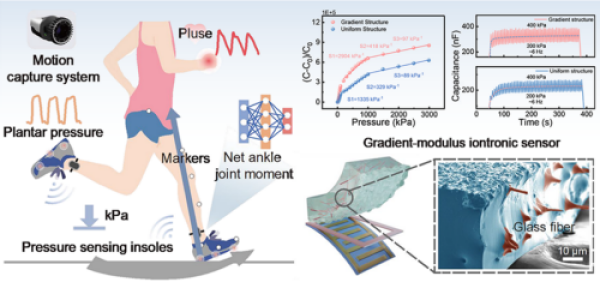
Inspired by the layered fiber network of human skin and the ionic signal regulation mechanism, the team proposed a dual-mechanism synergistic model of “fabric microstructure contact area evolution (∝P1/3) + ionic concentration adaptive modulation (∝P2/3)”. This mechanism couples two different nonlinear effects of geometric contact and electrochemical modulation, making the overall output relationship approach ideal linearity (C∝P), fundamentally breaking through the traditional limitation of “structural response nonlinearity”. Based on this mechanism, the team prepared a new type of electric flexible pressure sensor, achieving a linearity of R2=0.997 and a sensitivity of 242 kPa-1 within a wide working range of 0 MPa to 1 MPa, with a linear sensitivity factor (LSF) as high as 242,000. The team integrated this sensor into a smart insole platform, establishing a real-time mapping model of gait-tibia load, achieving a high-precision load assessment error of only 1.8% during walking and running tests, significantly improving compared to traditional nonlinear sensing solutions.
Inspired by the gradient modulus structure of human skin’s “epidermal rigidity – dermal viscoelasticity – subcutaneous compliance”, the team constructed a heterogeneous composite structure by electrospinning a high-modulus nanofiber network embedded in a low-modulus ionic gel matrix. This structure allows the load to be gradually regulated along multiple paths, achieving cooperative dispersion of stress and restricted adjustment of ionic migration. The device achieved nearly perfect linear high sensitivity within a wide pressure range of 1 MPa, with a linear sensitivity factor reaching 81,300, placing it at a leading level among ionic flexible sensors.
The team also proposed a new idea for gradient modulus low-drift electric flexible sensors: by introducing a glass fiber reinforced layer and a layered cross-linking structure into the ionic gel system, achieving a continuous modulus gradient distribution from “soft – medium – hard” from top to bottom, effectively releasing stress concentration at the sensing interface. This structure maintains a stable electrical-force response relationship under high-pressure loading, allowing the flexible sensor to exhibit excellent signal consistency and environmental stability during multi-cycle testing.
Related research results have been published in Nano-Micro Letters, Composites Part B: Engineering, and ACS Sensors.
The research work was supported by the National Natural Science Foundation and others.
Source: Chinese Academy of Sciences website