The detection of Circulating Tumor Cells (CTCs) plays a crucial role in clinical diagnosis and research exploration, specifically applicable in scenarios such as monitoring tumor metastasis, formulating and adjusting treatment plans, and evaluating patient prognosis. However, due to the extremely low concentration of CTCs in peripheral blood, their enrichment operations are quite challenging. Existing CTC detection methods still face numerous issues, such as insufficient detection sensitivity, cumbersome experimental procedures, and the need for expensive instruments and reagents to achieve high-precision CTC detection, which limits their widespread application.
To further enhance the sensitivity of CTC detection, researchers have attempted to integrate various isothermal amplification technologies into the detection system. For instance, combining rolling circle amplification technology with surface-enhanced Raman scattering technology and specific nucleic acid aptamers can achieve ultra-sensitive detection of CTCs while also enabling non-destructive recovery of CTCs. Among various technologies, dynamic DNA technology (such as DNAwalker) shows great potential as a key technology for achieving high-sensitivity CTC detection due to its excellent controllability and functional diversity, and it also holds significant research value in the fields of signal transmission and amplification.
However, current research on dynamic DNA technology still faces two main bottlenecks: on one hand, existing DNAwalkers mostly rely on random and disordered motion paths, which limits their step kinetics and motion continuity, while some high-performance DNAwalkers require the design of complex and highly ordered paths, increasing the difficulty of development; on the other hand, existing DNAwalkers typically release only one or a few signal probes during each enzymatic cleavage reaction, and the efficiency of signal amplification still needs further improvement.
Lateral flow immunoassay (LFIA), as a commonly used instant detection technology, has many outstanding advantages. This technology is simple and convenient to operate, requiring no specialized training for operators and no complex instruments; it offers rapid detection, saving valuable time for disease diagnosis; at the same time, it is cost-effective and stable at room temperature, making it very suitable for promotion in resource-limited areas. If LFIA technology can be combined with advanced handheld detection instruments, it is expected to replace the high-priced equipment currently relied upon in precise detection processes, significantly reducing detection costs and thus promoting the widespread application of CTC detection technology in grassroots medical institutions and large-scale population screening.
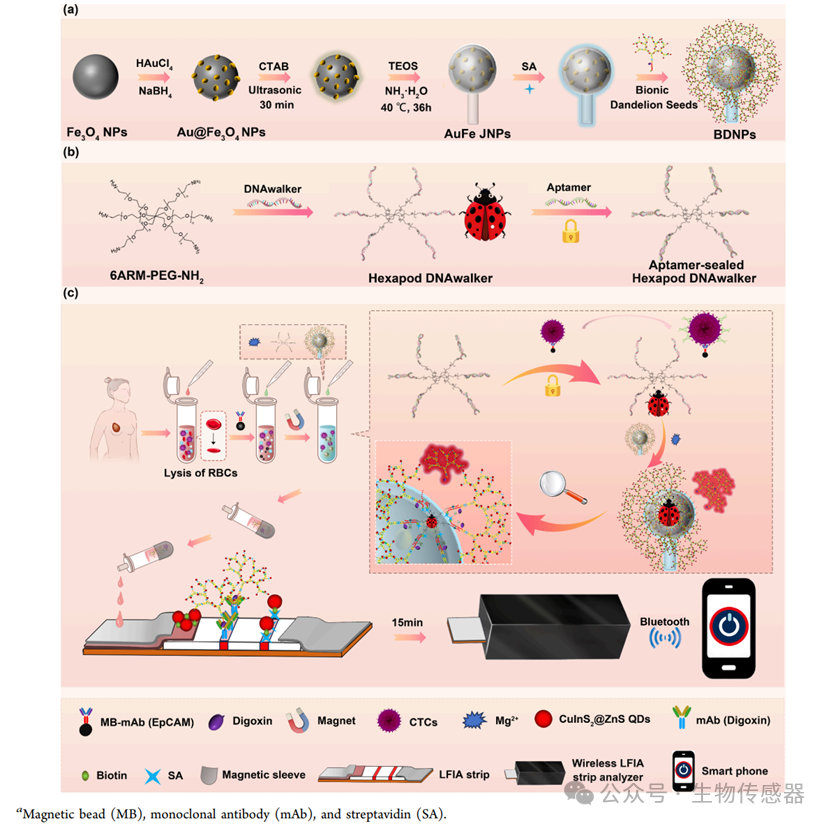
To address the current issues of insufficient sensitivity, complex operations, and high equipment costs in CTC detection, this study developed a high-performance wireless cell sensor platform (see schematic diagram 1 for specific structure), which has two core innovations:
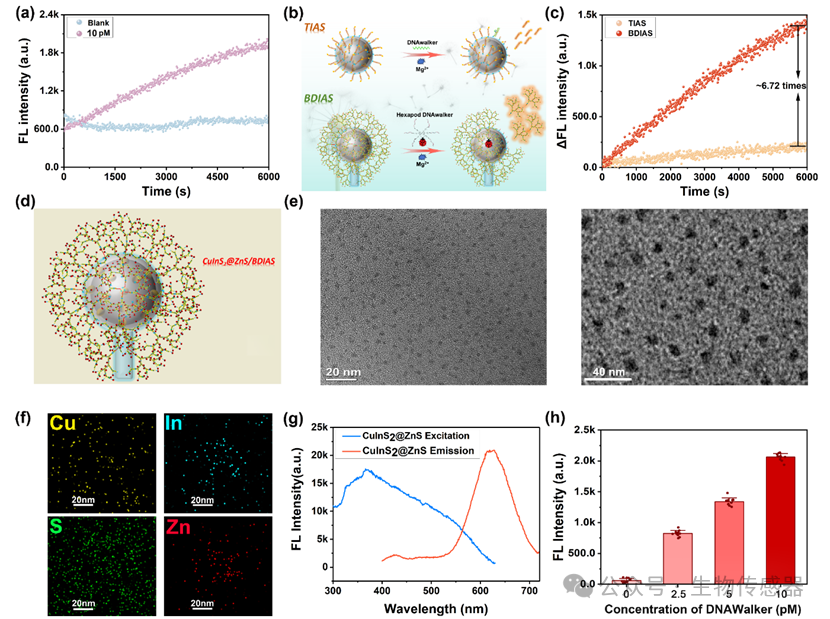
Firstly, the Bionic Dandelion Isothermal Amplification System (BDIAS). This system consists of Biomimetic Dandelion Nanoparticles (BDNP) and a hexapod DNAwalker. The BDNP is assembled from AuFe Janus nanoparticles (AuFe JNPs) and dandelion seed-like DNA macromolecules. The asymmetric Janus structure of AuFe JNPs provides a large specific surface area, significantly enhancing the loading efficiency of the Fluorescence Signal Probe (FSP). The hexapod DNAwalker not only efficiently releases a large number of FSPs during each enzymatic cleavage reaction but also shows significant improvements in step kinetics and motion continuity compared to traditional DNAwalker designs.
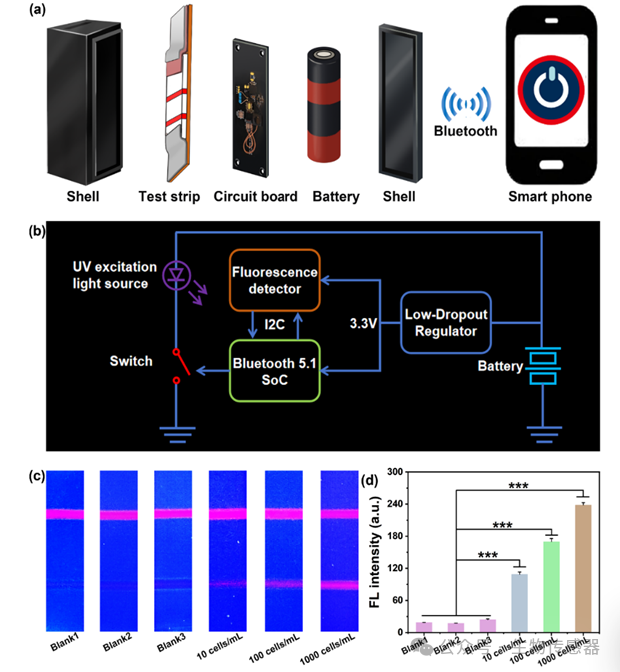
Secondly, the wireless LFIA test strip analyzer. This analyzer integrates an XYZ true color optical sensor with a Bluetooth 5.1 system chip, capable of accurately analyzing the fluorescence intensity on the test strip detection line and transmitting the detection signal to a smartphone within 1 second, facilitating the operator’s reading of the detection results.
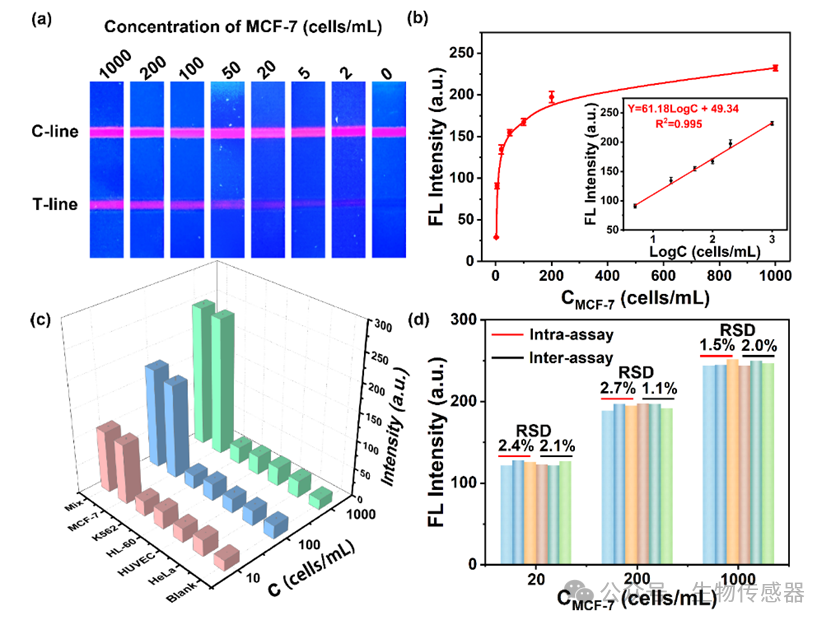
Experimental results indicate that the wireless cell sensor platform developed in this study can accurately detect MCF-7 cells within a concentration range of 5~1000 cells/mL, with a minimum detection limit of 1.58 cells/mL, and it demonstrates good stability in practical applications. Overall, this wireless cell sensor platform provides a high-sensitivity, easy-to-operate, and cost-effective solution for CTC detection, effectively promoting the transition of CTC detection technology from laboratory research to clinical practical application.
Reference link
https://doi.org/10.1021/acsnano.5c03586
What are your thoughts on this article? Feel free to leave a comment and share!Share and click to see, let more people understand the dynamics of the Chinese sensor industry!
Star-marking the content you care about,according to the recommendation principles of WeChat public accounts, if you do not set the Sensor Expert Network public account homepage as a star, you will not be able to receive the latest information in the sensor industry in a timely manner!
Source: Biological Sensors
Disclaimer: The content of this article reflects the author’s personal views and does not represent the views or positions of the Sensor Expert Network. For inquiries, please contact: pengzhenlie (WeChat ID). If you have submission or interview requests, please send an email to:[email protected].