The design patterns of agent workflows are a very important and cutting-edge topic. It refers to the methodology of organizing multiple single-function agents through specific rules and structures to collaboratively complete complex tasks.
These patterns draw on the ideas of design patterns in software engineering but have evolved to cater to the characteristics of AI agents (such as autonomy, tool usage, communication, etc.). Below are six core design patterns for agent workflows, along with detailed explanations and use cases.
1. Chain Workflow
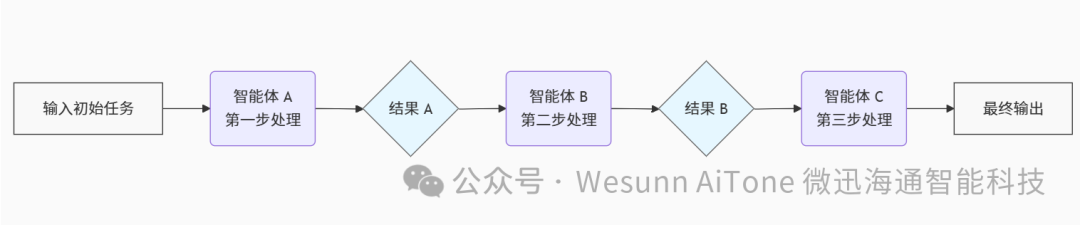
Core Idea: Decompose tasks into a series of sequential, dependent subtasks, where each agent completes a subtask and passes its output as input to the next agent. It is akin to an assembly line in a factory.
-
Workflow:
<span>Agent A (input) → Result A → Agent B → Result B → Agent C → Final Output</span> -
Advantages:
-
Simple Structure: Easy to design, implement, and debug.
-
Clear Responsibilities: Each agent has a single function, specializing in a specific area.
-
Disadvantages:
-
Lack of Flexibility: The process is fixed and cannot dynamically adjust the path based on intermediate results.
-
Error Propagation: If one link fails, it will cause the entire chain to break.
-
Typical Use Cases:
-
Content Creation:
<span>Planning Agent</span>(generates outline) →<span>Writing Agent</span>(writes main text) →<span>Proofreading Agent</span>(edits and revises). -
Data Analysis:
<span>Data Extraction Agent</span>(retrieves data from the database) →<span>Data Cleaning Agent</span>(handles missing values) →<span>Analysis Agent</span>(generates insight reports).
The Chain Workflow is applied in fintech intelligent approval, where the complex task of credit approval is decomposed into a series of sequential, interlinked “small steps” like an assembly line. Each step is handled by a specialized agent or module, passing results to the next stage, significantly enhancing efficiency, accuracy, and consistency.
Although the search results do not directly describe the theory of “Chain Workflow,” its practical application in fintech intelligent approval clearly reflects the core idea of this pattern.
To help you quickly understand the key stages and value of the Chain Workflow in intelligent approval, I have summarized it in a table:
Application 1: Intelligent Approval
|
Approval Stage |
Pain Points of Traditional Model |
Chain Workflow Application (AI Driven) |
Core Value and Results |
|
Risk Assessment and Identification |
Relies on human experience, low efficiency (average time over 24 hours), poor consistency |
Agents integrate millions of credit data and real-time market dynamics, achieving “real-time + precision” risk assessment through large model technology |
Risk judgment time reduced to 10 minutes, accuracy rate improved 35% |
|
Approval Decision and Generation |
Long process, high human intervention rate (up to 82% for small and micro businesses), poor customer experience |
Deploy automated approval processes + anti-fraud rule engine, or achieve AI approval officer to output quota suggestions in T+0 |
Approval time reduced from 72 hours to 35 minutes, achieving second-level batch verification |
|
Data Integration and Processing |
Multiple data silos, cumbersome paper material verification |
RPA robots automatically fetch credit, tax, invoice, and other multidimensional data |
Reduce 75% of manual operations, providing comprehensive, real-time data support for risk assessment |
|
Compliance Review |
Complex and rapidly changing regulations, high cost and difficulty of manual review |
AI compliance assistant integrates 2000+ regulatory regulations, 300+ risk control models, achieving “prevention” through knowledge graph + algorithm model + dynamic monitoring“5 |
Transforming “post-correction” into “prevention” achieves breakthroughs in efficiency, cost, and risk control |
Application 2: Intelligent Report Generation for Corporate Clients
A financial analysis platform needs to generate industry weekly reports:
Intent Recognition: Parse user queries (e.g., “Generate 2024Q2 Internet Industry Competitive Report”)
Data Retrieval: Retrieve industry data, competitive dynamics, financial indicators from the database
Content Generation: Fill data based on templates to generate drafts (including market size, trend analysis)
Format Verification: Check chart numbering, data accuracy, language fluency
2. Routing Workflow
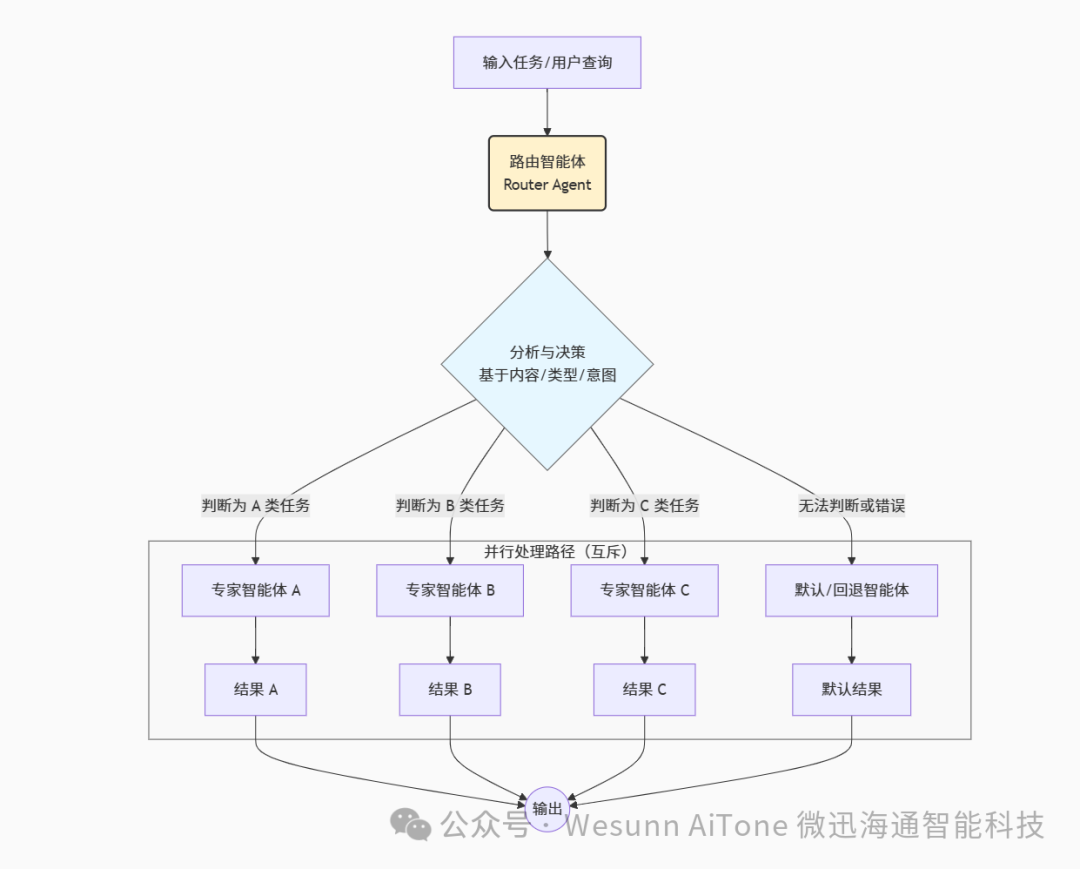
Core Idea: Introduce a “routing” or “dispatch” agent that dynamically decides which subsequent agent(s) to assign tasks based on input content or initial analysis results.
-
Workflow:
<span>Input → Routing Agent (determines task type) → [ Path A: Agent A | Path B: Agent B | Path C: Agent C ]</span> -
Advantages:
-
Highly Flexible: Can build very dynamic and self-adaptive workflows.
-
Efficient: Able to route tasks precisely to the most suitable experts, avoiding resource waste.
-
Disadvantages:
-
Complex Design: The routing logic needs to be carefully designed and is a critical single point of the system.
-
Typical Use Cases:
-
Customer Service:
<span>Routing Agent</span>analyzes user query’s sentiment and intent → if it is a complaint, route to<span>After-sales Expert Agent</span>; if it is an inquiry, route to<span>Sales Expert Agent</span>. -
Document Processing:
<span>Routing Agent</span>determines the type of uploaded file → PDF files route to<span>PDF Parsing Agent</span>, images route to<span>OCR Agent</span>, data tables route to<span>Data Analysis Agent</span>.
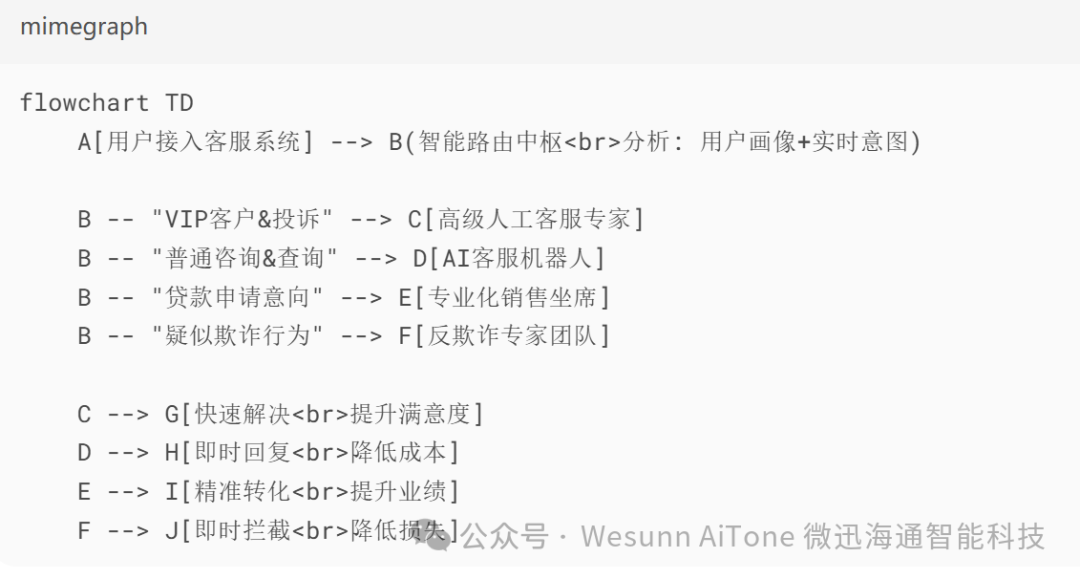
Application 1: Intelligent Customer Service
To intuitively demonstrate its core role, we can understand it through a typical intelligent customer service routing case:
Application 2: Credit Approval
-
Intelligent Credit Approval:
-
<span>Low Risk & Small Amount</span>→ Fully Automated Approval Channel (seconds-level approval) -
<span>Medium Risk & Complete Documentation</span>→ AI-assisted Manual Approval Channel (fast review) -
<span>High Risk & Large Amount & Missing Documentation</span>→ Senior Credit Review Expert Team Channel (in-depth due diligence)
-
Routing Basis: Application amount, customer credit score, data completeness, preliminary output of risk rating model.
-
Routing Path:
-
Value: Under the premise of controllable risk, automate 80% of simple cases, greatly enhancing overall approval efficiency.
Application 3: Transaction Anti-fraud (Real-time Risk Control)
-
Routing Basis: Transaction amount, location, merchant type, user behavior profile, device fingerprint, and thousands of real-time features.
-
Routing Path:
-
<span>Low Risk Transaction</span>→ Normal Payment Channel (pass without perception) -
<span>Medium Risk Transaction</span>→ Challenge Verification Channel (send SMS/face verification code for secondary confirmation) -
<span>High Risk Transaction</span>→ Real-time Interception Channel (directly reject and trigger an alert for review by the risk control team) -
Value: Find the best balance between user experience and fund security, achieving the most effective risk control with the lowest friction cost.
Application 4: Compliance and Suspicious Transaction Reporting (STR)
-
Routing Basis: Transaction patterns, customer background, triggered compliance rule types, risk levels.
-
Routing Path:
-
<span>Suspected Money Laundering Pattern</span>→ Anti-Money Laundering (AML) Expert Group -
<span>Potential Fraudulent Transaction</span>→ Anti-Fraud Investigation Team -
<span>Involving Politically Exposed Persons (PEP)</span>→ Senior Compliance Officer -
Value: Ensure that different types of compliance cases receive the most professional and fastest processing, meeting regulatory requirements.
3. Evaluator-Optimizer Based Workflow
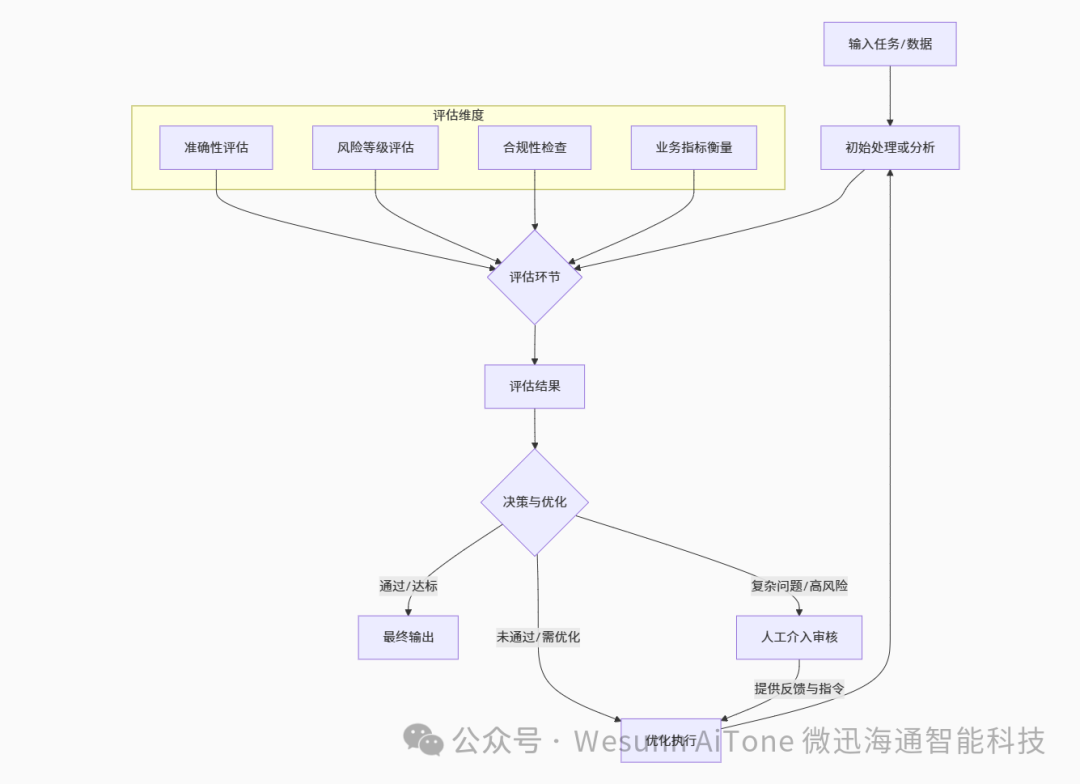
Core Idea: Integrate “evaluation” and “optimization” as first-class citizens into the workflow, ensuring the quality and reliability of output results through continuous self-criticism and improvement.
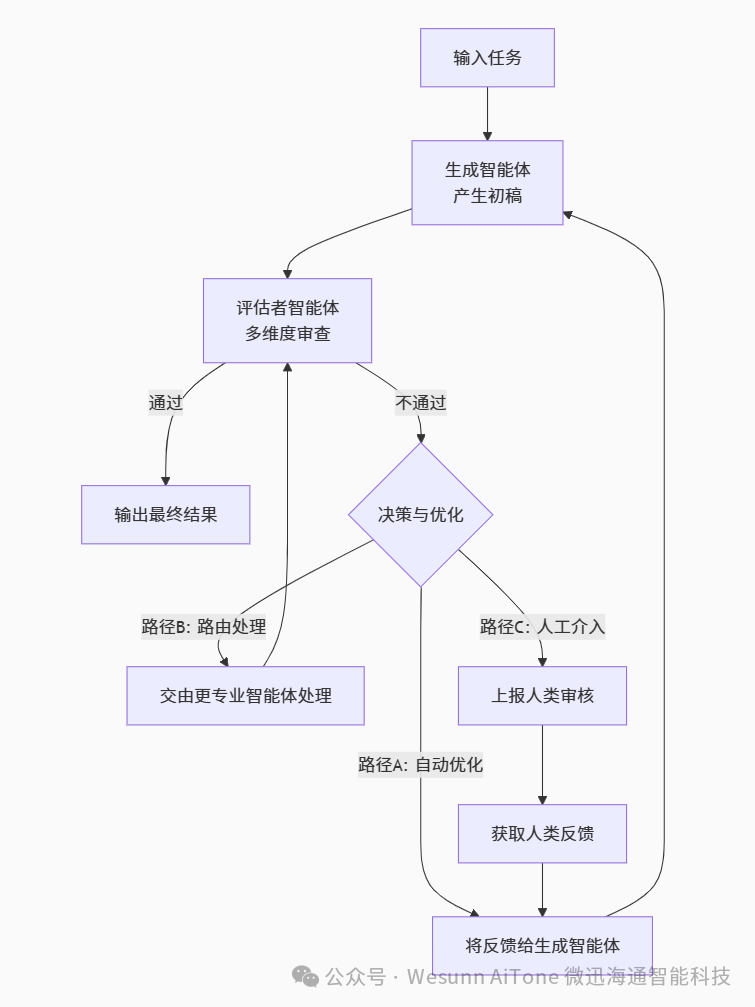
Basic Workflow (using report generation as an example):
-
Generation:
<span>Writing Agent</span>generates a draft report based on demand. -
Evaluation:
<span>Evaluator Agent</span>scores and reviews the report based on preset criteria (e.g., factual accuracy, logical coherence, format standards, absence of harmful content, etc.). -
Decision and Optimization:
-
Path A (Automatic Optimization): Directly send evaluation feedback (e.g., “needs more data support”) to
<span>Writing Agent</span>for modification based on feedback. This process can loop multiple times until approved or reaches the maximum loop count. -
Path B (Routing Processing): Send issues and evaluation results to another more specialized agent (e.g.,
<span>Data Analysis Agent</span>) to solve specific problems, then summarize and continue.
-
If Evaluation Passes: Workflow ends, output final report.
-
If Evaluation Fails:
-
If Multiple Optimizations Still Fail: May report to human review (Human-in-the-Loop).
Application 1: Financial Technology Middle Platform Code Assistance Generation Platform
Workflow of an intelligent coding assistant in a developer toolchain:
-
Draft Generation: Generates Python code based on user requirements (e.g., “implement user login interface”)
-
Static Evaluation: Code checking tool scans for syntax errors, security vulnerabilities, naming conventions
-
Human Review: If evaluation fails, prompts developers for correction direction (e.g., “missing exception handling”)
-
Iterative Optimization: Based on human feedback, the generator adjusts code logic and resubmits for evaluation
Application 2: Financial Technology Intelligent Risk Control Platform
Applicable Scenarios
-
Tasks with extremely high output quality requirements (e.g., code, legal documents, medical reports, financial reports)
-
Need to balance automation and human intervention (to avoid “black box output” risks)
Core Value: Through human-machine collaborative iteration, gradually improve the accuracy of agent output and reduce trial-and-error costs.
4. Parallel Workflow with Broadcasting and Aggregation
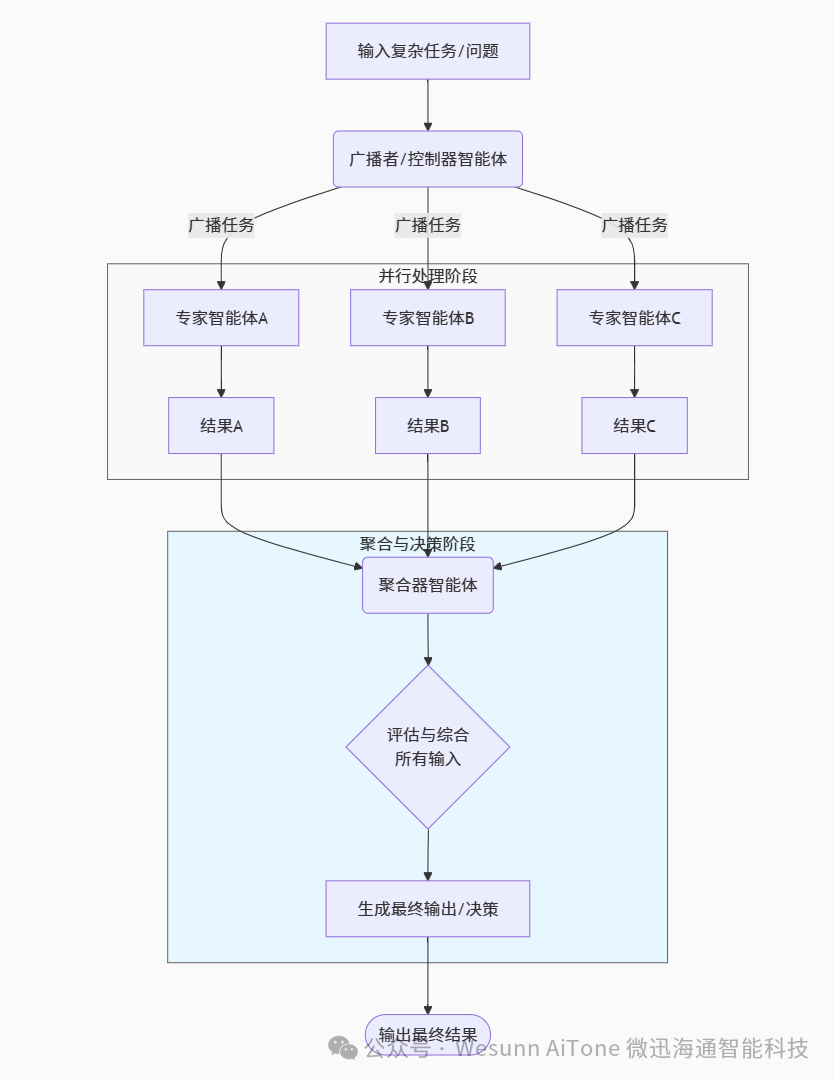
Core Idea: Broadcast a task simultaneously to multiple same-type or specialized agents, then an “aggregator” agent summarizes, compares, and filters all results to ultimately derive the best answer or consensus.
-
Workflow:
<span>Task → [Agent A, Agent B, Agent C]</span>(parallel processing) →<span>Aggregator Agent</span>→ Final Output -
Advantages:
-
Improved Quality and Reliability: Avoid biases or errors from a single agent through “collective wisdom”.
-
Increased Diversity: Can produce multiple different perspectives for selection.
-
Disadvantages:
-
High Resource Consumption: Requires mobilizing multiple agents, leading to higher computational and time costs.
-
Typical Use Cases:
-
Complex Decision Making: Consult multiple “expert agents” (e.g., legal, financial, technical experts) on the same issue, with the “chief decision-maker” agent synthesizing all opinions to make the final decision.
-
Creative Generation: Require multiple “creative agents” to provide ideas for the same advertising campaign, with the “creative director” agent selecting the best plan.
Application 1: Financial Technology Intelligent Investment Advisory and Risk Detection System
A certain investment platform needs to analyze millions of data streams from stock, foreign exchange, and commodity markets:
Data Sharding: Split by asset class into “stock strategy”, “foreign exchange volatility”, and “bulk commodities” three subtasks
Parallel Processing:
-
Subtask 1: Call stock model to calculate position risk value
-
Subtask 2: Monitor exchange rate anomalies through foreign exchange engine
-
Subtask 3: Conduct supply chain risk warnings based on commodity data
Result Merging: Summarize risk scores from various dimensions to generate real-time warning reports
Applicable Scenarios
-
Tasks containing independent submodules (e.g., text/image/speech processing in multimodal analysis)
-
Time-sensitive processing (e.g., real-time monitoring, high-frequency trading)
Core Value: Break through serial bottlenecks, improving computational resource utilization by N times, suitable for large-scale data processing.
Application 2: Financial Technology ITSM and IT Management Intelligent System
Typical Case: Intelligent Project Management Assistant
A certain team uses agents to coordinate multi-role collaboration to complete SaaS product iterations:
Requirement Decomposition: Decompose “user permission module upgrade” into “requirement document parsing → technical solution design → front-end development → test case writing”
Resource Scheduling:
-
Text Parsing → Call NLP model to extract key requirements
-
Solution Design → Associate with company technology middle platform API library
-
Development Tasks → Assign to corresponding engineers and track progress
-
Dynamic Adjustment: If development is delayed, automatically trigger alternative plans such as “adding testing resources” or “simplifying non-core functions”
Applicable Scenarios
-
Complex projects requiring multi-step, multi-role collaboration (e.g., product iteration, event planning)
-
Dynamic changes in the environment require real-time responses (e.g., resource shortages, demand changes)
Core Value: Transform “experience-driven” into “rules + model-driven”, enhancing the controllability of complex tasks.
5. Hierarchical Delegation & Planning Pattern is a workflow pattern for agents that mimics human organizational management structures, very suitable for solving large and complex tasks. It emphasizes the hierarchical decomposition, planning, and delegated execution of tasks.
The core of this pattern lies in the recursive cycle of “planning-decomposing-delegating-executing-summarizing”.
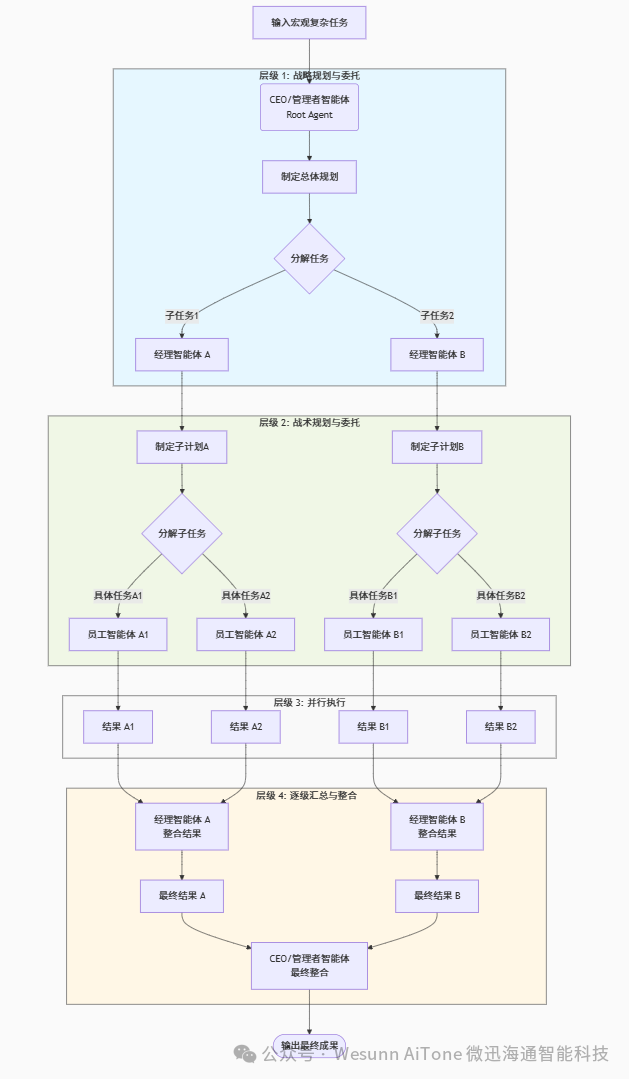
Level 1: Strategic Planning and Top-level Delegation (Root Level – Strategy)
-
Task Input: A macro, complex, and ambitious task is input into the system (e.g., “develop a successful mobile game”, “formulate the annual company budget”).
-
CEO/Manager Agent:
-
Overall Planning: First, analyze the macro task and conduct high-level planning. It needs to understand the ultimate goal and consider what major directions or modules are needed to achieve that goal.
-
Task Decomposition: Decompose the macro task into several large, relatively independent subtasks (e.g., game development can be decomposed into “game design”, “art creation”, “program development”, “market promotion”).
-
Top-level Delegation: Delegate each subtask to a manager agent specialized in that field and issue instructions.
Level 2: Tactical Planning and Secondary Delegation (Mid Level – Tactics)
-
Manager Agent:
-
Receive Instructions: Each manager agent receives subtask instructions from the manager.
-
Develop Sub-plans: The manager agent further refines the subtask into more specific, executable action plans (e.g., the “program development” manager decomposes it into “set up server”, “develop client logic”, “design database”).
-
Secondary Delegation: Delegate each specific task in the action plan to the most skilled worker agent for execution.
Level 3: Execution Layer (Leaf Level – Execution)
-
Worker Agent:
-
Receive Specific Tasks: Each worker agent receives very clear, specific instructions (e.g., “write user login API in Python”, “generate a 3D model of a forest scene”).
-
Tool Invocation and Execution: They will utilize their own functions or call external tools (such as code interpreters, APIs, drawing models) to complete tasks in parallel.
-
Return Results: Return their respective task results to the upper-level manager agent that delegated them.
Level 4: Gradual Summarization and Integration (Aggregation Level – Integration)
-
Result Integration (Bottom-up):
-
Manager Integration: Each manager agent receives outputs from all its subordinate worker agents and integrates these results into a complete, coherent subtask solution (e.g., integrating all code modules into a runnable backend service). Then report to the CEO/Manager Agent.
-
Final Integration: CEO/Manager Agent receives all sub-solutions reported by manager agents, conducts final summarization, coordination, and integration, forming the final macro result (e.g., integrating design, code, art assets into the final product plan and report).
Final Output
-
Output: Output a complete final result that solves the initial macro complex task.
Pattern Characteristics and Evaluation
-
Advantages:
-
Handling Extreme Complexity: The only pattern that can effectively manage ultra-large, multi-level projects, mimicking the organizational methods of human companies and armies, with excellent scalability.
-
Clear Responsibilities, Modular: Each agent’s role and responsibility are very clear, the system is highly modular, easy to manage and maintain.
-
Specialization: Allows each agent to focus deeply on its specific field without needing to be a generalist.
-
Parallel Efficiency: Lower-level execution can be highly parallelized, improving efficiency.
-
Challenges and Optimization Points:
-
System Latency: Due to the need for multiple upper and lower-level communications and integrations, overall latency may be high.Optimization Strategy: Ensure efficient communication interfaces between levels; allow each level to perform some other planning work while waiting for subordinate results.
-
Single Point of Failure Risk: If a certain manager agent (middle layer) fails, the entire branch task will fail.Optimization Strategy: Design backup or substitute agent mechanisms for critical nodes.
-
Top-level Design Bottleneck: The overall intelligence limit of the system depends on the planning ability of the top-level manager agent.Optimization Strategy: The top-level manager can also adopt a “seeking multiple opinions” model to formulate the best overall plan.
-
High Costs: Requires mobilizing a large number of agents.Optimization Strategy: Carefully design the depth of hierarchy to avoid excessive decomposition; choose lightweight models for simple subtasks.
Typical Use Cases: Large software project development, company strategic planning and execution, complex scientific research projects (e.g., climate modeling), large events (e.g., Olympic Games) overall planning.
6. Competition & Selection Pattern
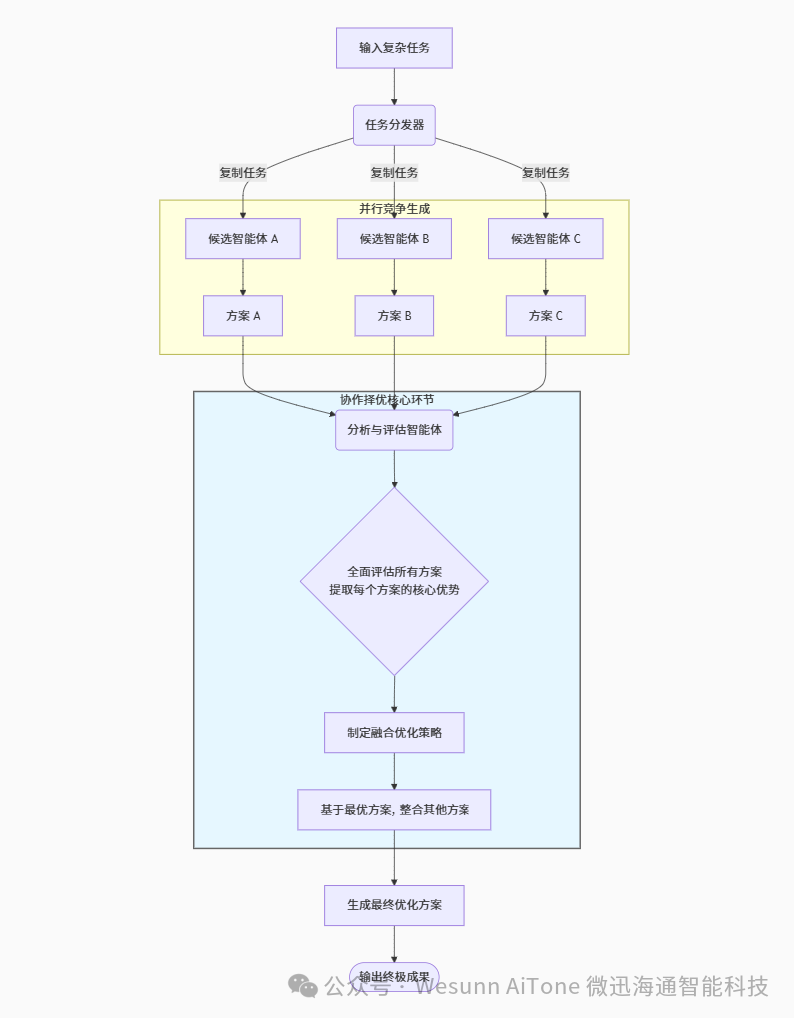
The core idea of this pattern is: The purpose of competition is not to determine a winner or loser, but to stimulate diversity and collect different perspectives on solutions. The ultimate winner is not a specific agent, but the best solution that integrates the wisdom of all agents.
It posits that in complex tasks, rarely is a single solution the best in all dimensions. One solution may be highly creative but not rigorous, while another may be executable but lack innovation. The collaborative model aims to complement each other’s strengths, achieving an effect of “1+1>2”.
Detailed Steps of the Process
-
Input and Distribution: A complex task is simultaneously distributed to multiple candidate agents. These agents should ideally be heterogeneous (different models or different expert roles) to maximize solution diversity.
-
Parallel Competitive Generation: All candidate agents work in parallel, independently generating their solutions (Solution A, B, C…). This step is identical to the basic competition model, aiming to collect as many different ideas as possible.
-
Analysis and Evaluation: This is a key upgrade point of the collaborative model.Analysis and Evaluation Agent (or “Chief Architect”) receives all solutions, but its task is no longer simply to “score and select”.
-
In-depth Analysis: Evaluate each solution’s pros and cons, highlights, and unique values one by one.
-
Identify Patterns: Find complementarities between different solutions. For example: “Solution A has an excellent introduction, Solution B has a rigorous data analysis section, Solution C has very insightful conclusions.”
-
Formulate Fusion Strategies: Plan how to integrate these scattered advantages together.
-
Its Responsibility is:
Collaborative Selection and Fusion: This is the core link. The evaluation agent begins to execute its fusion strategy.
-
Complementing the Best: Using the most comprehensive solution (“winning solution”) as a base, then “grafting” better parts from other solutions.
-
Drawing on Strengths: Not limited to any one base, but extracting the best parts from all solutions to recombine into a brand new solution.
-
Common Strategies:
-
This process is usually iterative: The evaluation agent may repeatedly call text generation, code execution, and other tools to complete the fusion work.
Generation and Output: Finally, produce a ultimate optimized solution, which serves as the output of the workflow.
Pattern Feature Evaluation
Advantages:
-
Extreme Quality: The quality of the output is usually far superior to any single solution, representing a true “collective wisdom”.
-
Reduce Waste: All candidate agents’ work contributes value to the final result, greatly reducing the “waste feeling” of computational resources.
-
Resolve Conflicts: Able to handle complex decision-making scenarios that do not have a clear optimal solution but require weighing multiple advantages.
-
More Creative: By fusing solutions with different styles and perspectives, it is easier to generate innovative breakthroughs.
Disadvantages and Challenges:
-
Extreme Complexity: The requirements for the “Analysis and Evaluation Agent” are extremely high; it needs deep understanding, critical thinking, and strong synthesis capabilities. Designing and implementing its prompts is very challenging.
-
Highest Cost: It includes not only the costs of parallel generation but also the additional costs brought by the complex process of in-depth analysis and fusion.
-
Potential Incoherence: If fusion is not done properly, the final solution may appear incoherent and stylistically disjointed, like a “Frankenstein”.
-
Latency Issues: The entire process takes the longest time, making it unsuitable for scenarios with high real-time requirements.
Typical Use Cases
-
Strategic Report Writing: Different agents write analysis reports from market, technology, and financial perspectives, ultimately merging into a comprehensive strategic plan.
-
Complex Code Development: Multiple agents generate modules with different implementation methods, with the evaluation agent selecting the optimal architecture and integrating the most efficient algorithms and the most elegant code styles from each module.
-
High-end Creative Design: Generate multiple design concepts for the same product, ultimately merging the most striking elements from each concept into the final design draft.
-
Conflict Mediation and Negotiation: Simulate the positions and plans of different stakeholders, ultimately finding a fusion plan that accommodates the core demands of all parties.
**In summary, the Competition and Selection Pattern represents one of the highest levels of agent workflow design. It abandons the simple logic of “winner takes all” in favor of the complex wisdom of “the best of all worlds”. Although it is costly and difficult to implement, the quality improvements it can bring when solving extremely complex and critical tasks are unmatched by other patterns.
Application 1: Financial Technology Intelligent Customer Service Ticket Processing System
A certain bank’s customer service center deploys a multi-agent collaboration network:
-
Coordinator Agent: Receives user complaints, parses problem types (e.g., “credit card fraud”, “investment consultation”)
-
Executor Agent:
-
Technical Team Agent: Calls the risk control system to query transaction records
-
Copywriting Team Agent: Generates standardized response scripts
-
Verifier Agent: Cross-verifies execution results (e.g., whether responses meet regulatory requirements, whether data is complete)
-
User Interaction: The coordinator integrates outputs from multiple agents to form a final solution and replies to the customer
Applicable Scenarios
-
Tasks requiring multi-dimensional professional support (e.g., legal consultation, medical diagnosis)
-
Emphasizing process compliance and result reliability (e.g., financial audits, insurance claims)
Core Value: Break through the capability boundaries of a single agent, reducing the complexity of individual nodes through division of labor, and enhancing system robustness.