Author: Zhao XiaofeiIoT Think Tank Original
Recently, the latest survey by Eurostat revealed that 70.9% of the EU population uses smart IoT devices in their daily lives. This data comes from an annual survey initiated by Eurostat in 2022 regarding the use of information and communication technology in households and by individuals. With over 70% of the population using IoT devices, it is evident that IoT has a high penetration rate in daily life, supporting many new forms of consumption, especially smart consumption. IoT has increasingly become the underlying technology behind smart consumption, smart production, and smart governance, yet its ‘presence’ seems to be diminishing in front of frontline users. However, this decreasing ‘presence’ is precisely a reflection of the necessity and stable development of IoT.
Over 70% of EU Residents Use IoT Devices, Domestic Consumption of IoT Continues to Rise
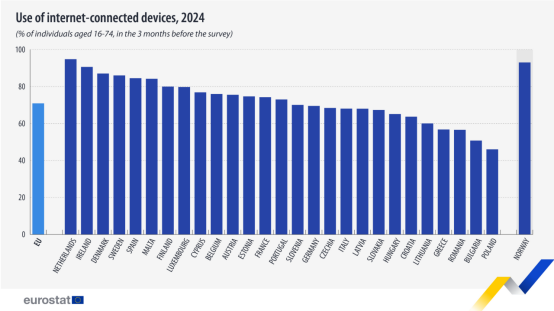
The Eurostat survey on residents’ use of connected devices focuses on consumer IoT. The survey shows that by 2024, the proportion of EU residents using smart IoT will exceed 70%, with the highest percentage of connected device users in the Netherlands at 94.8%, followed by Ireland at 90.6% and Denmark at 87%. In contrast, Poland, Bulgaria, and Romania have the lowest usage rates at 46.1%, 50.8%, and 56.6%, respectively. The following chart presents the survey data on the usage rates of smart IoT devices across various EU countries.
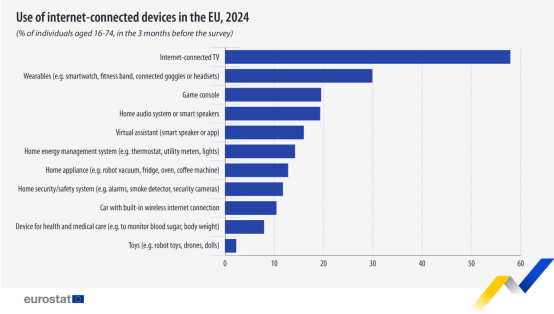
Among different types of smart IoT devices, EU residents show clear preferences. Smart TVs are currently the most commonly used devices, with approximately 57.9% of surveyed residents indicating they use smart TVs. Next are smart wearable devices, with 29.9% of respondents reporting the use of smart wearables, including smartwatches and fitness trackers. Nearly one-fifth of residents reported using gaming consoles (19.5%) and connected home audio systems (19.3%), while 16% indicated they use smart speakers as virtual assistants. Home automation devices are also an important form of smart IoT, with 14.2% of residents using connected home energy management systems, 12.8% using smart appliances, and 11.8% using smart home security devices. Finally, 10.5% of residents reported using cars with built-in wireless connectivity, 7.9% using health-related IoT devices, and 2.3% using connected toys.
What are the barriers to using smart IoT devices? The Eurostat survey also provided answers: among residents who do not use smart IoT devices, 41% believe there is no need to use them, 9% find the prices prohibitive, 6% feel they lack the skills to use such devices, and 7% express concerns about security.
The above conclusions from the Eurostat survey indicate that most residents have a relatively high acceptance of IoT devices, and the penetration rate of IoT in people’s consumption lives is expected to further increase, making IoT an indispensable part of life.
Although there is no systematic survey on household and personal consumer IoT in China, based on the development of the IoT industry and the shipment volumes of major products in recent years, it can be expected that the penetration rate of IoT products among domestic residents is also continuously rising. For example, QuestMobile’s 2025 panoramic ecological traffic semi-annual report shows that the number of active smart TVs has risen to 288 million units. According to Aowei Cloud Network, from August 2024 to July 2025, total air conditioner sales in China reached 196 million units, a year-on-year increase of 11.5%, with domestic sales exceeding 100 million units, reaching 102 million units, a year-on-year increase of 8.7%, with smart products being the favorites in urban markets.
Major manufacturers are continuously making efforts in the consumer IoT field, bringing more intelligent products to residential consumers. For instance, in the first half of 2025, Midea’s smart home business revenue accounted for 66.58% of total revenue; Xiaomi’s smart home appliance business revenue in the first half of 2025 increased by 66.2% year-on-year, with air conditioner shipments exceeding 5.4 million units. Against the backdrop of manufacturers increasing their R&D and production of smart products, domestic residents will also use more consumer IoT products.
IoT is a Necessary Condition for Smart Consumption, but There is a Significant Gap Between High Penetration and Low ‘Presence’
Smart consumption has become an important component of the current macro policy to promote consumption. In August of this year, the State Council issued the “Opinions on Deepening the Implementation of the ‘Artificial Intelligence+’ Action,” which proposed cultivating new business formats for product consumption in the chapter on improving consumption quality through “Artificial Intelligence+”, including promoting the intelligent terminal ‘Internet of Everything’, cultivating an ecosystem of smart products, and vigorously developing new generation smart terminals such as smart connected vehicles, AI smartphones and computers, smart robots, smart homes, and smart wearables, to create an integrated smart interaction environment covering all scenarios. Accelerating the integration of artificial intelligence with technologies such as the metaverse, low-altitude flight, additive manufacturing, and brain-computer interfaces, and exploring new forms of smart products.
Experts from the National Development and Reform Commission pointed out that “Artificial Intelligence+” brings new trends in consumption, one of which is the upgrade from “auxiliary tools” to “intelligent partners.” New generation smart terminals represented by smart connected new energy vehicles, AI smartphones and computers, and smart robots no longer simply rely on user input commands for passive execution, but possess the ability to “perceive-decision-evolve,” evolving from tools to partners, and forming an integrated smart interaction environment through the Internet of Everything. Smart connected new energy vehicles are upgrading from mere transportation tools to “mobile intelligent spaces.”
Smart consumption products are largely also connected products; apart from smartphones and computers, other smart consumption products first require support from IoT technology to realize various intelligent functions. As proposed in the State Council’s policy document regarding smart connected vehicles, smart robots, smart homes, and smart wearables, all new generation smart terminals require IoT-related technologies such as sensors, wireless connectivity, edge computing, and device management platforms. It can be said that IoT is a “necessary condition” for smart consumption, and its low-cost, high-quality development directly impacts the growth of smart consumption. From this perspective, the penetration rate of IoT is very high, almost permeating most terminals and scenarios of smart consumption.
However, this “necessary condition” is facing a state of low ‘presence’; IoT is rarely mentioned in various scenarios, and the attention given to IoT in various policy documents is low. The role of IoT has not been fully considered in related industry and market planning, and media attention to the development of IoT technology and industry has significantly decreased. In the author’s view, the significant reduction in its ‘presence’ stems from the following factors:
First, IoT has a certain professional barrier, and the public’s understanding is limited.IoT is not a specific technology; it is a systematic combination that also involves integration with various cutting-edge technologies and rich scenarios across different industries, making it difficult to explain clearly to the public. For consumers, when using a product or in a particular scenario, they generally do not pay much attention to the underlying technical principles.
Second, new hotspots and new technologies receive more attention, leading to insufficient attention to IoT.For example, due to current breakthroughs in AI innovation, society is highly focused on this field, with a large amount of resources converging here, while attention to other fields has decreased. In fact, from a broad perspective, IoT also includes the integrated applications with AI and big data, having entered the AIoT development stage; however, the entire society is highly focused on cutting-edge fields such as large models and intelligent agents, neglecting this area that can integrate with AI and be rapidly implemented.
Third, IoT has entered a mature development phase, becoming a common underlying technology for smart societies.After years of development, the value of IoT has become apparent, and it is no longer a field that needs to be hyped. Gartner’s technology maturity curve shows that as early as 2015, IoT had reached the peak of hype and was expected to enter a substantial production maturity phase 5-10 years later. Indeed, it has developed along the predicted path, with the IoT industry shedding its bubble, and the current industry landscape is relatively stable, supporting the overall intelligent development of society.
In this context, the public’s low ‘presence’ of IoT is not a bad thing; rather, it largely reflects the steady development of the IoT industry and its contribution to the economy and society.
On one hand, with the continuous development of AIoT, IoT provides a broader range of scenarios for AI implementation. Over the past decade, IoT has deeply explored various fields of consumption, production, and social governance, penetrating various scenarios and gathering a wealth of genuine user needs and pain points. Now, cutting-edge technologies such as large models and intelligent agents combined with IoT inject powerful intelligent capabilities into various scenarios, supporting cloud-edge-end collaboration through connection and perception technologies, while the massive connections of IoT bring vast amounts of data, supporting the value realization of data elements.
On the other hand, after the initial hype and bubble burst, IoT has also entered a substantial development maturity phase. Although it does not have the excessive premiums of the hype phase, the development of the industry has formed a virtuous cycle, with most companies no longer pursuing conceptual hotspots but instead solving substantial problems based on scenario needs.
In 2025, the International Telecommunication Union (ITU) will release its first IoT report, citing the viewpoint of Mark Weiser, the father of ubiquitous computing: the best-developed technologies are those that seem to “disappear”; they integrate into the structure of daily life until they become indistinguishable from it. In the author’s view, IoT is moving towards this state, with its ‘presence’ seemingly diminishing, yet it is integrated into all aspects of production and life, such as smart locks and remotely controlled appliances at home, shared bicycles on the street, disappearing water and gas meter readers, assisted driving cars, real-time tracking of key items, smart factories, etc. Although many people are unaware of the underlying IoT technology, they use it every day.