RIO Electric Drive

Focusing on sharing knowledge and information related to new energy vehicles and the three electric systems.
《
Research on White Box Modeling Methods for Negative Effects of Permanent Magnet Motor Variable Frequency Drive Based on Small Signal Finite Element Analysis》,This is original content and may not be reproduced without permission. For further communication regarding this article, please contact the editor: paul95231075
Related
Articles
🔹ANSYS Workbench Practical: Strength Analysis of High-Speed Motor Rotor Stamping Sheets
🔹33 Tips to Optimize NVH in Permanent Magnet Electric Drive Systems!
🔹How was the Xiaomi 27200rpm Motor Made? Discussing the Simulation Logic Behind It🔹In-depth Exploration of Permanent Magnet Synchronous Motor Design: Optimization of Back EMF Differences, Eddy Current Losses, and Stator Slot Numbers
To promote communication among upstream and downstream enterprises and professionals in the new energy vehicle electric drive system industry chain, Lingao Consulting and RIO Electric Drive have specially launched the “RIO Lingao Networking Circle” mini-program, which is free to register and share connections. Easily find the connections you want.
(Click the image above to learn about the latest agenda)
Introduction
The performance requirements for rotor position sensors in new energy electric drive systems are stringent, as their accuracy and stability directly affect the precision of motor control. Currently, rotary transformers dominate the position sensor market in new energy electric drive systems due to their simple structure, convenient layout, and high precision characteristics. However, another type of sensor worth noting is the eddy current sensor. Next, we will provide a detailed introduction to eddy current sensors.
01#
Structure and Working Principle of Eddy Current Position Sensors
Eddy current position sensors are non-contact measuring devices based on the principle of electromagnetic induction. Their core components include a coil (integrated with a PCB), a target wheel, and a decoding chip, structured as shown in the figure below.
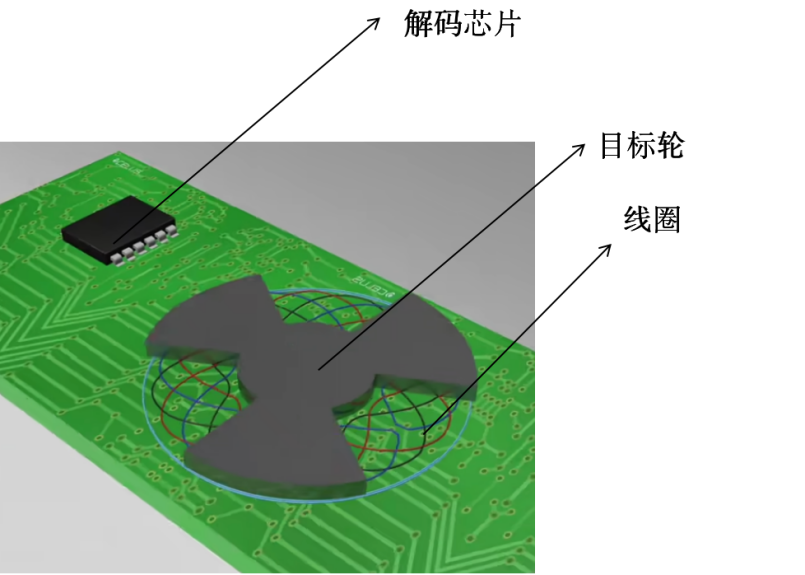
The primary coil requires a 5V DC power supply to generate a high-frequency AC signal of approximately 3.5 MHz, which acts on the surface of the metal target wheel, creating an eddy current effect. As the target wheel rotates, the secondary coil receives changes in the magnetic field, resulting in variations in voltage levels. This change is decoded by the internal chip and sent to the electronic control unit to obtain the actual position of the rotor.
From the structure described above, it is clear that the major cost is actually the decoding chip; if this chip is an imported one, it accounts for about 50% of the total cost of the eddy current sensor.
02#
How to Choose Between Eddy Current Position Sensors and Rotary Transformers
Why do rotary transformers dominate the market while the application of eddy current sensors is relatively limited? Let’s compare eddy current position sensors with rotary transformers.
| _ |
Eddy Current Position Sensor |
Rotary Transformer |
|
Accuracy |
High Precision |
High Precision |
|
Response Speed |
Relatively Fast |
Relatively Fast |
|
Resistance to Harsh Environments |
Can operate stably under harsh conditions |
Can operate stably under harsh conditions |
|
Cost |
Depends on the chip |
Depends on size |
|
Installation and Debugging |
Installation and debugging process is relatively complex and requires precise adjustment |
Installation and debugging are relatively simple |
From the comparison in the table above, we can draw the following conclusions: in terms of functionality, eddy current sensors and rotary transformers exhibit comparable performance, especially in terms of accuracy and response speed, both achieving high levels. However, there are significant differences in cost and installation/debugging aspects.
In terms of cost, the expenses for eddy current sensors are primarily concentrated on the chip, while the cost of rotary transformers is mainly composed of silicon steel sheets. In recent years, due to the shortage of automotive chips, the cost of eddy current sensors has not shown a significant advantage over rotary transformers. However, as the shortage of automotive chips gradually eases, the cost of eddy current sensors has significantly decreased, especially with the emergence of domestic automotive-grade chip alternatives, eliminating the cost disadvantage of eddy current sensors. Particularly when compared to larger rotary transformers, such as those used in oil-cooled motors, where the rotor needs to accommodate oil passages, choosing rotary transformers can lead to a significant increase in costs, thereby highlighting the cost advantage of eddy current sensors.
Regarding installation and debugging, eddy current sensors require the target wheel to be positioned on the rotor (usually placed on a balancing plate), which imposes certain requirements on the overall layout of the motor. In contrast, rotary transformers have a smaller impact on motor layout and are easier to adjust later. Therefore, when costs are similar, the advantages of using rotary transformers are evident.
Conclusion
In terms of functionality and performance, eddy current sensors and rotary transformers are comparable, but in terms of cost, especially when compared to large rotary transformers, eddy current sensors demonstrate advantages. Therefore, when selecting sensors, cost factors become an important reason to consider using eddy current sensors.
Copyright and Disclaimer:
1. If you need to reprint or extract, please indicate at the beginning or end of the article: Content sourced from the 【RIO Electric Drive】 public account.
2. Any works marked “Source: XXX (not RIO Electric Drive)” are reprinted or extracted from other media, and the purpose of reprinting or extracting is to convey more information, and do not represent the platform’s endorsement of their views or responsibility for their authenticity.
3. This article is for readers’ reference, learning, and communication only, and may not be used for commercial purposes. If the above requirements are violated, the platform has the right to request deletion and pursue corresponding legal responsibilities.
Contact Number: 021-57786005