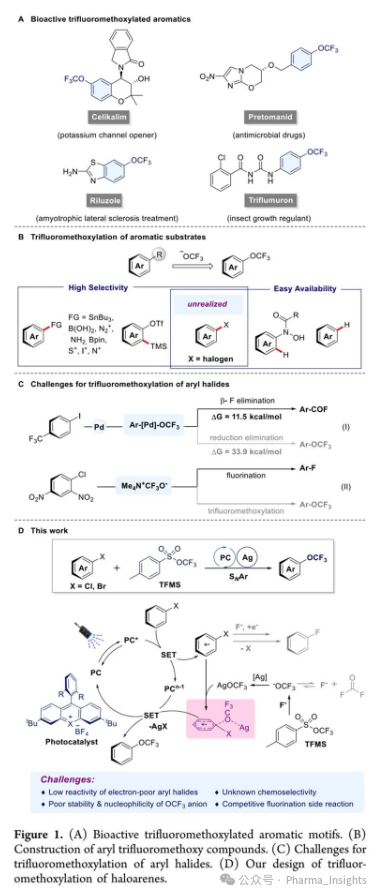
The trifluoromethoxy group (-OCF3) is a highly valuable functional group in the design of pharmaceutical and pesticide molecules—its unique stereostructure (perpendicular to the aromatic ring plane) can significantly enhance the binding ability of molecules to biological targets. Additionally, its strong electron-withdrawing nature and high lipophilicity can improve the metabolic stability and cell membrane permeability of drug molecules. Currently, the OCF3 group can be found in many lipid-lowering, antimalarial, antibacterial drugs, and herbicides, such as the antimalarial drug atovaquone and the lipid-lowering drug clofibrate (Figure 1 A).
Due to factors such as the easy decomposition of the OCF3 anion into fluoride and difluorophosgene, as well as its relatively weak nucleophilicity, the direct introduction of OCF3 into the aromatic ring has proven difficult. Efficiently and precisely installing OCF3 onto organic molecules has long been a challenge in the field of synthetic chemistry.
Among many potential substrates, aryl halides (Ar-X) are considered one of the most ideal raw materials due to their commercial availability, stability, and ease of regioselective control. However, it is regrettable that the direct trifluoromethoxylation of aryl halides has remained unachievable for decades. Traditional methods face two major issues: (1) OCF3 radicals tend to attack the C-H bonds of the aromatic ring rather than the stronger C-X bonds. (2) The weak nucleophilicity of the OCF3 anion makes it difficult to undergo traditional aromatic nucleophilic substitution reactions with aryl halides. Transition metal (such as palladium) catalysis can quickly lead to β-fluoride elimination, yielding acyl fluoride products instead of trifluoromethoxy products (Figure 1 C).
Recently, the team of Professor Tang Pingping at Nankai University reported the first example of silver-promoted photocatalyst-controlled trifluoromethoxylation of aryl halides. The key to this strategy lies in utilizing photocatalysis to generate aryl cation radical intermediates, significantly enhancing the reaction activity. Silver salts play a crucial role in this transformation: they promote halogen departure to improve chemical selectivity; they form AgOCF3 species to stabilize the OCF3 anion; and they complex with substrates to accelerate the capture of unstable cation radicals, allowing even inert and electron-deficient aryl halides to participate smoothly in the reaction (Figure 1 D).
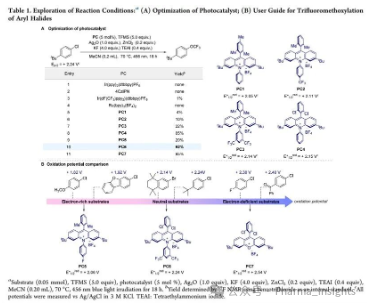
Through systematic optimization of conditions, the authors found that the choice of photosensitizer is crucial for substrates with different electronic properties: PC5 is used for electron-rich aryl halides; PC6 is used for neutral aryl halides; and PC7 is suitable for electron-deficient aryl halides (Table 1).
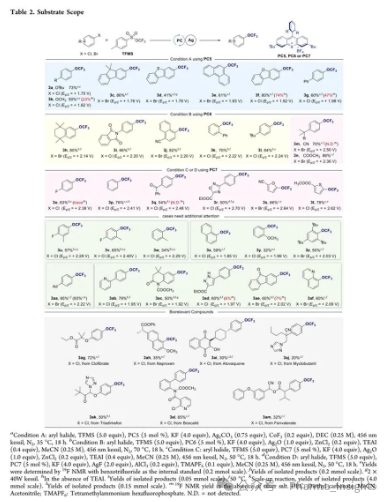
This method demonstrates excellent substrate compatibility: conventional aryl halides, heterocyclic compounds, and bioactive molecules can all be smoothly converted into the corresponding trifluoromethoxy products (Table 2).
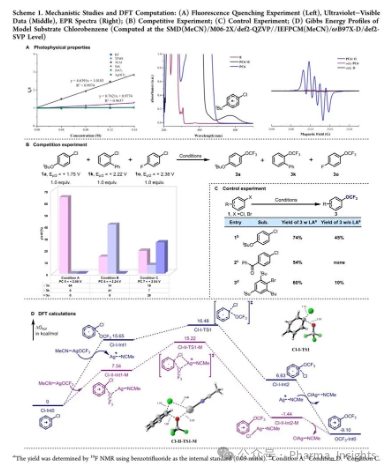
Based on fluorescence quenching experiments, UV spectroscopy, EPR experiments, control experiments, and DFT theoretical calculations, the authors propose that the nucleophilic attack of the OCF3 anion on the chlorobenzene cation radical can proceed via the SNAr pathway, with an energy barrier of 16.48 kcal/mol; coordination with a single acetonitrile molecule by the bridging silver ion can simultaneously coordinate with the leaving group Cl and OCF3, reducing the energy barrier to 15.22 kcal/mol; when considering coordination with two acetonitrile molecules, the transition state energy barrier further decreases to 14.80 kcal/mol. These results confirm the critical role of silver salts in promoting the halogen departure process (Scheme 1).
Conclusion
The authors have achieved the trifluoromethoxylation of aryl halides for the first time by generating aryl cation radical intermediates through photocatalysis. By adding silver salts, inert neutral and electron-deficient aryl halides can successfully participate in the reaction. The broad substrate applicability of this method suggests its potential value in the field of medicinal chemistry. This silver-assisted strategy also provides new ideas for other challenging transformations and is expected to play an important role in organic synthesis, materials science, and drug development.
This achievement was recently published in the Journal of the American Chemical Society, with Professor Tang Pingping, Professor Chen Li, and Associate Professor Luan Yuxin from Nankai University as co-corresponding authors, and doctoral student Zhou Jingya as the first author of the paper. The theoretical calculation part of this work was assisted by Professor Xu Xiufang.
Full text link:
https://pubs.acs.org/doi/10.1021/jacs.5c11167
(Source: Nankai University)