Corresponding Author: Xu Zhi-Chuan
Affiliation:Nanyang Technological University (南洋理工大学)
Professor Xu Zhi-Chuan’s Research Group Homepage:https://personal.ntu.edu.sg/xuzc
Abstract
Single-atom catalysts (SACs) have emerged as transformative materials in the field of multiphase electrocatalysis, yet their traditional symmetric coordination environment often leads to suboptimal catalytic efficiency. This paper systematically investigates the disruption of local symmetry as a powerful design strategy to precisely tuneSACs‘ electronic properties. The authors classify and analyze atomic-level tuning methods, including strain-induced lattice distortion, defect engineering coordination control, and curvature-induced interfacial fields, demonstrating how these strategies effectively break the inherent symmetry of structures such asM-N4. The authors’ analysis indicates that this symmetry breaking redistributes the electronic density around the metal center, enhances orbital degeneracy, and optimizesd band centers, thereby enhancing intermediate adsorption, accelerating reaction kinetics, and breaking scaling relationships. Furthermore, these asymmetric configurations ofSACs exhibit higher stability through enhanced metal-support interactions. Although significant progress has been made, future efforts must address challenges in atomic-level precision, reaction stability, and scalable synthesis to fully realize the potential of symmetry-breakingSACs in various electrocatalytic applications, thereby establishing new paradigms for the rational design of advanced electrocatalytic materials.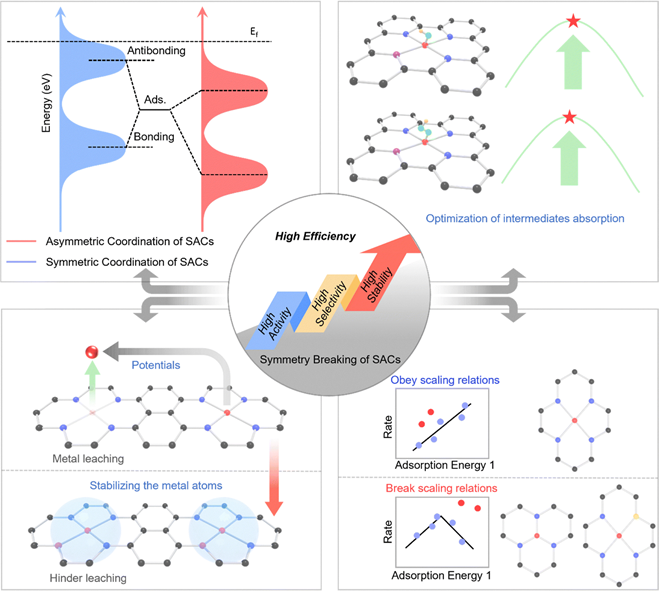
DOI:10.1039/D5CS00209E
Link:https://doi.org/10.1039/D5CS00209E[Literature Transfer]Chem. Soc. Rev. Review: Achieving Better Catalysis through Symmetry Breaking: Insights into Single-Atom Catalyst Design