Intrahepatic cholangiocarcinoma (ICC) is a malignant tumor originating from the epithelial cells of the secondary and higher bile ducts, and it is the second most common primary liver cancer. In recent years, the incidence and mortality rates of ICC have been rising globally. Clonorchis sinensis (referred to as “liver fluke”) has been classified as a definite Group 1 carcinogen by the International Agency for Research on Cancer (IARC). The incidence of cholangiocarcinoma in patients infected with liver flukes ranges from 5.5% to 12.2%, which is 6 to 10 times higher than that in uninfected patients. On December 28, 2023, the team led by Kuang Ming at the First Affiliated Hospital of Sun Yat-sen University published a clinical report titled Clonorchis sinensis Liver Flukes in the internationally recognized clinical medicine journal The New England Journal of Medicine. This study is the first to report the activity of liver flukes in the human biliary tract, vividly presenting the living habits of the liver fluke and providing extremely valuable imaging data. However, the impact of liver fluke infection on the prognosis of ICC patients and its potential molecular characteristics remain unclear. On March 19, 2024, the Kuang Ming team at the First Affiliated Hospital of Sun Yat-sen University published a research paper titled FASN-mediated Fatty Acid Biosynthesis Remodels Immune Environment in Clonorchis sinensis Infection-Related Intrahepatic Cholangiocarcinoma in the authoritative international journal on liver diseases, Journal of Hepatology. The study found that the survival of ICC patients infected with liver flukes was significantly shortened, and their response to immune checkpoint inhibitors was poor; the expression of fatty acid synthase (FASN) in ICC cells infected by liver flukes was upregulated, leading to increased fatty acid synthesis, which in turn promoted the anti-inflammatory phenotype of macrophages and inhibited the cytotoxic function of CD8+ T cells; FASN inhibitors could significantly enhance the efficacy of PD-1 monoclonal antibody therapy for liver fluke-related ICC.
 The researchers collected tissue samples and clinical information from 251 ICC patients with and without liver fluke infection from three centers. Through single-cell sequencing and multi-omics analysis, they found that ICC tumor cells infected with liver flukes exhibited more pronounced proliferation characteristics and more active fatty acid synthesis. Among them, the expression of the key enzyme FASN for fatty acid synthesis was significantly upregulated. The ICC tumor cells infected with liver flukes produced a large amount of fatty acids through metabolic reprogramming, promoting the differentiation of immunosuppressive tumor-associated macrophages (TAM), thereby inhibiting the effector function of CD8+ T cells and forming an immunosuppressive microenvironment. The researchers further confirmed through spatial transcriptomics that, compared to ICC patients uninfected with liver flukes, ICC patients infected with liver flukes had more active fatty acid synthesis metabolism in tumor cells, and the tumor cells were spatially closer to TAM. Animal experiments suggested that treatment with the excretory/secretory products (ESPs) produced by liver flukes significantly increased tumor burden in mice, accompanied by upregulation of FASN expression. Tumor tissues from both groups of mice were collected for bulk RNA sequencing and metabolomics analysis, revealing that the fatty acid synthesis pathway in the tumor tissues of the ESPs treatment group was significantly upregulated, and fatty acids were significantly increased. Further flow cytometry analysis showed that in the tumor microenvironment of ESPs-treated mice, the pro-inflammatory protein CD80 in macrophages was significantly downregulated, while the immunosuppressive proteins CD163, CD206, and PD-L1 were significantly upregulated, and the effector molecules INF-γ and GZMB in CD8+ T cells were significantly downregulated. To further explore the impact of FASN on the immune microenvironment of liver fluke-related ICC and its translational significance, the researchers used FASN inhibitors alone, PD-1 monoclonal antibodies alone, and a combination of both treatments. They found that the combination of FASN inhibitors and PD-1 monoclonal antibodies significantly reduced the tumor burden of ICC in the ESPs treatment group. Flow cytometry analysis confirmed that after receiving combination therapy, the pro-inflammatory characteristics of macrophages in the ESPs treatment group were significantly upregulated while the immunosuppressive characteristics were significantly downregulated, and the effector function of CD8+ T cells was significantly enhanced.
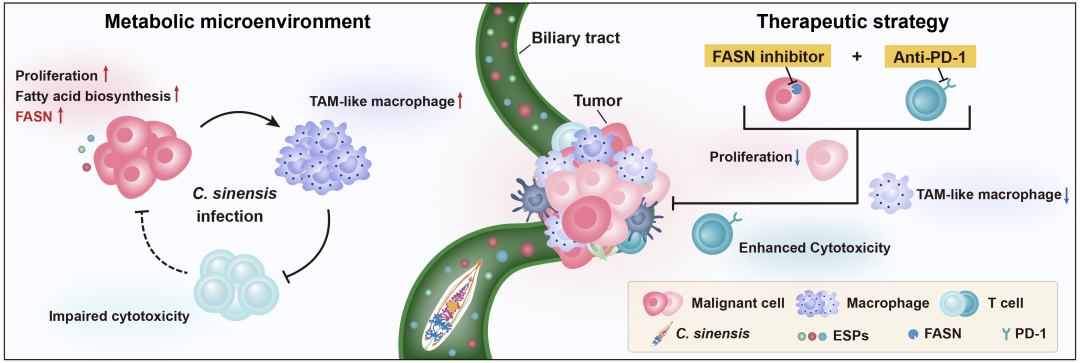 In summary, the enhanced activity of the FASN-mediated fatty acid synthesis pathway induces the production of an immunosuppressive phenotype in macrophages, thereby inhibiting the effector function of CD8+ T cells, promoting the formation of an immunosuppressive tumor microenvironment in ICC patients infected with liver flukes. Mouse experiments suggest that the combination of FASN inhibitors and PD-1 monoclonal antibodies may become a new therapeutic strategy for liver fluke-related ICC.Dr. Xu Lixia, attending physician, Dr. Zhang Ying, resident physician, PhD student Lin Zhilong, and PhD student Deng Xinlang are co-first authors of this study. Professor Kuang Ming, director of the Hepatobiliary and Pancreatic Surgery Center at the First Affiliated Hospital of Sun Yat-sen University, is the corresponding author of this study, along with associate researcher Xie Yubin and attending physician Lai Jiaming as co-corresponding authors.Original link: https://www.sciencedirect.com/science/article/pii/S0168827824001995