
Host’s Note:
The tradition of Western philosophers reflecting on art since ancient Greece has promoted the development of Western aesthetics and art theory. Modern French philosopher Merleau-Ponty explored the purpose of painting not just as a contemplation of art. This issue’s article by Hu Min points out that Merleau-Ponty constructs his “phenomenology of perception” theory through reflection on the art of painting, advancing philosophical development. It also provides a “feedback” to art, theoretically confirming the value of Western modern painting’s efforts to break traditional representational models and establish new paradigms of truth. The modern art effort to break boundaries is multidirectional. In this issue, Ao Lulu introduces the research of British scholar Dave Beech on the development of “text art” that began in the mid-1960s, indicating that through linguistic tools, modern art achieves its own new expansion, with “language” becoming an important expressive tool for contemporary artists. The German Bauhaus, founded in the 1930s, existed for a short time, but its design ideals have had a profound impact. This issue’s article by Wei Li studies how Bauhaus design concepts have been continuously deconstructed and reconstructed by generations of designers in the Middle East, enabling its architectural design to participate in and serve national construction, social economy, and cultural development in a deeper, proactive, and holistic manner, exemplified by the urban architectural design of Tel Aviv, Israel, indicating that its historical experiences hold certain reference value for current design development in China.
——Wang HongyuanTranslator’s Note
The author of this article, Dave Beech (1960s—), is a British artist and art theorist. He has served as a professor at the University of Gothenburg in Sweden and is currently a professor of art and Marxism at the University of the Arts London. He is recognized as a leading scholar in the UK and Europe, but there is currently no relevant introduction in China.
Regarding text art, the Western academic community generally considers it to have begun in the late 1960s in the UK and the US. At that time, influenced on one hand by Wittgenstein’s philosophical turn to language and on the other by Saussure’s linguistic research findings, conceptual and ideological became everything in art. Thus, language became a tool for reform and entered visual art. During this period, the UK established one of the most important groups in text art, “Art & Language,” which mainly consisted of four members but included nearly fifty artists from the US and Europe, who further expanded the influence of contemporary text art. Therefore, this article discusses several artists and their artistic thoughts that play important roles in the field of text art, initially sketching a “picture” of text art, aiding our systematic understanding of text art.
This article is included in the book “Art and Text” (Art and Text, 2009), and its main academic value lies in two aspects. First, it clearly proposes the concept of “text art” as a specialized term, distinguishing it from text-based art. This helps us reflect on the similarities and differences between the two, and thus re-recognize text art: many works use text, but they may not be considered text art. Text in artistic works is not merely used to convey an idea or serve as a speech act; it is the core of the artistic work, thus involved in the artwork, questioning and provoking our thoughts about language, text, and related issues. Second, it is the first to propose the periodization and genealogy of text art, based on the framework and philosophical foundations of artists from the mid-1960s to 2009. Although these assertions may be questioned, later researchers discussing this topic have cited Beech’s ideas to varying degrees. In other words, this article can be seen as a foundational work in the study of this field and a significant historical and theoretical support.
The academic value of this article is historical. Although text art has developed for nearly sixty years since the mid-1960s, there has been little specialized research on text art. Canadian scholar Kim Dhillon pointed out in his 2017 doctoral thesis submitted to the Royal College of Art in the UK, titled “More Than Words: Text Art Since Conceptualism”: so far, there has been only one lengthy in-depth study on this topic, Liz Kotz’s monograph “Words to Be Looked At: Language in 1960s Art” (2007). Although the number of related publications has increased in the five years since then, such as Dhillon’s new book “Counter Text: Language in Contemporary Art” published this August, research on this topic remains scarce. In light of this, I hope this translation can serve as a catalyst.
Author’s Preface
This article was written at a time when “text art” was no longer a serious artistic discourse; however, at that time, the use of text in art was more prevalent than when “text art” was first created. Therefore, I feel the need to provide some explanation and serve two main purposes. First, I think it is necessary to re-examine and evaluate the significance of text art for a new generation of artists, as these artists seem to take the legitimacy of text as art for granted. Second, I want to overturn the dominant narrative about text art at that time: text art was initially a claim against aesthetics and painting, but in the 1990s, due to the interest in “text as image” and the sculptural and painterly qualities of written text, text art mainly became a visual form.
These two points of academic value help clarify the most basic superficial consensus about the use of text in contemporary art. Of course, this is also significant for me personally, as the so-called new attitude towards text is very familiar and old to me. When I explored conceptual art as a student in 1984, my mentor would say, “Do you expect anyone to read this stuff?” “Have you thought about painting the words instead of typing them?” “Using color instead of black and white would make the text look more interesting.”
The distinction between drawing and writing text in art, as well as the distinction between watching and reading text in art, actually reflects a kind of ideological competition, as critical art historians at the time described as the “disembodied eye,” and as Terry Atkinson said, “perception over cognition.” One of the greatest pleasures of text art (at least for me as a young art student) is that it provides a liberating space where “I” become a subject, a non-viewer. In it, I can be a scholar, a citizen, a critical thinker, an intellectual, a philosophical artist, a writer-type artist, or a new type of artist that belongs to none of these categories. Rather than saying that text art lacks something (visual pleasure), it seems to me that re-transforming text art into a primarily visual type or formal type would lose a lot.
Perhaps my personal investment in the issues discussed in this article is limited, and the conceptual and geographical scope of this article needs to be further expanded. It revolves around a series of brief descriptions of the use of text in contemporary art, especially among artists of my generation residing in London, which was my limitation at the time. Moreover, looking back, I hope the article emphasizes the contextualization of contemporary text art more and provides fewer examples. In this way, it can be further structured and highlight the argument, preventing my main points from being drowned in various facts.
The core of this article advocates for the centrality of language in all art after Duchamp and conceptualism. In retrospect, if I had better understood the difference between the post-Duchampian practice of nomination and the post-Cage practice of “event scores,” as well as the division of art production into a series of “tasks,” I would not have been overly committed to the idea of “post-Duchampian ontology of art.” This overstatement of a singular, unified ontology of text art may obscure the more important claims of this article.
I want to begin to sketch or redraw the history of art research on text art in a dual-wave manner. In my view, text artists of different generations are influenced by philosophers of language from different generations. I cannot fully match these two wave diagrams, but it seems possible to derive something from the argument that the first generation of text artists was mainly influenced by analytic philosophers, the second generation by structuralist and post-structuralist philosophers, and possibly the third generation by theories of the performative nature of language. This intellectual project is still ongoing.
Text art is a genre that has never been seen as a competitor by conceptual art, nor has it been viewed as a subgenre of the conceptual art movement. It is generally believed that text art is too narrow, too specific, and too a priori. However, to simply view conceptual art as a form of text art would be to underestimate it. Indeed, artists of the conceptual generation turned to language and viewed this shift as part of a thorough reform of art, but completing this shift is far from as simple as having text appear in art; after all, it is not merely a formal issue. As Terry Atkinson said, you can borrow any medium to create any form of work, regardless of whether it is done well or poorly. Thus, even if “text can explode into a moment of brilliance in the cultural history space of painting or image,” the group “Art & Language” insists that “conceptual art is not entirely a linguistic turn in artistic practice, although it does represent artists’ appropriation of certain dialogues and discursive mechanisms, and on this basis, critically seeks to empower themselves and others. However, conceptual art did not reduce images to (or attempt to transform them into) language or text; it merely presented a linguistic turn to a limited extent.”
Therefore, the main purpose of this article is to reevaluate the linguistic turn of conceptual art and its relationship with the linguistic turn in philosophy, and to explain to what extent it can help us timely reassess text in art and its corresponding specific context. However, we must acknowledge that the revival of all theoretical values of text art has an unoptimistic starting point. In the 1980s and 1990s, when a new generation of young artists were labeled as “new conceptualists,” very few of them used text in their works. And those who did did not identify their works as text art. At that time, mainstream new conceptual artists, including Damien Hirst, Tracey Emin, and Douglas Gordon, were more interested in how to transform conceptualism into conceptual art after the baptism of postmodernism. Conceptual art, as the legacy of conceptualism, emphasizes appropriation rather than nomination, focuses on semiotics rather than ontology, and values double coding rather than analytical propositions.
Among the outstanding representatives of the new generation of conceptual art, Simon Patterson is such an artist. Interestingly, although he is regarded as a text artist, his works have never been referred to as text art. His earliest work, the diptych “Portraits,” features a pair of blank white canvases, screen-printed with names: Richard Burton and Elizabeth Taylor, Marquis de Sade and Leopold von Sacher-Masoch, and other couples’ portraits, including Stan Laurel and Oliver Hardy, Harry Houdini and Leon Trotsky. This is akin to the early conceptualists’ works, which used text in place of visual or material content, such as Mel Ramsden’s abstract works or Lawrence Weiner’s descriptive statement works. Patterson replaces images with names.
Patterson then continued to use names to replace the content of works, but he expanded the conceptual scope by placing names within images, creating a meaningful image system. The most famous of these is the 1992 work “The Great Bear,” which replaces station names with people’s names, thereby recreating the London Underground map. In this work and others, such as the 1990 work “The Last Supper Arranged According to the Sweeper Formation (Jesus Christ in Goal)” and the 1994 work “Rex Reason,” he uses a series of existing charts and diagrams, including football formations, the periodic table of elements, star maps, the London Underground map, and even airline route maps, ultimately achieving “personalization” by substituting each original term with a name. This introduces another layer of meaning: “If these text art works from the 1960s began to adopt the theory of ‘political vernacular’ described by Benjamin Buchloh, then Patterson liberates it from institutional recognition and reassigns it poetic possibilities.”
Patterson’s later works further develop this, where names no longer occupy the position of images but replace other words. His initial works may indeed have simply replaced portraits and names, but later, his works entered into a dialogue between the original terms or contexts and the substitute terms, becoming the most easily understood metaphors. Regarding metaphor, Paul Ricoeur once said: “A spark of semantic incompatibility collapses in the confrontation of several levels of meaning, and meaning exists only on the fault lines of the semantic field.”
The fire of metaphor ignited by Patterson always ignites in specific discursive and material contexts. He adds a Foucaultian dimension to his works by questioning language through his creative methods. Bernhard Fibicher, when discussing Patterson, referred to Michel Foucault’s “The Order of Things” (the original French text “Les Mots et les Choses”) and Foucault’s narration of Jorge Luis Borges’ short story “The Analytical Language of John Wilkins.” The examples cited are said to come from a “Chinese encyclopedia” about animal classification, including “those belonging to the emperor,” “those who just broke a vase,” and “things that look like flies from a distance.” Although Borges’ “Chinese Encyclopedia” is humorous, it carries profound significance, especially when we realize that the strangeness of these specific cases can be universally replicated. Thus, the core question arises in Patterson’s work, namely the question of text art. Fibicher wrote: “Foucault’s conclusion is that these incompatible categories can only exist in language.”
Here, language cannot merely be viewed as a specialized domain, separate from things and events like many sounds or shapes. Wittgenstein pointed out that understanding a language is understanding a way of life, and questioning language is questioning the very social and cultural landscape. In other words, language is political. Jennifer Higgie pointed out that Patterson’s works aim to “extend and explore the limits of the relationships between language, history, and objects.” Of course, an art constructed from language is not limited to the art of language, but due to the inevitable role of language, we are led to these questions: How do we think, how do we live, how do we judge, how do we feel, how do we produce differences, and how do we dissolve differences? It is precisely all of this that constantly appears in Patterson’s works, breaking through material boundaries. To explain it in Foucault’s formula: language involves every forced and unforced combination of power and knowledge. This is why even though the term “text art” is no longer a novelty, the use of text in art has spread like wildfire.
From the 1980s to the 1990s, text began to appear in contemporary art, but without the fanfare, controversy, or heroic momentum seen in the conceptual art of the 1960s. Initially, artists might use a single text as a medium, such as Cornelia Parker’s 1992 work “Words That Define Gravity,” which represents gravity using cast lead blocks thrown off a cliff. Tracey Emin created various neon text works, while Douglas Gordon listed the names of everyone he could remember from meetings and filled several galleries with these names. Some of Martin Creed’s significant works are also text works, including “Everything is Going to be Alright” and “The World + The Work = The World.” Jeremy Deller’s printed lyric posters, exciting bumper stickers, and T-shirts with slogans like “My Drug Shame” and “My Alcohol Hell” politicized text to counter moral campaigns against lifestyle choices. Richard Wentworth’s 1993 work “Tract (From Boost to Wham)” is a pocket Oxford dictionary filled with chocolate bar wrappers in alphabetical order. Hayley Newman’s descriptive performance piece “Kissing” and written work “Kiss Exam” are another example of text works from that period, while the BANK group’s “Fax-backs project” successfully stirred up language politics by “correcting” press releases grammatically and culturally and sending them back to galleries. An early video by Roddy Buchanan fluently read familiar names, contrasting with the obvious differences in linguistics when hesitantly reading foreign names.
Many artists have established their practices around text. Fiona Banner created a series of memorial texts to describe the experience of watching films, which, according to David Barrett, “led to the collapse of literature.” One of the main works in this series, “The Nam,” is a 500-page book in which she traces the actions in several Vietnam War films and transforms them into text. Some of her recent works also describe the experience of viewing nude works in art history, continuing to raise highly charged questions about images, culture, society, and politics through language, making these issues acutely tense yet entirely ordinary. Speaking of her neon letter work “Every Word Unmade” made in 2007, Banner said: “Personally, I am very aware of the brilliance of language and communication, it is the blood of our thoughts. However, I also find it very frustrating; I have many fears about language and communication, and the materiality of this work is to address that problem.”
Mustafa Hulusi’s early works consist entirely of text, always the same short text—his own name. This derives from the label culture of graffiti artists, realized through techniques of promotion, advertising, and media. In specific works, these means are minimized in text art, resulting in strong and complex critical effects. In the alternative logic of text art, Hulusi’s name becomes the image, the art object, and even the work itself, akin to a talentless celebrity or wealth without labor. Superficially, Hulusi’s works are the signature of an artist without a work, or a work that has nothing but a signature, much like Duchamp’s “Fountain,” where the original meaning and customary understanding of the work have been erased. Therefore, if modern art audiences expect works to embody the artist’s presence, such as leaving a lasting expression in the work or a stylized signature, then Hulusi directly resolves everything with his name.
Alan Currall is another artist who places language at the center of his practice. His works often feature monologues directed at the camera, combining elements of stand-up comedy, video diaries, and early video performance practices of figures like Vito Acconci and Martha Rosler. His 2000 work “Message to My Best Friend” showcases what he says to a “best friend,” generally praising their record collection. “Clearly, language is important to what Currall does, but even without language, his humor points to those unreliable literal meanings.” In another work, he consults his parents on how to survive various disasters, including shipwrecks, plane crashes, and unknown wars. In the 1995 piece “Jetsam,” he tells us that although he has a human form and has attended art school, he is an alien. In this work, he also admits that he impersonates an English person simply because he cannot produce a Scottish accent.
Thus, the use of text in contemporary art can be seen as an extension and complication of the alternative logic of the first wave of text art from the 1960s. Today’s text art not only places text in the position of image but also allows text to replace the artist’s presence, occupying a position of subjectivity, replacing experience with description, and can spontaneously adjust. In this sense, Currall’s works, like many other contemporary artists, have made text an important part of their artistic practice in one way or another, raising many serious questions about language itself. In an early work, Currall faces a computer chip, asking it to perform basic text processing tasks, but as expected, the computer’s poor performance is both comical and melancholic. This failure of communication and understanding is the failure where art meets technology. When colloquial language encounters binary code, nothing meaningful emerges, and subjectivity itself disappears due to the frustration of encountering artificial intelligence.
Contemporary text art exists at the intersection of contemporary philosophy, contemporary artistic thought, and contemporary language theory. Text art is an art synchronized with the linguistic turn in philosophy, replacing speculation about thought with analysis of language use. From Wittgenstein to Derrida, from Austin to Butler, the linguistic turn in philosophy, also known as “post-conscious philosophy” or “post-humanism,” overcomes the privacy and internal thought proposed by Cartesian tradition. Rather than simply asserting that reality and experience are constituted or constrained by language, the best way to understand the crisis of understanding is to reflect on which old philosophical pillars have been replaced by the linguistic turn. For example, Wittgenstein turned to the analysis of everyday language use, treating it as a multi-tool operating in uncertain social environments, replacing abstract speculation about concepts with concrete investigations into how words point to concepts in specific language games. Thus, philosophers may find the concept of time confusing; as Wittgenstein once said, when we buy train tickets, we have no such confusion.
Wittgenstein is one of the philosophers Richard Rorty thought of when describing the linguistic turn; he said: “Philosophical problems can be solved (or dissolved) by reforming language, or by understanding language better, or by understanding the language we are currently using better.” However, the linguistic turn does not always have enough confidence in its own power. For instance, structuralists and post-structuralists, while abandoning Cartesian self-determination and rejecting the truth demands of the Enlightenment, did not make ordinary language the cornerstone of explanation but emphasized arbitrary signs, floating signifiers, and texts without authors or referents. Derrida consistently retranslated the linguistic turn into philosophical analysis, but this inevitably remains an analysis of language because philosophy must deal with writing and the practice of “close reading.” Therefore, his critique of philosophy begins with the rejection of the destructive impact of language on philosophy itself. “Most importantly, the work of deconstruction is to eliminate the idea that, according to Derrida, this is the dominant illusion of Western metaphysics, that reason can somehow detach from language to reach a pure, self-certifying truth or method.”
The linguistic turn in linguistics is neither limited to the first wave of analytic philosophy nor the second wave of structuralism and post-structuralism. Jürgen Habermas responded to the linguistic turn in a completely different way. He criticized the role of reason in previous concepts of democracy and social action, shifting the focus of philosophy from subject-object relations to intersubjective communication processes, which retained a rational version of dialogue using language. If the first wave of the linguistic turn replaced questions about what we mean and how language refers with questions about existence and what we can know, then Habermas’s linguistic turn replaces political questions about the nature and structure of society with questions about how language establishes common beliefs and collective actions.
For art, the linguistic turn was heralded by the death of the author, the critique of expression, the post-aesthetic state, and the systems, structures, grids, rules, tasks, and processes of post-minimalism. Consider how many lists and collections of contemporary text art exist, or how many system programs have been used in the selection, organization, and mediation of the new text art discourse. Whether it’s Ward Shelley’s timeline drafts and paintings, or Paul O’Neill’s list of all the brands of ecstasy listed after “The Archive Impulse,” text art has been involved in the linguistic turn at least twice: the first is the actual presence of language in works, and the second is the arrangement of structures. Using lists is a grid version of text art, allowing us to see key features of the linguistic turn in contemporary text art. This does not simply point out that these works use language; rather, it examines how they handle meaning, interpretation, things, and systems. Nevertheless, artists influenced by post-Cartesian and post-Kantian thought resonate with the most interesting and challenging ideas around them. This is the creative context of the aforementioned Simon Patterson, both an alternative spark and a constellation pattern. This is also seen in Cathy Haynes’ and Sally O’Reilly’s project “Meandering Implicasphere,” Layla Curtis’s maps, Peter Davies’ Frank Stella-esque painted lists, Nathan Coley’s neon statements, and Aleksandra Mir’s slogan paintings and newspapers.
Kay Rosen creates text installations using the craft and techniques of commercial signage, filled with various puns, wordplay, and humorous content. For example, “Silence License” is a piece made up of two identical letters, using the capital letter “S” as the penultimate letter of the word “License.” The work “Pendulum” spells out the letters of the word twice, alternating back and forth but missing one letter, thus presenting as PNUUMLDE. “Go Miami/Amigo Miami” is a billboard poster commissioned by the Miami Beach Basel Art Fair in 2002, playfully merging the phrases “mi Amigo Miami” and “Miami Go Miami.” In this work, she carefully cut and arranged the text based on color blocks, making the color blocks serve both as decorative backgrounds and as syntactic elements. “Rosen negotiates between the meaning of the work, the visual seen in the work, and the sound discourse heard when the work is read, the linguistic space between linguistics and phonetics, and the cultural customs and subjectivity, establishing the structure of her works on the oppositions of instrumentalism, that is, the binary correspondence of writing, reading, and painting, and visual.”
Bob and Roberta Smith and Mark Titchner occupy a similar position at the intersection of text and visuals. They both embed text into colorful, culturally rich aesthetic forms. Bob and Roberta Smith interpret text in a style and technique reminiscent of hand-painted signs or notices, while Titchner juxtaposes his text with designs drawn from popular avant-garde abstraction or historical political slogans. Like Rosen, these artists are text artists whose works, regardless of which form of conceptual art they embody, possess a certain degree of pictoriality. “Do your own damn art” is one of the slogan texts drawn in Bob and Roberta Smith’s vernacular style, often combining a moral charge emphasizing self-reliance, with a naïve or ironic tone. Other similar slogans include “Steal my ideas,” “I’m not a liar, you are,” “Writers are idiots,” and “Are you crazy? You want me to do an art project in a mental hospital?”
Titchner’s “The Visible Republic” is a huge fiberglass banner inscribed with a long sentence demanding: “We want mutual loyalty, we want to see potential, we want to improve the human condition, we want unyielding integrity, we want to shape the future of the world…” These aspirations are directly drawn from the corporate declarations of the world’s top ten companies, but the repeated “we want” is taken from the Black Panther Party’s “Ten-Point Plan.” The montage of brand-identified civil rights declarations in the work hints at the demise of radical politics and the rise of neoliberal corporate power. In Titchner’s creation, these slogans are restructured into text art for the third time, raising the question of whether art is a self-governing, independent, and critical space, or a dominant institution for a few privileged individuals to dominate and colonize marginal cultures. Which side does it stand on?
The first generation of text art mainly comes from the “Art & Language” artist group, including Keith Arnatt, Joseph Kosuth, and Lawrence Weiner, and is influenced by the analytic philosophy of Wittgenstein, Austin, Willard van Orman Quine, and A. J. Ayer. The second generation of text artists, including Jenny Holzer, Barbara Kruger, Kay Rosen, and Raymond Pettibon, drew from structuralist and post-structuralist theories of language and meaning from Saussure, Barthes, Derrida, and Lacan. Although Judith Butler’s theory of the performativity of language has undergone a politicized revival, for artists emerging after the second generation, such as Patterson, Bob and Roberta Smith, and Titchner, the linguistic turn is merely a series of background assumptions aimed at securing a place in contemporary art. Therefore, as the linguistic turn has been thoroughly incorporated into art theory, text art has developed on the basis of drawing from art, art history, and art theory.
Contemporary text art focuses on reflecting post-conceptual issues, such as what art is and what makes art interesting. We can identify something akin to an ontology of art in the post-Duchamp period, which I will outline from three key aspects. John Roberts theorized the roles of skill, de-skilling, and re-skilling in contemporary artistic thought; Martha Buskirk elaborated on the characteristics of post-Duchamp artworks as contingent objects; Nicolas Bourriaud emphasized intersubjectivity as a new ontology of art. Thus, pre-modernist craftsmanship, like modernist optical and formalism, places text outside the framework of art works. However, the ontology of post-Duchampian art places text as one of its key practices, especially regarding the skills, objects, and social relations involved in text.
In “The Intangibilities of Form,” John Roberts argues that Duchamp initiated a shift from handmade to presenting ideas through ready-mades, ushering in “a discourse about disseminating authorial identity through social division of labor.” Duchamp produced a copy (a mass-produced commodity) without producing anything, of course, the copy is not the original. This is achieved through the act of “naming,” and this achievement is crucial for the ontology that leads to and promotes the development of text art. In this process, language plays a decisive role, leading to the emergence of what Roberts calls the “post-Cartesian artist” and allowing us to discuss the linguistic turn. This issue was detonated by Duchamp and later reintroduced by Andy Warhol’s “Factory.” The aggressive Cartesianism and non-social aestheticism of modernism were completely abandoned by conceptualism; furthermore, conceptualism replaced the focus on making unique objects in art with nomination, text, and dialogue, thus reversing the relationship between “primary” and “secondary” information.
As Seth Siegelaub said, “The art that interests me is the one that can be communicated through books and catalogs. Clearly, most people’s familiarity with art comes from illustrations, slides, and films. Rather than facing the art itself directly, it is a second-hand, indirect experience. This is unfair to the artwork, as it relies on physical presence, and all these are distorted and altered from the work’s color, scale, material, and context. However, when art no longer relies on its physical presence and becomes an abstract entity, it will not be distorted or changed by its representation in books and catalogs. It becomes primary information, while the representation of traditional art in books and catalogs becomes secondary information. For example, a photograph of a painting is different from the painting itself, but a photograph of a photograph is still just a photograph, or a line of type is still just a line of type. When information becomes the primary thing, the catalog itself can become an exhibition, while also serving as an auxiliary catalog for the exhibition. For instance, in the exhibition “January 1969,” the catalog was primary, while the physical exhibition was auxiliary. This completely reverses the situation.”
Nominating, naming, commenting, and all “secondary” information enter the realm of artistic practice as weapons, replacing what was previously considered “primary,” namely the artwork and its traces as artistic subjects. Post-conceptual art not only places language at the core of contemporary art but also retrospectively emphasizes the role of language in pre-Duchampian art (which is merely supplementary and not within the scope of this discussion), especially in terms of titles, interpretations, art history, criticism, etc. Roberts’ description of post-Cartesian artists, which I refer to as post-Duchampian ontology of art, is not merely a description of events or a linguistic turn of conceptual art; rather, it theoretically elucidates the centrality of language in all art after Duchamp and conceptualism. In other words, craftsmanship disappeared from art, and the subsequent recreation, in the broadest sense, is linguistic, conceptual, discursive, theoretical, managerial, and organizational. Artists like Mary Kelly and Hans Haacke combine images, archival processes, and text in ways that are either Lacanian or Habermasian, investigating existing institutions through analytical, scrutinizing, research-oriented, and demonstrative practices, which is what Buchloh refers to as “managed aesthetics.” We should not underestimate the central role of language in these practices. These two artists clearly benefit from the key thinkers of the second wave of the linguistic turn and are clearly creating within the field of post-Duchampian ontology of art, often dealing with nomination, information, documentation, and ready-mades.
Martha Buskirk expands on this, arguing that in practices where art objects depend on physical and other contextual conditions, “attention to the object itself must be supplemented or even directly replaced by relevant information about the artist’s creative concept.” Generally speaking, performance, video, installation, and ephemeral works are all “second-hand,” rarely undergoing a “hands-on” process (the typical modernist engagement with art objects), but rather mediated through photography and other documentation, including descriptions, instructions, certificates, and contracts. This leads Buskirk to pose the question: “Does the artist’s work rely on the material work, or does it rely on the artist’s plans and directives for the work?” This question has become central to much contemporary art, but in reality, it is a question that only arises within the domain of post-Duchampian ontology of art. To emphasize the transformation involved, Buskirk cites Michael Fried’s criticism of minimalism, which he calls “literal” art. For him, the main issue is that it “can be expressed in words.” Fried views this development, which we call the linguistic turn of art itself, as a manifestation of “running out of ideas.” Indeed, if you want to have an aesthetic encounter between subject and object, then the linguistic turn of art is a traumatic attack, as its representational objects are not failed aesthetic objects but rather a critique of the subjectivity that aesthetics presupposes, based on the philosophical linguistic turn.
The contingency of contemporary art objects—of course, including the contingency of art towards language—is not limited to art objects but permeates all aspects of art: from our contact with it to its mechanisms, from what art can do to what art hopes we become. This is precisely the series of questions posed by Bourriaud in his “Relational Aesthetics” and “Postproduction.” He states: “If an artwork is successful, it will consistently gaze towards existence beyond space. It will open the door to dialogue, discussion, and the ‘coefficient of art’ that Duchamp referred to among people.” Thus, for Bourriaud, this leads to the “surge of joyful, accessible, festive, collective, and participatory artistic projects.”
Bourriaud emphasizes the ethical value of dialogue in such works, including the final goal of works by artists like Rirkrit Tiravanija and Liam Gillick to create works that are literally dialogical, as well as the more broadly understood dialogues in the works of Christine Hill and Noritoshi Hirakawa. Although not text artists in the traditional sense, groups like “Superflex,” Jens Haaning, and Carey Young are excellent examples illustrating that the relational art supported by Bourriaud is fundamentally rooted in the post-Duchampian ontology of art, which is what I describe as the linguistic turn of art itself, that is, the social models they have developed can be referred to as text art. In the “Karlskrona 2” project by the “Superflex” art group, they encourage citizens of Karlskrona, Sweden, to establish a virtual city with avatar characteristics on an internet site, thereby reflecting and discussing the operational ways of the city they live in. In the “Super Channel” project, they use the studios of over twenty artists from different cities as “discussion forums, display media, and physical meeting places.” Besides promoting linguistic exchanges among citizens, the “Superflex” art group also critiques institutionalized language. Their project “Contract” is an example of the social model of text art and is highly provocative. The Royal Danish Theatre invited them to organize some off-site activities, such as events in the theatre’s basement bar, but they refused, instead negotiating with the theatre to sign a contract stating that throughout March, all theatre staff must not use ten specific words in verbal and written communication: theatre, actor, performance, stage, director, ticket, role, rehearsal, premiere, audience.
Jens Haaning created a series of works that “confront the viewer with realities that might change their perceptions of cultural and social environments, and make them question their biases, perceptual habits, and thought patterns.” Although Haaning’s works seem to focus on the social contact created by the viewer, it is important that the turning point of these works often revolves around language or text. In 1996, he displayed “Arabic Jokes” in the form of printed posters on the streets, and in 2001, he played “Turkish Jokes” over a loudspeaker in a park, using language as a stage where political and cultural differences were brought to attention and addressed. The work “Foreigners Free” (1997—2001) calls attention to political differences by allowing foreign visitors free entry to the art museum during the exhibition period. Whether this work primarily functions through the contractual agreements discussed between the artist and the gallery or merely through the signs appearing at the entrance, its political nature is primarily realized through language.
Carey Young’s works critically integrate various avant-garde artistic forms, including performance, video, photography, installation, and institutional critique, but mentioning text art and its variants is essential for completing this list of avant-garde arts. Young’s works consist of behaviors and their related parts, belonging to a type of performance, but regardless, they are linguistic, textual, or discursive. Language plays a crucial role in her works. One of her pieces features her performing a speech on “how to speak in public” at the “Speaker’s Corner” in Hyde Park. On another occasion, she marked a space in a gallery with wall-sized text stating: “When you enter this painted area, during your stay, you declare and agree that the United States Constitution does not apply to you.” She also established a call center, indicating that the artist and her works could be directly contacted via the gallery’s telephone. In her 2007 work “Speechcraft,” she organized a meeting to help people speak like a real “leader”; while in her 2001 piece “I am a Revolutionary,” she was filmed learning how to convincingly say the namesake phrase from a speech coach.
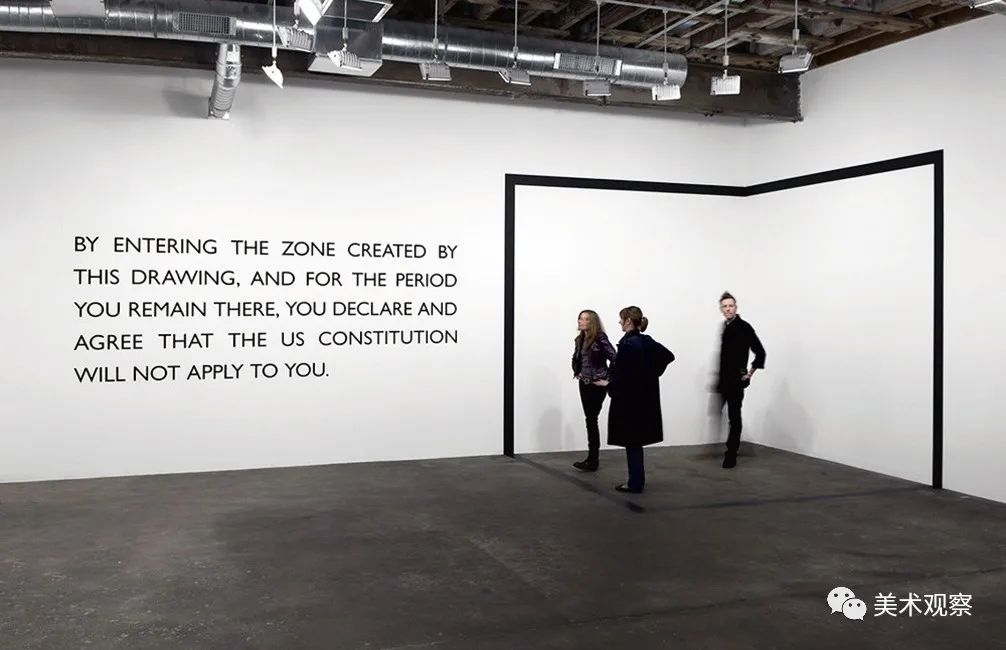 Carey Young Speaker 2007
In her 2008 video “Uncertain Contract,” Young had performers recite a script based on legal documents, with specific clauses omitted, creating tension and anxiety around the existence and non-existence of language. Similarly, in her 2007 video “Product Recall,” the artist entered the consulting room of a psychotherapist, lying on the sofa, while the therapist read a series of advertising slogans, pausing after each to ask Young if she could recall which company the ad was for. Her successes and failures depended not only on her dialogue with the therapist but also on tracing her memories occupied by these multinational companies. This is a performance of the post-Cartesian linguistic turn, where the artist narrates how her internal private consciousness has been manipulated by large corporations. In fact, when we watch the video, we find ourselves joining this game, sometimes guessing the company faster than the artist, and sometimes being impressed by her ability to match a very difficult slogan with its source.
Since the emergence of text art in the 1960s, there have been tremendous changes in the art world. After the end of the Cold War and the rise of neoliberalism and globalization, art has been influenced by biennials, used for urban branding and revitalization, and the superstar status of artists and “super curators” has also emerged; this is the so-called “management and incorporation of art by the new world order.” Despite these changes, the ontology of post-Duchampian art has not been surpassed; we are still post-Cartesian artists. It is just that contemporary examples of text art can illustrate that artists have found new ways to cope with the conditions of post-conceptual art, no longer promoting the linguistic turn in art. The emphasis here is no longer on seeing text art as a special case but recognizing its significant importance to contemporary art and its value to artists. Only in this way can everyone freely combine text with performance, installation, video, photography, “relationality,” sculpture, and the internet.
(This article is translated from Art and Text, Aimee Selby ed., London: Black Dog Publishing, 2009, pp. 26-35. The translation is supported by the China Scholarship Council.)
Notes:
[1] Translator’s note: The English terms “conceptualism” and “conceptual art” in this article derive from the same term, with the translator translating the first and second waves of text art (modernism and structuralism periods) as conceptual art, and the third wave (postmodern and contemporary) as conceptual art based on the historical and theoretical logic of this article and the translation conventions in the domestic art historical context.[2] Art and Language, “We Aimed to be Amateurs”, paper delivered at the ICA, London, 1996; reprinted in Conceptual Art: A Critical Anthology, Alexander Alberro and Blake Stimson eds., Cambridge, MA: The MIT Press, 1999, p.445.[3] Archer, Michael, “Jesus Christ in Goal”, Frieze, Issue 8, January/February 1993.[4] Blazwick, Iwona, “Widescreen Visions”, Simon Patterson, Newcastle Upon Tyne: Locus+, 2002, p.15.[5] Ricoeur, Paul, The Rule of Metaphor: Multi-Disciplinary Studies of the Creation of Meaning in Language, Robert Czerny trans., London:Routledge,1978, p.303[6] Fibicher, Bernard, “In the Name of…”, Simon Patterson, Locus+, 2002, p.6.[7] Higgie, Jennifer, “Simon Patterson”, Frieze, Issue 29, June/August 1996.[8] Barrett, David, “Close Up: Fiona Banner Profile”, Art Monthly, Issue 194, March 1996.[9] Banner, Fiona, in an interview with Gregory Burke, The Bastard Word, (exhibition catalogue), Toronto: The Power Plant, 2007.[10] Turner, Grady T, “Alan Currall at Rupert Goldsworthy”, Art in America, January 1999.[11] Rorty, Richard, The Linguistic Turn: Recent Essays in Philosophical Method, Chicago: University of Chicago Press, 1967, p3.[12] Norris, Christopher, Deconstruction: Theory and Practice, London and New York: Methuen, 1982, p.19.[13] O’Reilly, Sally, “Ward Shelly”, Frize, Issue 100, May 2006.Foster, Hal, “An Archival Impulse”, October 110, Fall 2004, pp.3-22.[14] Kirshner, Judith Russi, “Read Read Rosen”, Artforum, December 1990, p.91.[15] Roberts, John, The Intangibilities of Form, London: Verso, 2007, p.53.[16] Roberts, The Intangibilities of Form, p.54.[17] Roberts, The Intangibilities of Form, pp.101-132.[18] Roberts, The Intangibilities of Form, p.128.It is therefore only after Conceptualism that we can speak with any confidence about a post-Duchampian ontology of art.[19] Siegelaub, Seth, interviewed by Ursula Meyer, 1969, reprinted in Lucy Lippard, Six Years, Berkeley, Los Angeles and London: University of California Press, 1973/1997, pp.124-125.[20] Buchloh, Benjamin, “Conceptual Art 1962-1969: From the Aesthetics of Administration to the Critique of Institutions”, October 55, Winter 1990, pp.105-143.[21] Buskirk, Martha, The Contingent Object of Contemporary Art, Cambridge, MA: The MIT Press, 2005, p.16.[22] Buskirk, The Contingent Object of Contemporary Art, Cambridge, p.27.[23] Fried, Michael, Art and Objecthood, London: University of Chicago Press, 1998, p.117.[24] Bourriaud, Nicolas, Relational Aesthetics, Simon Pleasance and Fronza Woods trans., Dijon: Les Presses du Réel, 2002, p.41.[25] Bourriaud, Relational Aesthetics, p.61.[26] Superflex, Tools, Köln: Verlag der Buchhandlung Walter König, 2003, p.67.[27] Pécoil, Vincent, “Jens Haaning”, Hello, My Name is Jens Hanning, Dijon: Les Presses du Réel, 2003, p.9.[28] Stallabrass, Julian, Art Incorporated: The Story of Contemporary Art, Oxford: Oxford University Press, 2004, p.28.Ao Lulu, PhD student at Loughborough University, UK(This article originally appeared in the 2023 issue 1 of “Art Observation”)
The copyright of this article belongs to this magazine. Please do not reproduce it without permission; infringement will be pursued.

Scan the QR code to follow the WeChat public account of Art Observation
 Please scan the QR codeto enter the “Beijing Art Observation Magazine” WeChat shopto subscribe and purchase the magazine
“Art Observation” Magazine
Supervised by the Ministry of Culture and Tourism
Hosted by the China Academy of Art
Core Chinese Journal of Peking University
RCCSE Authority Academic Journal in China (A+)

For reprint cooperation, please contact WeChat or QQ: 526891471