
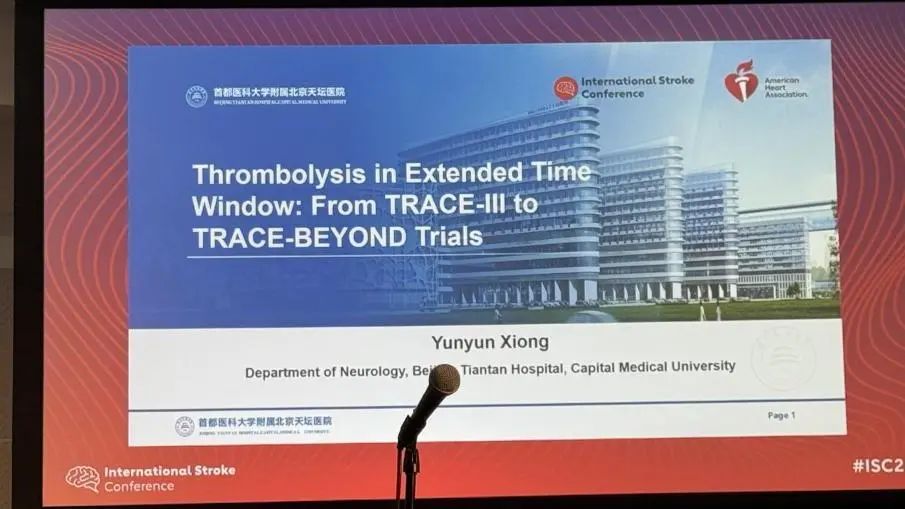
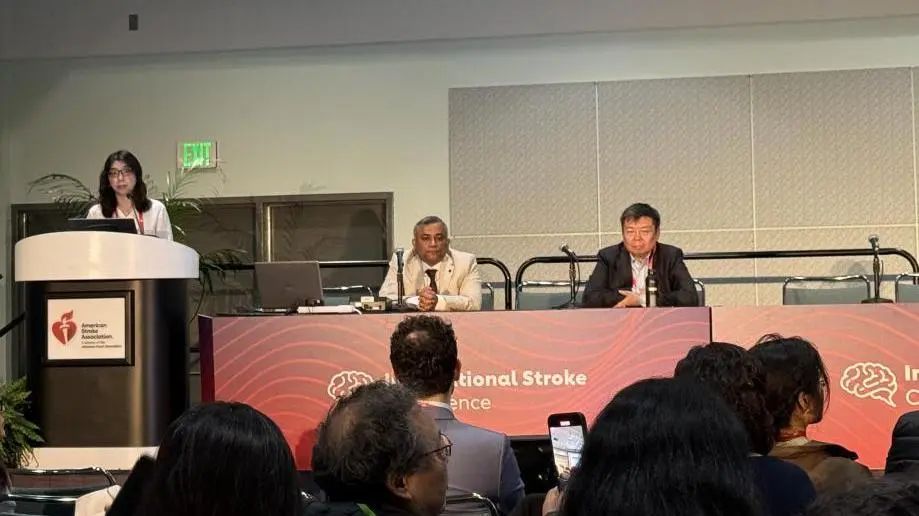
From February 5 to February 7, local time, the International Stroke Conference 2025 (ISC 2025) was grandly held in Los Angeles, USA. On February 7, during the invited symposium, Professor Xiong Yunyun from the Neurology Center of Beijing Tiantan Hospital, Capital Medical University delivered a presentation titled “Thrombolysis in Extended Time Window: From TRACE-3 to TRACE-BEYOND Trials” on intravenous thrombolysis in the extended time window.
0-4.5h Time Window
For acute ischemic stroke patients who meet the indications, intravenous thrombolysis with tenecteplase within 4.5 hours of onset has been proven to be safe and effective[1]. The 2024 Guidelines for Reperfusion Therapy in Acute Ischemic Stroke issued by the Chinese Stroke Association has included tenecteplase in the thrombolysis treatment recommendations within the 4.5-hour time window (Class I recommendation, Level A evidence). However, about 67%-75% of patients arrive at the hospital more than 4.5 hours after onset or have an unknown onset time[2]; about 49% of stroke patients in China arrive at the hospital more than 24 hours after onset[3], which severely limits the accessibility of intravenous thrombolysis treatment.
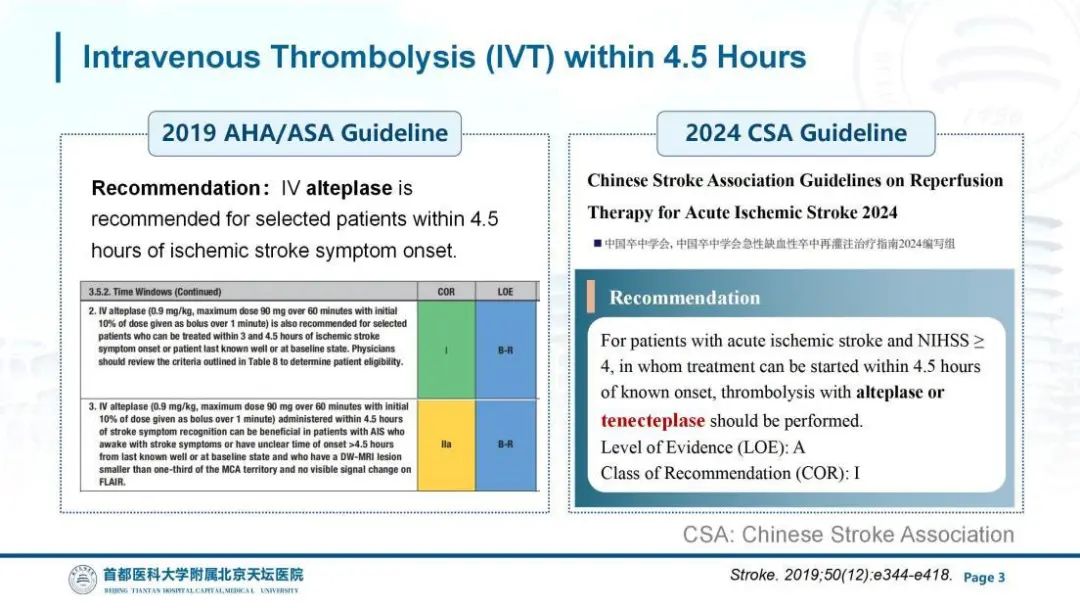 Figure|Guidelines for intravenous thrombolysis in the 0-4.5h time window
4.5-24h Time Window
The TIMELESS trial (Tenecteplase for Stroke at 4.5 to 24 Hours with Perfusion-Imaging Selection) confirmed that among patients with large vessel occlusion and perfusion imaging suggesting salvageable brain tissue, intravenous thrombolysis with tenecteplase is not significantly different in efficacy and safety compared to placebo when administered within 4.5 to 24 hours after onset, and most patients included in this trial immediately underwent endovascular treatment[4]. However, the median global prevalence rate of endovascular treatment is only 2.79%[5]. In 2023, only 7.1% of eligible stroke patients in China received endovascular treatment[6]. Therefore, for patients who cannot undergo endovascular treatment immediately, the effects of intravenous thrombolysis with tenecteplase in the extended time window still need further exploration.
The TRACE-Ⅲ trial is a multicenter, prospective, open-label, endpoint-blinded, randomized controlled phase III clinical trial initiated by Professor Wang Yongjun’s team from Beijing Tiantan Hospital, Capital Medical University. It primarily includes patients with acute ischemic stroke who present within 4.5-24 hours (including wake-up strokes and unwitnessed strokes), with MRA/CTA indicating large artery (ICA, M1, M2) occlusion and CT/MRI perfusion imaging suggesting salvageable brain tissue, but who cannot undergo endovascular treatment; the key imaging inclusion criteria are: (1) ischemic core volume <70 mL, (2) mismatch ratio ≥1.8, (3) mismatch volume ≥15 mL. The TRACE-Ⅲ trial indicates that intravenous thrombolysis with tenecteplase can reduce disability rates in stroke patients with anterior circulation large artery occlusion and imaging penumbra who cannot undergo endovascular treatment within 4.5-24 hours after onset[7]. A meta-analysis of the TIMELESS and TRACE-Ⅲ studies shows that compared to the control group, tenecteplase significantly increased the proportion of patients with a modified Rankin Scale (mRS) score of 0-1 at 90 days (RR 1.29, 95%CI 1.06-1.57, I²=0%).
Based on the above research results, the 2024 Guidelines for Reperfusion Therapy in Acute Ischemic Stroke recommend that patients with NIHSS scores ≥6, onset time within 4.5-24h, anterior circulation large artery occlusion, and perfusion imaging suggesting infarct core/low perfusion mismatch, but who cannot undergo endovascular treatment, should receive intravenous thrombolysis with tenecteplase at a dose of 0.25 mg/kg (Class I recommendation, Level A evidence).
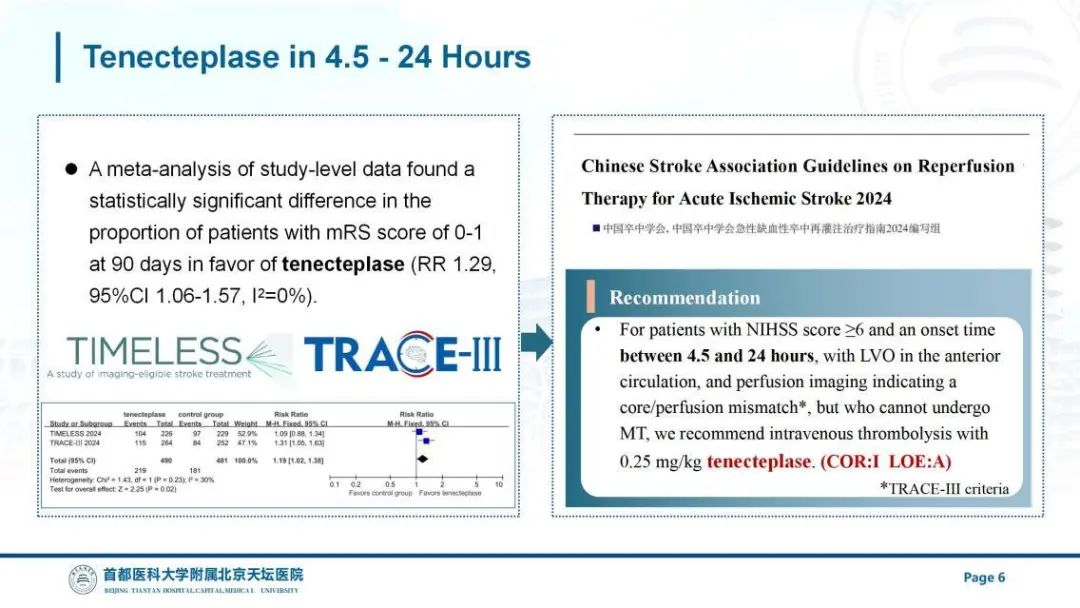
Figure|Guidelines for intravenous thrombolysis in the 4.5-24h time window
Further Exploration of Intravenous Thrombolysis in the Extended Time Window
Professor Wang Yongjun’s team at Beijing Tiantan Hospital, Capital Medical University has been continuously deepening research in the field of extending the time window for intravenous thrombolysis treatment and has conducted multiple randomized controlled trials. In addition to the TRACE-III study, they have also conducted the TRACE-5 study targeting intravenous thrombolysis for posterior circulation large artery occlusion within the 24-hour time window; and the TNK-PLUS study targeting bridging therapy for anterior circulation large artery occlusion. Furthermore, they have initiated the TRACE-BEYOND study for intravenous thrombolysis for anterior circulation large artery occlusion beyond 24 hours. Professor Xiong Yunyun introduced the research objectives, study designs, and current research progress of each trial at the conference.
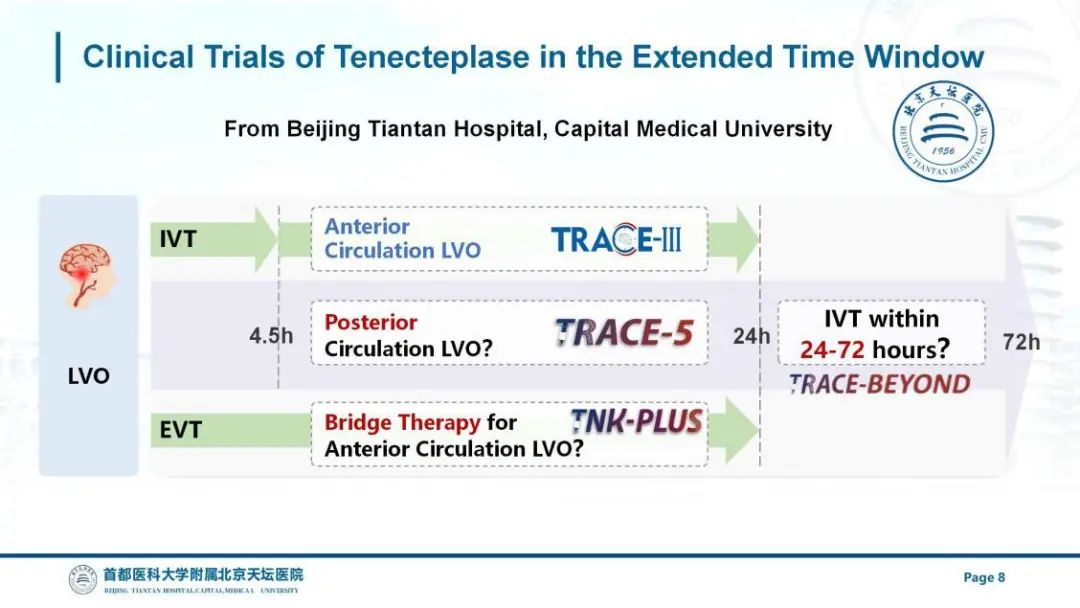
Figure|Some Randomized Controlled Trials on Intravenous Thrombolysis in the Extended Time Window
At the international level, intravenous thrombolysis in the extended time window has also attracted widespread attention, with multiple related randomized controlled trials underway simultaneously. Professor Xiong Yunyun briefly introduced these domestic and international studies and looks forward to these research results bringing new breakthroughs and hope to the field of intravenous thrombolysis treatment.
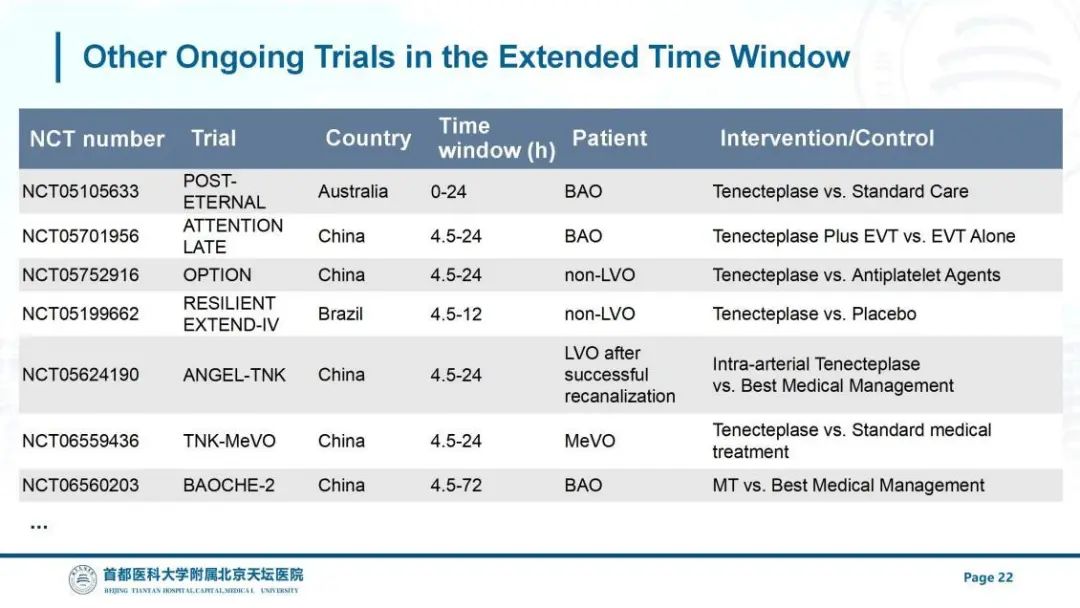
Figure|Domestic and International Randomized Controlled Trials on Intravenous Thrombolysis in the Extended Time Window
Professor Wang Yongjun Professor
President of Beijing Tiantan Hospital, Capital Medical University, Chief Scientist of the Neurology Center, and Professor. He serves as the Director of the National Quality Control Center for Neurological Diseases, President of the Chinese Stroke Association, Chairman of the Neurology Branch of the Chinese Medical Association, and Editor-in-Chief of the journal Stroke and Vascular Neurology. His main research focuses on the recurrence mechanisms and intervention strategies for ischemic cerebrovascular diseases, having pioneered the short-course dual-channel dual-effect treatment method for cerebrovascular diseases (abbreviated as CHANCE), which has rewritten global cerebrovascular disease guidelines; he has revealed the mechanisms of residual recurrence risk in cerebrovascular diseases, developed treatment drugs targeting new mechanisms and new targets, and achieved industrialization. He has published over 300 papers as the first or corresponding author in journals such as NEJM, Lancet, JAMA, BMJ, Circulation, Sci Transl Med, Cell Stem Cell. He has received two second-class National Science and Technology Progress Awards, two first-class provincial and ministerial awards, and the first batch of National Innovation and Excellence Medals (2017), He Liang He Li Science and Technology Progress Award (2022), and the William M.Feinberg Award in the field of international stroke (2025).
Professor Xiong Yunyun Professor
Neurology professor, chief physician, doctoral supervisor, currently serving as the Deputy Director of the Vascular Neurology Department of the Neurology Center at Beijing Tiantan Hospital, Capital Medical University, and Director of the Clinical Research Center and Guidelines and Standards Research Center of the Chinese Stroke Association. He is an editorial board member of the journal Stroke (guest editor). His main research focuses on reperfusion treatment for ischemic stroke, having published 54 SCI papers as the first/corresponding author in journals such as NEJM, JAMA Neurology, Circulation Research, Stroke, and has led three National Natural Science Foundation projects, as well as two Beijing Outstanding Young Scientist projects and AI key projects. He has been selected as a top young talent in the National “Ten Thousand Talents Program”, Beijing Outstanding Young Scientist, Beijing Overseas High-level Young Talent, and Future Stroke Leaders of the World Stroke Organization.
References
1. Alamowitch S, Turc G, Palaiodimou L, et al. European Stroke Organisation (ESO) expedited recommendation on tenecteplase for acute ischaemic stroke. Eur Stroke J 2023;8(1):8-54.2. Tong D, Reeves MJ, Hernandez AF, et al. Times from symptom onset to hospital arrival in the Get with the Guidelines–Stroke Program 2002 to 2009: temporal trends and implications. Stroke 2012;43(7):1912-1917.3. Yuan J, Lu ZK, Xiong X, et al. Age and geographic disparities in acute ischaemic stroke prehospital delays in China: a cross-sectional study using national stroke registry data. Lancet Reg Health West Pac. 2023 Jan 16;33:100693.4. Albers GW, Jumaa M, Purdon B, et al. Tenecteplase for Stroke at 4.5 to 24 Hours with Perfusion-Imaging Selection. N Engl J Med 2024;390(8):701-711.5. Asif KS, Otite FO, Desai SM, et al. Mechanical Thrombectomy Global Access For Stroke (MT-GLASS): A Mission Thrombectomy (MT-2020 Plus) Study. Circulation 2023;147(16):1208-1220.6. Chinese Stroke Association. CSA declaration of next-generation reperfusion therapy for ischaemic stroke. Stroke Vasc Neurol. 2024 Jan 17:svn-2024-003110.7. Xiong Y, Campbell BCV, Schwamm LH, et al. Tenecteplase for Ischemic Stroke at 4.5 to 24 Hours without Thrombectomy. N Engl J Med. 2024 Jul 18;391(3):203-212.Submission / Reprint / Business Cooperation: [email protected] SVN Editorial Office (China)Official Website: svn.bmj.comEmail: [email protected]Address: Room 508, Building 1, Area B, No. 119, South 4th Ring West Road, Fengtai District, BeijingTel: 010-59975024SVN, looking forward to your support and attention!Click on “Read the original text” below to browse the SVN official website for more journal-related information.Copyright statement ©This public account enjoys copyright for all content published, including text, images, audio and video materials, and layout design. Without authorization from this public account, no other institution may infringe upon the copyright of works published by this public account in any form, including but not limited to: unauthorized copying, linking, illegal use or reprinting, or establishing a work mirror in any way. For reprint authorization, please contact the backend or email. If reprint authorization is obtained, please indicate the source and do not modify the content of the article arbitrarily.