In the field of PCB design, impedance is the key factor determining whether signals can be transmitted stably. Many engineers have encountered issues such as signal reflection and crosstalk due to neglecting impedance matching, leading to repeated debugging of products. In fact, as long as you grasp the core logic of impedance calculation, you can easily handle everything from parameter preparation to software operation. This article breaks down the entire process of impedance calculation in simple language, with detailed examples, making it easy for beginners to get started!
1. Why is Impedance Calculation Necessary? The Root Cause of Signal “Running Slow”
When voltage and current propagate in a transmission line, if the characteristic impedance is inconsistent, it will cause “signal reflection” just like sound echoing off a wall. In the field of signal integrity, common issues such as reflection, crosstalk, and power plane splitting are essentially caused by “impedance discontinuity”.
Especially in high-frequency and high-speed PCB design, impedance mismatch can directly affect signal transmission speed and stability, even leading to product function failure. Therefore, achieving impedance matching through precise calculations is a core step in ensuring PCB performance, and it is indispensable!
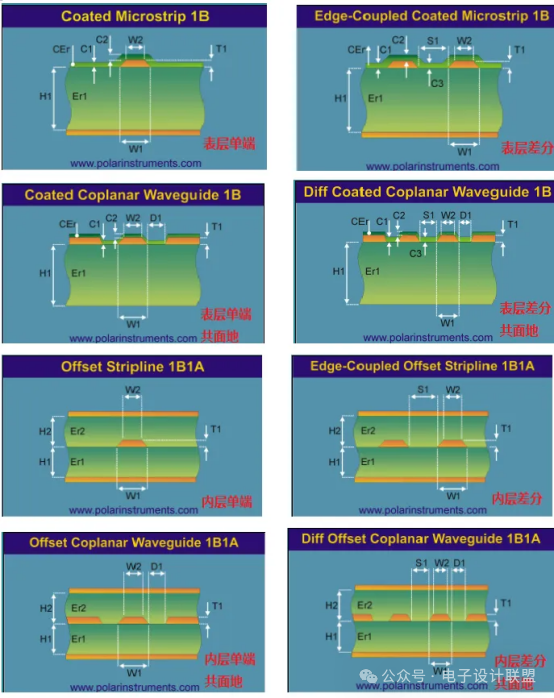
2. Three Core Impedance Models: A Diagram to Distinguish Inner and Outer Layer Differences
Before performing impedance calculations, it is essential to clarify “which model to use”. The commonly used Polar.SI9000 tool mainly revolves around three types of impedance models, each of which is further divided into inner and outer layer versions, as follows:
- Characteristic Impedance Model: Outer Layer Characteristic Impedance Model, Inner Layer Characteristic Impedance Model
- Differential Impedance Model: Outer Layer Differential Impedance Model, Inner Layer Differential Impedance Model
- Co-planar Impedance Model: Outer Co-planar Characteristic Impedance, Inner Co-planar Characteristic Impedance, Outer Co-planar Differential Impedance, Inner Co-planar Differential Impedance
The structural differences of each model can be intuitively understood with the diagram below:
3. Essential Knowledge Before Calculation: 7 Necessary Conditions + 6 Influencing Factors
Impedance calculation is not “just filling in numbers”; it requires clarifying core parameters and understanding influencing factors to ensure accurate results.
1. 7 Necessary Conditions: Missing One Counts as None
Just like cooking requires ingredients, impedance calculation must prepare the following 7 parameters in advance:
- Board Thickness: Overall thickness of the PCB
- Number of Layers: Including signal layers and power layers
- Material: Such as FR-4, Rogers, etc.
- Surface Process: Gold plating, tin spraying, etc.
- Impedance Value: Design target (e.g., 50Ω, 90Ω)
- Impedance Tolerance: Allowable error range (e.g., ±10%)
- Copper Thickness: Inner and outer layer copper foil thickness (1OZ=0.035mm, commonly used unit)
2. 6 Key Influencing Factors: Understanding Parameter Meanings with This Diagram
The impedance value is influenced by 6 factors, and the specific definitions of each factor can be understood through the parameter annotations in the diagram below:
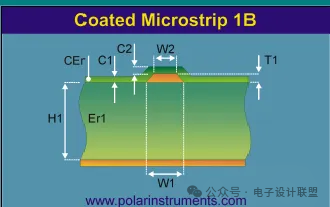
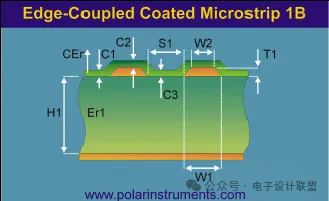
The specific meanings of each parameter are as follows:
- H1: Dielectric thickness (PP sheet or material, excluding copper thickness)
- Er1: Dielectric constant (average value when multiple PP/materials are laminated)
- W1: Width of the impedance line; W2: Width of the impedance line on the upper layer
- T1: Finished copper thickness
- Cer: Dielectric constant of green oil (fixed value 3.3)
- C1: Thickness of substrate green oil (usually calculated as 0.8mil)
- C2: Thickness of green oil on copper skin/line (usually calculated as 0.5mil)
- Zo: Theoretical value of the final calculated impedance
3. Tips: Relationship Table of Upper and Lower Line Widths
The upper and lower line widths (W1 and W2) are not fixed values and are influenced by copper thickness and process. The specific corresponding relationship can be referenced in the table below, and you can directly look it up during calculations:
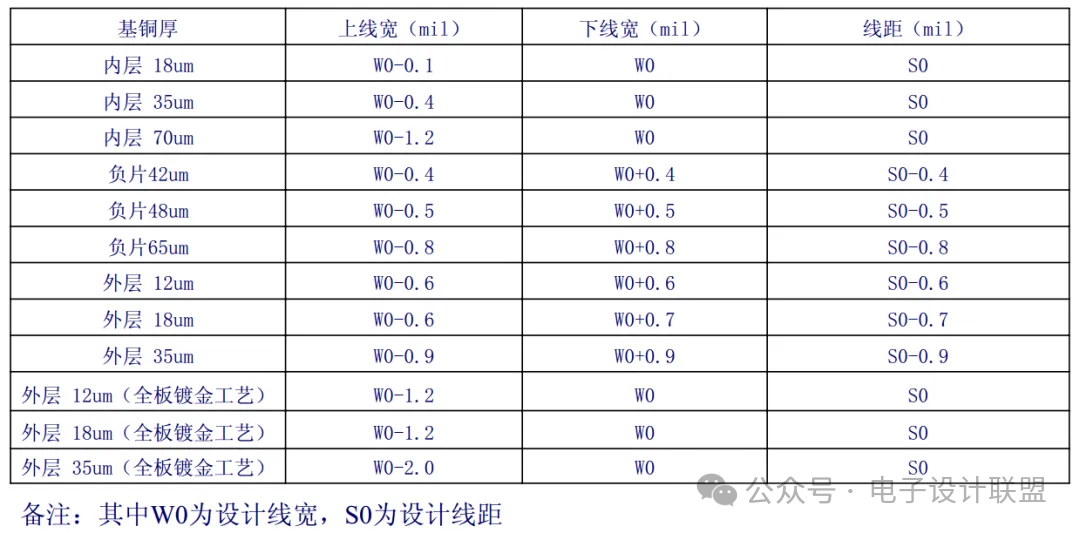
(Note: W0 in the table is the design line width, S0 is the design line spacing, and different copper thicknesses and processes correspond to different offset values)
4. Quick Reference for Material Parameters: No Need to Flip Through Manuals for FR-4, Rogers
The dielectric constant and thickness of the material are core inputs for impedance calculation. Different materials have significant parameter differences, and here we have compiled key data for commonly used materials that can be directly applied.
1. Common FR-4 Core Board: Shengyi and Equivalent Materials
FR-4 is the most commonly used material. The thickness (mm/mil) of Shengyi FR-4 core board corresponds to the dielectric constant as follows, choose according to board thickness requirements:

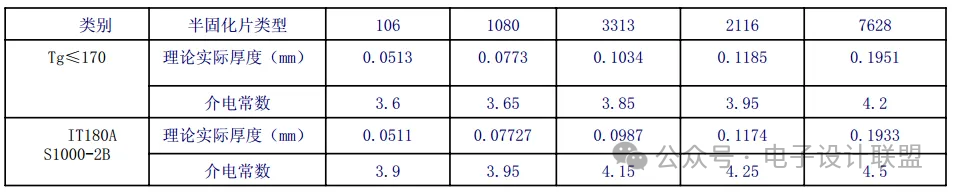
2. PP Sheets (Prepreg): Common Model Parameters Fixed
PP sheets are key materials for lamination, and the thickness and dielectric constant of common models are as follows:
- Model 106: Thickness 0.04mm
- Model 1080: Thickness 0.06mm
- Model 2116: Thickness 0.11mm
- Model 7628: Thickness 0.19mm
Specific parameters can be referenced in the table below:
3. Rogers Materials: Essential for High-Frequency Design
Rogers materials are commonly used in high-frequency PCBs due to their stable dielectric constant. Key parameters are as follows:
- Rogers4350: 0.1mm thickness with dielectric constant 3.36, other thicknesses 3.48
- Rogers4003: Dielectric constant 3.38
- Rogers4403 Prepreg: Dielectric constant 3.17
4. Lamination Precautions: Avoiding “Pitfalls”
Multilayer boards are formed by laminating core boards and PP sheets, and four rules must be followed to avoid interlayer misalignment and appearance defects:
- Do not stack 4 or more PP sheets, as it can easily lead to “sliding boards” (interlayer misalignment)
- Model 7628 PP sheets cannot be placed on the outer layer, as the rough surface affects appearance
- 3 Model 1080 PP sheets cannot be placed on the outer layer, as they can also easily slide
- Core board (CORE) thickness ≥0.11mm, use 2 core boards for 6-layer boards and 3 core boards for 8-layer boards
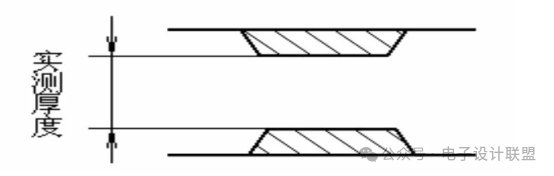
5. Measured Thickness ≠ Theoretical Thickness! This Formula Helps You Calibrate
During calculations, you may find that the theoretical board thickness and the actual measured value differ, and the issue lies in “copper thickness” and “remaining copper rate”.
1. Remaining Copper Rate: How to Define? How to Take Values?
The remaining copper rate is the ratio of “area with copper on the board / total board area”:
- Unprocessed raw material: 100%
- Etched light board: 0%
- Power ground plane: usually taken as 70%
- Signal layer: usually taken as 23%
- Outer layer: taken as 1 (default full copper coverage)
2. Actual Thickness Calculation Formula
To obtain an accurate measured thickness, use the following formula: Measured Thickness = Theoretical Thickness – Copper Thickness 1 × (1-X1) – Copper Thickness 2 × (1-X2) (X1, X2 are the corresponding layer’s remaining copper rates, copper thickness unit: 1OZ=0.035mm)
The difference between theoretical thickness and measured thickness can be understood with the diagram below:
6. Practical Case Study: Complete Impedance Calculation Process for a 6-Layer Board
Talking without practice is just empty talk. Here, we take a 6-layer board as an example to walk through the entire impedance calculation steps from requirement analysis to result output.
1. Clarifying Design Requirements (Known Conditions)
- Board Thickness: 1.2mm (allowable error ±0.12mm)
- Material: FR-4
- Number of Layers: 6 layers
- Copper Thickness: Inner layer 1OZ, outer layer 0.5OZ
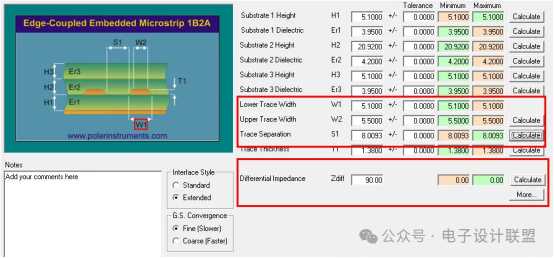
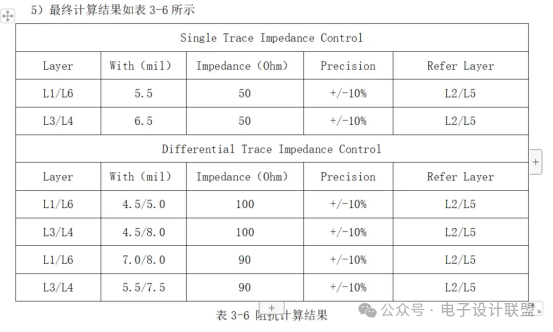
- Target Impedance: Outer layer 50Ω single line impedance, inner layer 90Ω differential impedance
2. Designing Lamination Structure
Based on the core board and PP sheet parameters, combined with the board thickness requirements, the designed 6-layer lamination structure is as follows, with key parameters annotated:
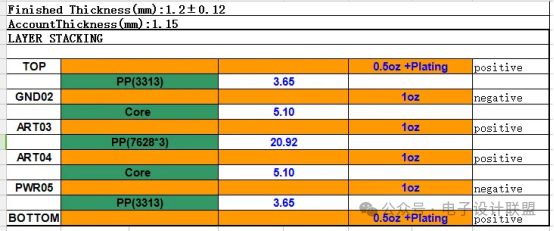
Key Calculation: Measured Thickness of PP Sheets
- PP (3313) Measured Value = 0.1034mm (theoretical value) – 0.035/2mm × (1-1) (outer layer 0.5OZ, remaining copper rate 1) – 0.035mm × (1-0.7) (inner layer 1OZ, remaining copper rate 70%) = 0.0929mm = 3.65mil
- PP (7628*3) Measured Value = 0.1951×3mm (theoretical value) – 0.035 × (1-0.23) (inner layer 1OZ, signal layer remaining copper rate 23%) × 2 = 0.5314mm = 20.92mil
Total Thickness Verification
Total board thickness
= 0.5OZ + 3.65mil + 1OZ + 5.1mil + 1OZ + 20.92mil + 1OZ + 5.1mil + 1OZ + 3.65mil + 0.5OZ = 1.15mm, meeting the requirement of 1.2±0.12mm.
3. Outer Layer 50Ω Single Line Impedance Calculation (SI9000 Practical Operation)
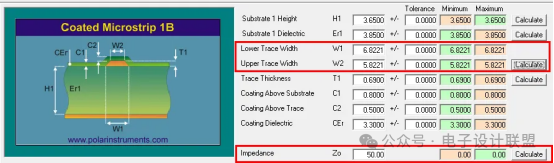
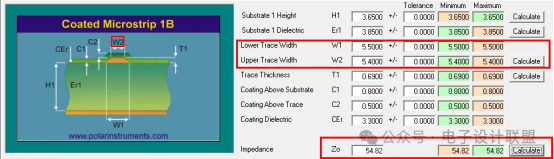
Open the SI9000 software, select “Outer Layer Characteristic Impedance Model”, fill in the lamination parameters (H1=3.65mil, Er1=3.85, T1=0.69mil, etc.), and calculate to obtain the theoretical line width W0=6.8mil.
Considering the actual routing difficulty, the line width can be slightly adjusted: when the line width is adjusted to 5.5mil, the impedance Zo=54.82Ω, which is within the tolerance range of 50Ω±10% (45-55Ω), meeting the requirements.
Calculation Interface Reference
5. Summary of Final Calculation Results
All impedance calculation results are organized as follows, which can be directly referenced during design:
Conclusion
Impedance calculation may seem complex, but it is actually a standardized process of “parameter preparation → model selection → software calculation → result adjustment”. As long as you grasp the meanings of the necessary parameters, material characteristics, and lamination rules, and practice with real cases, you can easily master it. I hope this article helps you avoid the “pits” of signal integrity and makes PCB design more efficient!

Simple Circuit Design: Sharing 10 Classic Circuit Diagrams
2025-11-18
Working in hardware is tougher, yet the rewards are less than software; what is the problem?
2025-11-17
Standardizing the Entire Process of Hardware Development: Chip Selection, Power Consumption Calculation, and Grounding Design
2025-11-14