Hello everyone, today I would like to share a recent article published in the Journal of the American Chemical Society, titled:Single-Crystalline Poly(disulfide)s Enabled by Photo-Triggered Topochemical Ring-Opening Polymerization of 1,2-Dithiolane.The corresponding author of this article is Professor Qi Zhang from East China University of Science and Technology.
Poly(disulfides) possess properties such as self-healing, self-adaptation, and chemical recyclability, making them one of the most attractive dynamic polymers in recent years. However, most poly(disulfide) materials are amorphous, and only a few poly(disulfide) materials exhibit semicrystalline properties through the introduction of cooperative ionic interactions or catalytic control of stereoregularity. Single-crystalline poly(disulfides) have yet to be synthesized or reported.
Topochemical polymerization restricts molecular mobility through the supramolecular preorganization of monomers, resulting in polymers with high crystallinity, high stereoregularity, and high purity, and has been used in the synthesis of many single-crystalline polymers. However, topochemical polymerization has mainly been applied to the formation of strong covalent bonds (such as C-C, C-N, and C-O bonds), and its applicability to dynamic and non-planar disulfide bonds remains unknown.
In this article, the authors report a photo-triggered topochemical polymerization reaction from single-crystalline 1,2-dithiolane monomers to single-crystalline poly(disulfides), synthesizing the first example of single-crystalline poly(disulfides). By synthesizing and screening a family of 1,2-dithiolane derivatives containing amide side chains, the authors found that the hydrogen bonds in the crystal structure of the monomer can precisely control the stereoconformation of the preorganized monomer. When the 1,2-dithiolanes are organized in a zigzag pattern with appropriate spatial distances, the monomer can undergo a quantitative photo-triggered topochemical polymerization reaction.
While studying the stereochemistry of disulfide bonds in 1,2-dithiolane containing chiral amide groups, the authors discovered that the single crystal of the monomer AD4 obtained at low temperature (100K) underwent a structural transformation upon heating to 200K while continuously receiving X-ray radiation. Further investigation revealed that this was due to the occurrence of a ring-opening polymerization reaction of AD4, resulting in the corresponding polymer single crystal PAD4, as shown in Figure 1.
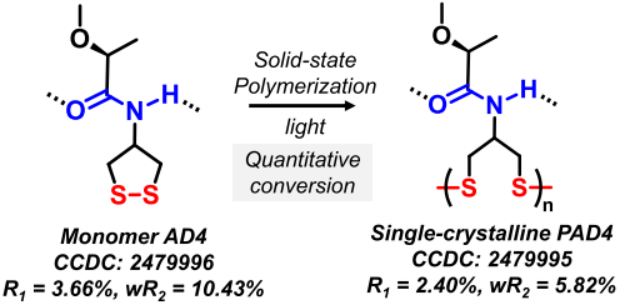
Figure 1. Schematic diagram of the polymerization of monomer AD4.
The authors conducted a detailed study of this process. In terms of crystal structure, the unit cell of PAD4 expanded by 13.5% and 4.8% along the b and c axes, respectively, compared to AD4, while it contracted by 17.4% along the a axis. On a macroscopic scale, after illumination, the yellow AD4 single crystal transformed into a white PAD4 single crystal, and an increase in width along the b axis (as indicated by the dashed line in the figure) was observed, along with the appearance of cracks. This was due to the internal stress generated by the non-uniform expansion/contraction of the crystal in different directions, as shown in Figure 2.
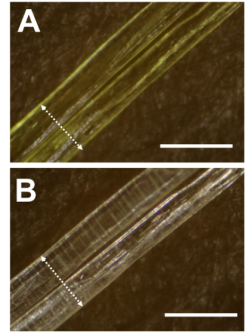
Figure 2. Photos of the large AD4 single crystal before (A) and after (B) X-ray photo-triggered polymerization.
From a thermodynamic perspective, the authors performed theoretical calculations to understand why photo-triggered polymerization could occur, as shown in Figure 3. Based on the crystal structures of AD4 and PAD4, the authors calculated the change in lattice energy to be -42 kJ/mol. Additionally, the release of ring strain during the ring-opening of 1,2-dithiolane also contributed approximately 18 kJ/mol to the enthalpy change.
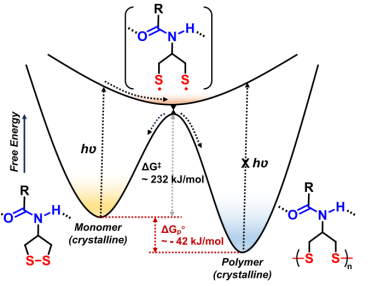
Figure 3. Theoretical calculation results of the polymerization process.
The authors also characterized the polymerization process through spectroscopy and phase structure analysis, as shown in Figure 4. In Raman spectroscopy measurements, the single crystal AD4 exhibited peaks at 485 cm-1 and 498 cm-1, which corresponded to two sets of C−S−S−C dihedral angles present in the crystal structure of AD4. After two hours of blue light irradiation, the resulting crystal showed a single Raman peak at 504 cm-1, confirming the quantitative conversion of cyclic disulfide bonds to linear disulfide bonds. Powder X-ray diffraction (PXRD) experiments demonstrated that the photo-triggered polymerization was a complete single-crystal to single-crystal transformation.
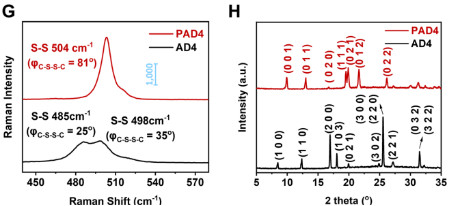
Figure 4. Raman spectroscopy characterization (G) before and after polymerization and PXRD characterization (H).
After successfully obtaining single-crystalline poly(disulfides), the authors compared its properties with those of amorphous poly(disulfides) prepared by solution methods, specifically poly(BSH-AD4), which was synthesized using DBU as a catalyst and benzyl mercaptan as an initiator through the ring-opening polymerization of AD4, as shown in Figure 5. TGA tests indicated that the single-crystalline poly(disulfides) exhibited higher thermal stability, with T95% = 251 °C, compared to 209 °C for poly(BSH-AD4). DSC tests of PAD4 showed no melting peaks or glass transition in the range of -20 °C to 140 °C, indicating its high thermal stability. Subsequently, the authors observed that the melting point of PAD4 reached as high as 240 °C through temperature-controlled optical microscopy, which corroborated the TGA results.
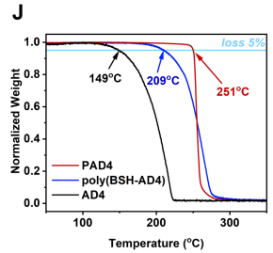
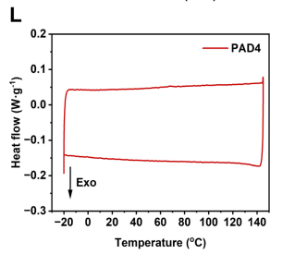
Figure 5. (J) TGA tests of PAD4, poly(BSH-AD4), and AD4, and (L) DSC test of PAD4.
Next, the authors investigated how the side chain groups of the monomer influence intermolecular hydrogen bonding and supramolecular self-assembly, thereby affecting the topochemical polymerization of 1,2-dithiolane. The authors synthesized a series of AD4 analogs, measured their structures after crystallization, and found that based on the assembly of the monomers in the crystalline state, all AD4 analogs could be divided into two categories: (1) layered and (2) zigzag, as shown in Figure 6. For the single crystals of AD4 analogs, hydrogen bonding was crucial for the assembly of the monomers. The rigidity of the hydrogen bond network prevented disulfide exchange from occurring in the direction parallel to the hydrogen bonds, allowing it to occur only in the orthogonal direction. In the case of layered assembly, 1,2-dithiolane was spatially separated, preventing disulfide exchange, while zigzag assembly allowed for the possibility of disulfide exchange. Whether topochemical polymerization can occur also depends on whether the atomic distances and geometric arrangements in the crystal structure are appropriate. The authors also identified two key distance parameters: (1) the distance dCC between C4 atoms of adjacent 1,2-dithiolane monomers, and (2) the distance dSS between S atoms of adjacent monomers. Only when the monomers are arranged in a zigzag manner and the aforementioned distances meet specific ranges can photo-triggered topochemical polymerization be achieved.
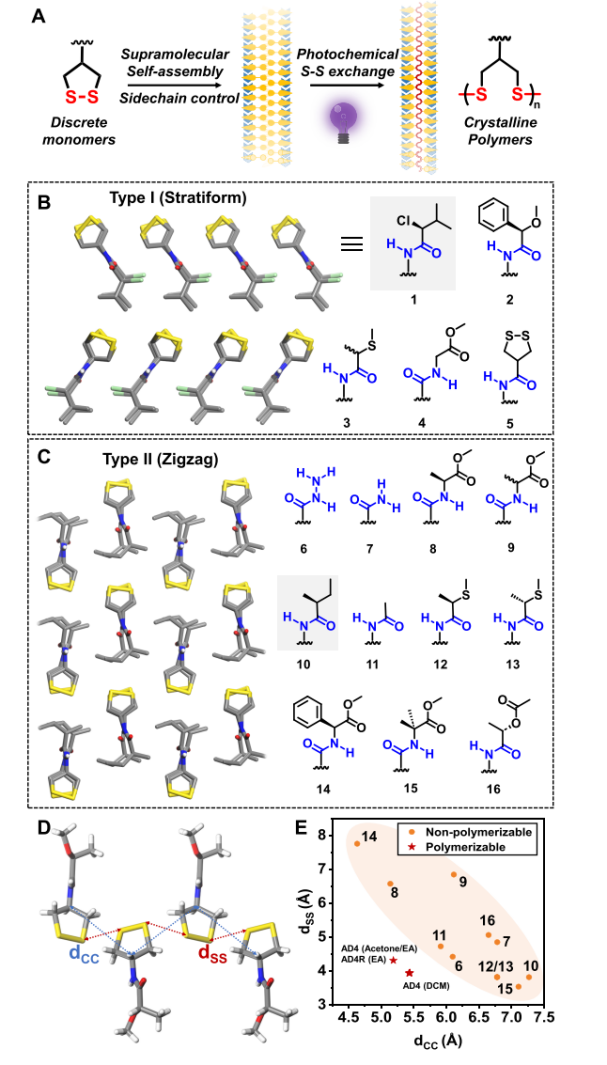
Figure 6. The influence of side chain groups on the topochemical polymerization of 1,2-dithiolane monomers.
In summary, this study successfully achieved the synthesis of single-crystalline poly(disulfides) through photo-triggered topochemical polymerization for the first time. The monomers underwent quantitative conversion during the polymerization process, and the side chain structure of the monomers played a crucial role in supramolecular assembly, which further influenced the ability of the monomers to undergo topochemical polymerization. The resulting single-crystalline poly(disulfides) exhibited record thermal stability. In the future, by combining high-throughput synthesis with theoretical simulations, it is expected to discover more monomer systems with similar behaviors, promoting the application of single-crystalline dynamic polymers in fields such as sensing, actuation, and information storage.
Author: LH
DOI: 10.1021/jacs.5c14450Previous article