I worry that when I mentionPCB test points, you might not know what I am talking about, so I specifically searched for a video screenshot on Bilibili to show you:
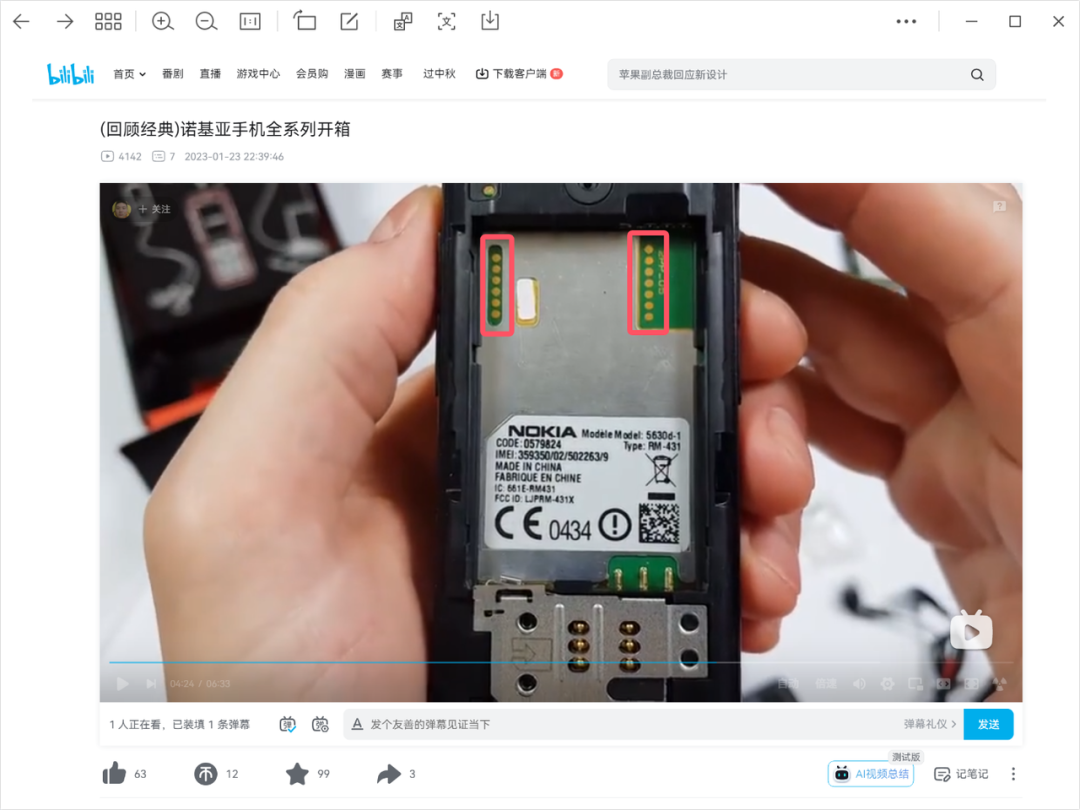
If you have ever used a NOKIA phone, every time you open the back cover to change the battery, you seethose two rows of circular dots—these are the PCB test points,or you can call them Test Points in English.
What is the purpose of the test points on NOKIA phones?Why are these two rows of test points left?
Although I do not know the specific functions of these test points on NOKIA phones, I can roughly guess:
-
Power supply: including at least one Vbat and one GND;
-
Power button: Power_Key, along with a pull-up power or pull-down GND;
-
Download: either the RX and TX of the serial port, or the VBUS, D-, D+, GND of USB, and possibly a BOOT signal to put the system into download mode;
-
SIM card test points: used during production or maintenance phase functional testing with an external fixture for quick detection;
-
Some signal test points for RF calibration;
-
Other test points that are not exposed but can provide some fault information during maintenance.
So back to the question, why leave these test points?
There are basically three reasons:
1. Some signals from these test points are not needed by users, so there is no need to bring them out with a dedicated connector;
2. The test point format is a perfect match with test fixtures; it is impossible to operate in large batches without the involvement of fixtures, such as software upgrades, RF parameter calibration, functional testing, etc.;
3. When you have assembled the product and need factory inspection or after-sales maintenance, the best practice is to avoid disassembling the shell if possible, so leaving test points on the shell without affecting aesthetics is the best and most universal approach.
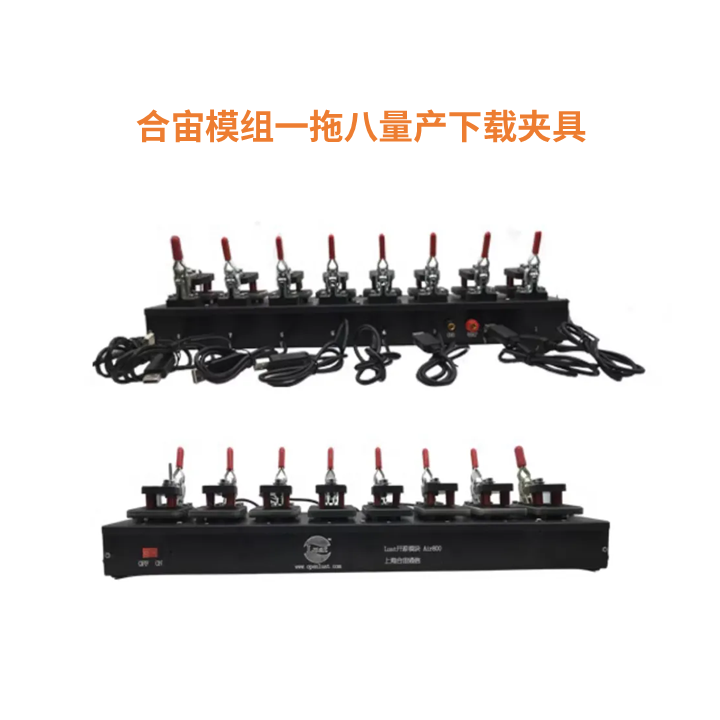
Regarding fixtures, if you have no concept of them, you can take a look at what the fixture we use for module software upgrades looks like:
So… what does this have to do with the module?
Even if it is related to the module, what does it have to do with me as a user of the module?
Let’s put it this way, it may not be very relevant to you, but there is still some connection.
If you are a user developing with AT commands:Although theoretically you will not need to upgrade the module software, what if? What if you encounter a problem you have never faced before? What if your product needs a little customization? What if you only discover these after your PCB assembly is complete?
If you are a user developing with LuatOS:Then you need to bring out the test points even more, because “all software-related issues need to be considered comprehensively”.
To avoid having to desolder the module for upgrades, I will take the Air700ECQ as an example and suggest that you must bring out the relevant test points.
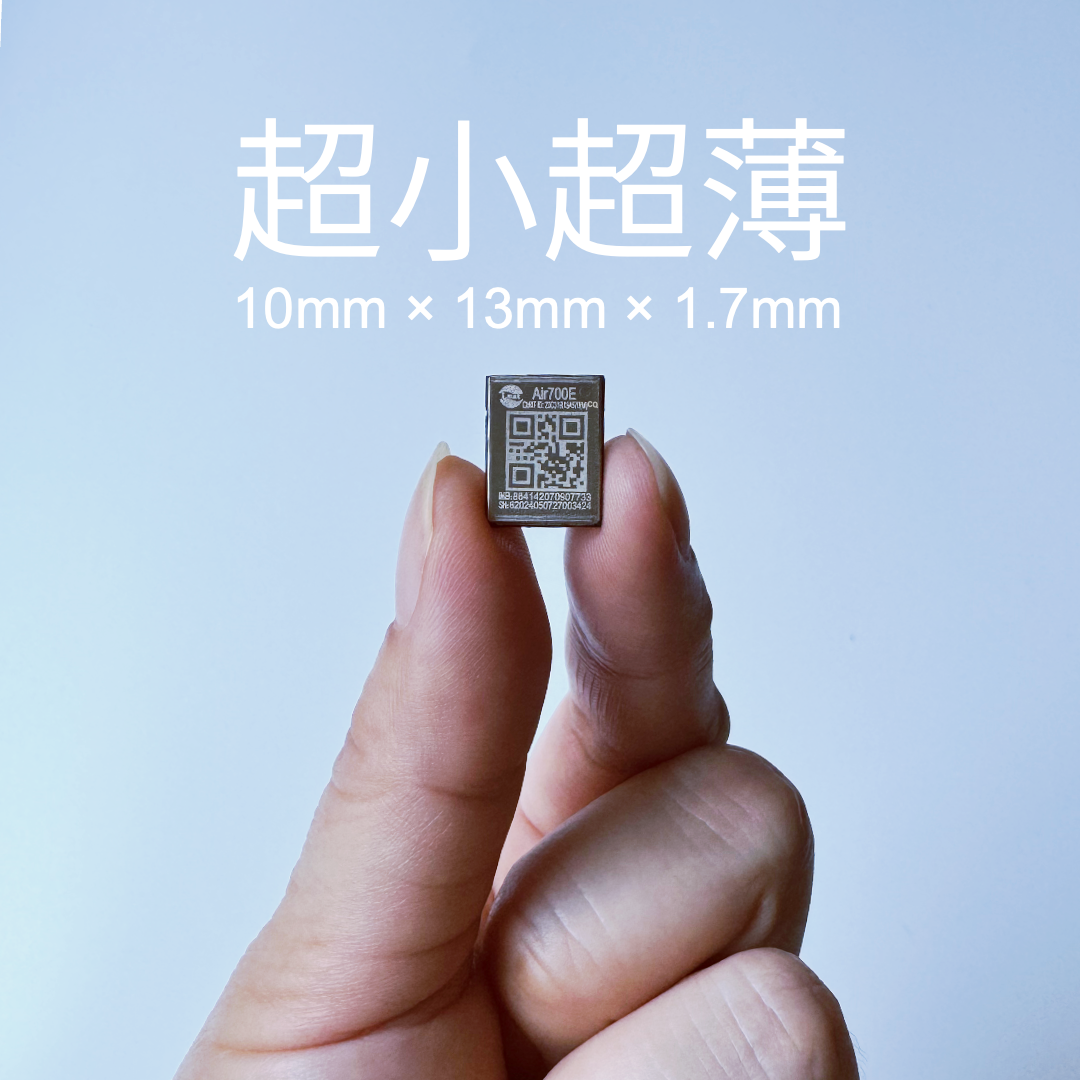

Pin Diagram of Air700ECQ Module
For detailed descriptions of the relevant pins, refer to the Air700ECQ hardware design manual.
Latest documentation link for Air700ECQ:
www.air700ecq.cn
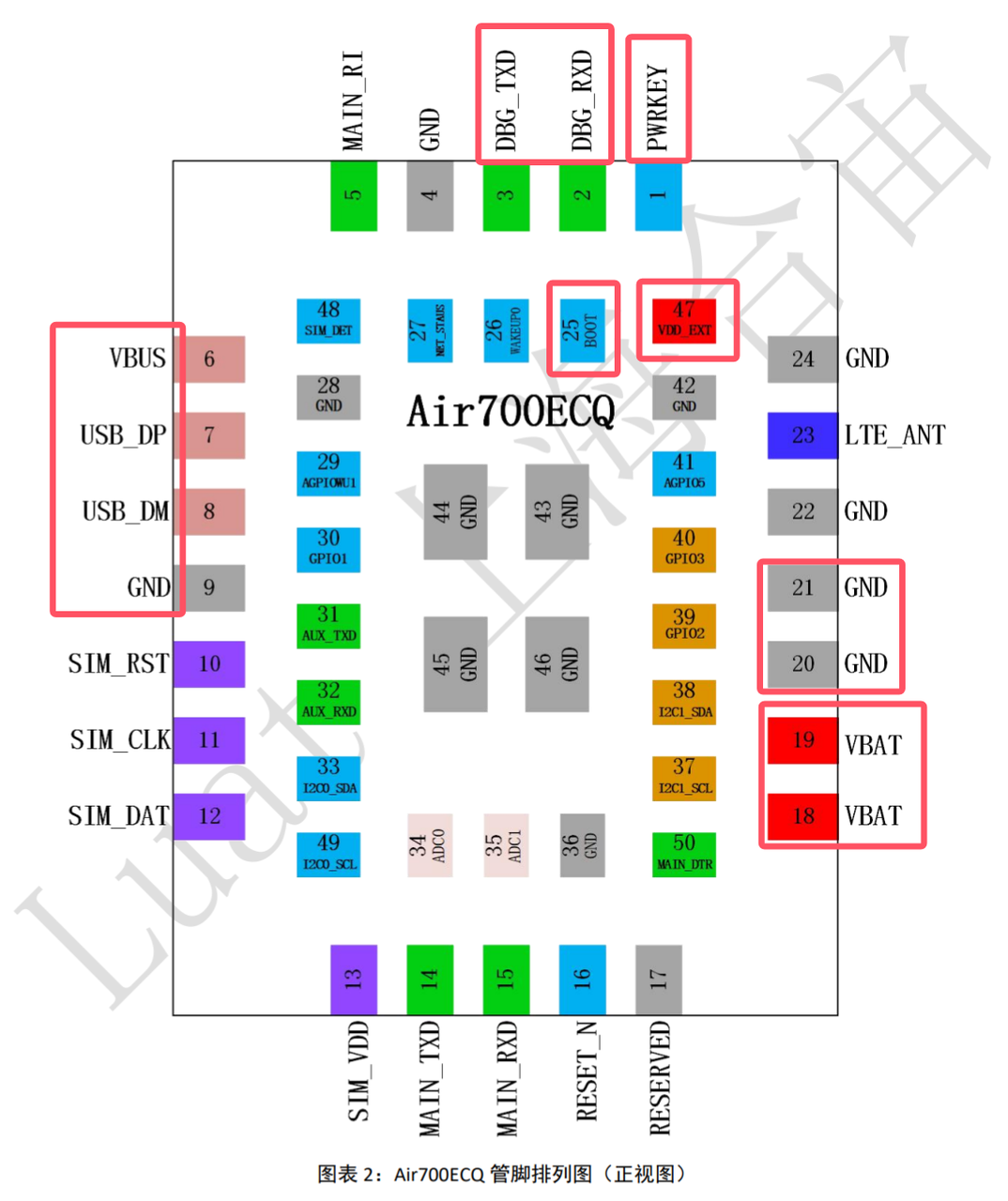
Recommended Test Points for Air700ECQ
-
Power-related:VBAT, GND;
-
Power-on related:Power_Key, BOOT, VDD_EXT;
-
Download related:VBUS, DP, DM, GND;
-
Debug serial port related:If your product architecture requires communication with the main control via USB, meaning that when you need to capture module traces, USB must be operational.
Then you also need to bring out the debug serial port test points:DBG_TXD, DBG_RXD;
-
Operational experience related:Moreover, the best situation is to have enough test points brought out on the PCB like NOKIA,and also to facilitate direct operation of the entire machine,rather than having to open the shell for operation, which is really a poor experience for large batch rework.
You might want to start “arguing” with me,what’s the worry without test points, isn’t there FOTA service from Hezhou?
Yes, you are right, but FOTA is generally used for operations after bulk shipment, as FOTA has several weaknesses:
1. It consumes SIM card data;
2. Requires queuing for large batch operations;
3. FOTA software upgrades are fine, but FOTA uploading traces is quite challenging.
So, it is still best to leave good test points.
Whether the PCB test points are well reserved essentially reflects your ability and thinking as an engineer in “preventing problems before they occur”.
It is possible that the test points you reserved will never be used, but when you absolutely need to use them—they can really prevent mass failures.
I hope our users all possess this ability of “preventing problems before they occur”.

▼ Contact Hezhou’s Marketing Department ▼

Scan the QR code to add friends on WeChat/Enterprise WeChat
▼ Learn More About Hezhou ▼
4G+ positioning + WiFi + Bluetooth, Air8000 complete development boardNew Air8101 core board + accessory board
Hezhou low-power 4G module, adding 4 more hardcore new products