 Device diagnostics is a core technical means to ensure the safe, stable, and efficient operation of production equipment within modern industrial operation and maintenance systems. The process features clear systematic and closed-loop characteristics. According to the device diagnostic process illustrated in the figure, the professional functions and operational logic of each link are as follows:
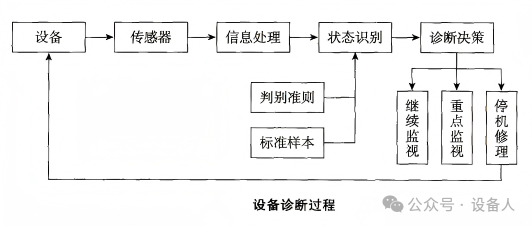 01Device Status Signal Acquisition StageThe diagnostic process centers around the target device, utilizing specialized sensors to complete the acquisition of status signals. In this stage, sensors capture key physical parameters such as vibration, temperature, pressure, and noise in real-time during the device’s operation, converting these non-electrical physical signals into standardized electrical signals to provide raw data support for subsequent diagnostic analysis. This stage serves as the data foundation for the diagnostic process, and the accuracy of data acquisition and parameter coverage directly determines the accuracy and comprehensiveness of subsequent analyses.02Information Processing StageInformation processing is a critical intermediate link connecting data acquisition and state recognition. This stage involves specialized processing of the raw signals collected by the sensors, including filtering, noise reduction, signal amplification, and feature extraction: on one hand, it eliminates ineffective information such as environmental interference and redundant noise from the device; on the other hand, it extracts key feature parameters that effectively represent the device’s operating status (e.g., vibration amplitude, temperature fluctuation coefficient), transforming raw signals into analyzable feature information to provide precise analysis targets for state recognition.03State Recognition StageState recognition is the core judgment stage of device diagnostics, relying on two fundamental elements: first, the preset criteria for determining device states (i.e., thresholds and rules based on industry standards and technical specifications); second, the standard sample library of device states (which includes characteristic data templates for normal operation, potential anomalies, and faults). This stage compares and analyzes the processed feature information with the data from the standard sample library, using the judgment criteria to accurately identify the current operating state of the device, clarifying the state level of the device and providing authoritative judgment basis for subsequent decision-making.04Diagnostic Decision and Closed-Loop Feedback StageDiagnostic decision-making is the output stage of the process, forming targeted operation and maintenance strategies based on the state recognition results, which include three types of measures:1. Continue Monitoring: Applicable when the device state meets normal operating standards, maintaining regular monitoring frequency and parameter acquisition range;2. Key Monitoring: For states showing slight abnormal trends, increasing monitoring frequency and expanding parameter acquisition density to dynamically track abnormal trends;3. Shutdown for Repair: When the device is identified as having a fault, immediately triggering a shutdown repair command to prevent production interruption or safety risks caused by fault escalation.At the same time, the decision results will be fed back to the device monitoring front end, continuously optimizing subsequent signal acquisition strategies and state monitoring plans, forming a complete closed loop of “acquisition-processing-recognition-decision-feedback” to ensure the dynamic adaptability and sustained effectiveness of the diagnostic process.In summary, the device diagnostic process achieves full-cycle dynamic tracking and precise operation and maintenance measures for the device’s operating status through systematic stage design. It is an important technical support for building modern industrial intelligent and refined operation and maintenance systems, playing an irreplaceable key role in enhancing equipment reliability, reducing operation and maintenance costs, and ensuring production continuity.