Is a system watchdog really a “dog”?
For newcomers in industrial control, the first time they hear about a “system watchdog,” they are likely to be puzzled: is it a pet dog for the device? Or some hardware marked with a “dog” label? The answer is quite simple —The system watchdog (Watchdog) is the “dedicated security guard” in industrial equipment; it is neither an animal nor independent hardware, but a monitoring mechanism embedded in the CPU, PLC, or microcontroller, with a core mission: to prevent the system from “crashing” or “hanging” and ensure the device operates continuously and stably.

The “working routine” of a watchdog is so simple that it doesn’t seem like a technical task!
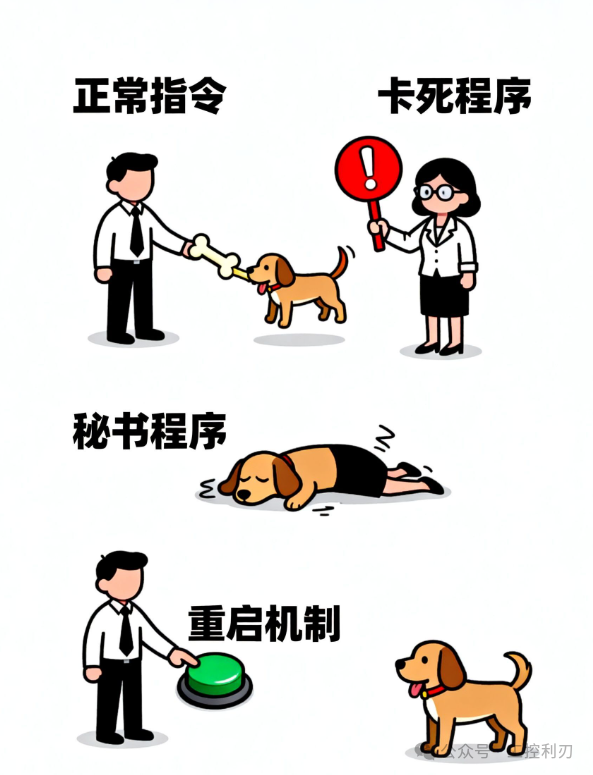
Many people think that a watchdog is high-end technology, but the principle is super simple; using the metaphor of “boss and secretary” makes it easy to understand:
1. Role DivisionThe system (CPU/PLC) is the “boss,” and the watchdog is the “secretary,” with a preset “timeout” (for example, 1 second);2. Regular “Check-ins”When the boss is working normally, he sends a “signal” to the secretary every so often (in the industry, this is called “feeding the dog”), telling the secretary, “I’m not slacking off, everything is normal”;3. Timeout “Accountability”If the boss fails to send a signal for more than 1 second due to program hangs, infinite loops, etc., the secretary determines that the “boss is unreachable” and immediately executes a “forced restart” (for example, cutting off the device’s power and then restoring it), allowing the boss to “return to work”;4. Core LogicThe watchdog itself does not participate in the normal operation of the device; it only supervises and provides emergency assistance, essentially installing an “automatic restart switch” for the system.
It is important to emphasize:The “feeding the dog” signal must be sent by a normally running program. If the program gets stuck in an infinite loop, experiences memory overflow, or hardware failure, and cannot “feed the dog” on time, the watchdog will assume a system fault and trigger a reset. For example, if a PLC gets stuck executing a complex instruction and cannot send the “feed dog” pulse on time, the watchdog will initiate the restart process to prevent the production line from stopping for an extended period.
Why can’t industrial control devices do without a “watchdog”?
The industrial environment is far more complex than a laboratory: voltage fluctuations, electromagnetic interference, dust and humidity, program bugs… all of these can cause devices to “go on strike.” The existence of the watchdog is to respond to these unexpected situations, and the following three scenarios particularly highlight its importance:
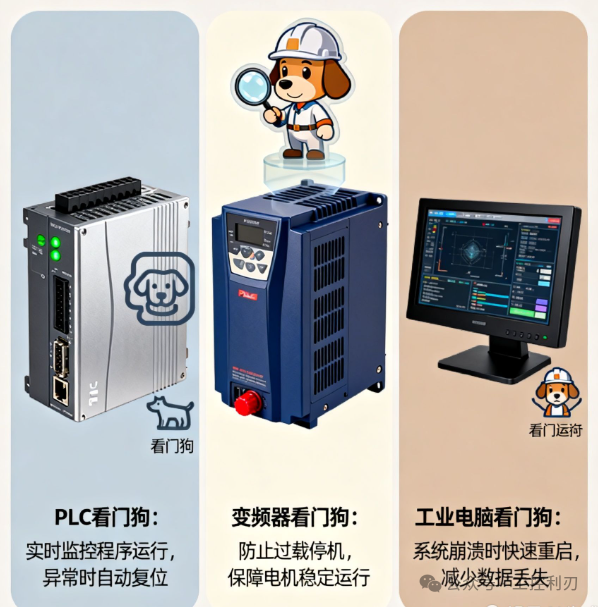
- PLC / Microcontroller Control SystemsFor example, in a factory’s sorting robot or injection molding machine, if the PLC program hangs, the robot may stop in the middle of the track, causing the entire production line to paralyze. The watchdog will restart the PLC within 10-100 milliseconds, allowing the device to quickly resume operation and minimize losses;
- Frequency Converters / Servo DrivesFrequency converters may experience program anomalies due to electromagnetic interference during high-frequency operation, resulting in “speed control failure” or “no response.” The watchdog will timely reset the drive to prevent equipment overload damage or safety incidents;
- Industrial Computers (IPC)Industrial computers used for monitoring production data may crash due to software conflicts, leading to data loss and monitoring interruptions. The watchdog can automatically restart the computer, ensuring the monitoring system remains online.
How to Properly Set Up a Watchdog?
1. Check the device manual: The watchdog function of devices like PLCs and frequency converters can usually be enabled through parameter settings (for example, the “watchdog timer” parameter in Siemens PLCs) according to the device manual;2. Set a reasonable timeout: Generally set to 1.5-2 times the normal operating cycle of the system; for example, if the normal response time of the system is 300 milliseconds, the timeout can be set to 500 milliseconds;3. Combine with fault logging: It is recommended to enable the fault logging function of the device while enabling the watchdog, to facilitate subsequent investigation of “why the watchdog was triggered” (for example, whether it was due to electromagnetic interference or program issues).
Previous Recommendations
Advanced industrial skills! Comprehensive materials for the entire AB series (PLC + touch screen + frequency converter + servo) to master everything!
In-depth learning of Inovance PLC! Complete learning materials packaged for direct use in industrial sites! [Exclusive download code at the end of the article]
A must-have for electricians & electrical engineers! A complete package of software tools for drawing/programming/simulation/calculation!
One-stop learning for Omron PLC! Comprehensive materials for the CP/NX/NJ series, from beginner to advanced! [Exclusive download code at the end of the article]
A comprehensive learning guide for electricians! Complete materials from beginner to intermediate and advanced levels, suitable for both novices and veterans!
Exclusive benefits for DCS & PCS maintenance engineers! Complete materials for ZheJiang University Central Control + Siemens, no worries about debugging and maintenance!
Robot resource library! Coverage of 13 major brands, including ABB/Fanuc/Yaskawa/KUKA, all packed together!
Want to learn CAD from scratch? This complete set of materials + underlying logic will help you get started quickly!
Industrial control professionals rejoice! A package of 3900+ essential PPTs covering electrical assembly, PLC, and robotics!
From beginner to expert in EPLAN! A complete set of learning resources packaged to double your electrical drawing efficiency!
Need case studies for automation? Here it comes! 15 major brands + over 5000 engineering cases, with software installation tutorials!
Short on source code for PLC programming practice? Practical cases & source programs for electricians + Mitsubishi & Siemens, ready for hands-on practice! (Download link at the end of the article)
Preparing for the electrician technician certificate? A package of over 700 pages of supporting courseware, covering exam points + practical operations! (Download link at the end of the article)
Newbies learning PLC? Here are 9 programming methods for one-click start-stop: a guide to improving efficiency from basics to advanced! Be sure to bookmark!
Stuck drawing electrical diagrams? Can’t troubleshoot? A package of 5000 ready-made drawings covering 90% of industrial scenarios! (Download link at the end of the article)
Can’t find the manual for repairing frequency converters? A package of manuals for over 300 brands, ready for immediate use!
From novice to expert: A complete guide to Siemens 1200 TIA Portal programming, easily mastering core skills! (Exclusive download link at the end of the article)