
Research Background:
Two-dimensional covalent organic frameworks (2D COFs) exhibit tremendous application potential in fields such as sensing, catalysis, and optoelectronic devices due to their tunable pore structures and excellent electronic conjugation properties. However, under solid-state conditions, the luminescent performance of most 2D COFs is weak or even non-existent due to intramolecular rotation and vibration, as well as strong intermolecular π-π stacking interactions, which severely limits their practical applications. Therefore, precisely modulating the D-π-A structural push-pull electronic effect in interfacial nanofilms to achieve high-performance fluorescence sensing remains a key challenge.
Article Overview:
Professor Ding Liping and the team of Taihong Liu from Shaanxi Normal University successfully prepared four types of structurally uniform, smooth-surfaced, thickness-controllable fluorescent nanofilms with different D-π-A push-pull electronic strengths, achieving ultrasensitive high-performance gas-phase sensing of chemical agent simulants. This research employed a liquid-liquid interfacial dynamic condensation strategy, using IDT (indeno[1,2-b]thiophene) with strong electron-donating ability as the donor, and conducting Schiff base condensation reactions with heterocyclic triphenylamine-based acceptors with varying nitrogen atom counts to achieve precise construction of the nanofilms. By adjusting the number of nitrogen atoms in the acceptors and the microenvironment, precise modulation of the D-π-A push-pull electronic strength in the interfacial films was achieved at the atomic scale, effectively regulating the energy level structure, intramolecular charge transfer (ICT) efficiency, and fluorescence performance of the nanofilm materials. Experimental validation and theoretical calculations both indicated that the IDT-TAPM nanofilm exhibited the strongest electron affinity and proton binding ability due to its central pyridine ring structure, showing the most significant fluorescence enhancement and red shift when in contact with the nerve agent simulant diethyl chlorophosphate (DCP) gas, confirming it as the optimal sensing material in this system. The layered sensor constructed based on this nanofilm demonstrated excellent overall performance in detecting DCP: rapid response (fluorescence “on” within 3 seconds), wide detection range (0.1 ppb to 132 ppm), and extremely low detection limit (0.066 ppt), far below the immediately life-threatening concentration of sarin reported in the literature (7 ppb). Furthermore, the IDT-TAPM nanofilm sensor maintained good stability after 55 cycles of use, demonstrating excellent photochemical stability and reversibility. This work not only opens up a new strategy for achieving fluorescence “on” and ultrasensitive fluorescence detection through precise modulation of the D-π-A system in interfacial nanofilms but also lays the material and device foundation for developing the next generation of portable, high-reliability chemical warfare agent detection devices.

Illustrated Guide:
Figure 1: This figure theoretically elucidates how to control the spin flip path of excitons like a switch by modulating the energy levels of charge transfer states, thereby selectively achieving TADF or RTP and demonstrating specific molecular implementation methods: starting with the Cor-PTZ molecule, systematically adjusting the energy levels of the CT state by selectively oxidizing the donor (PTZ).
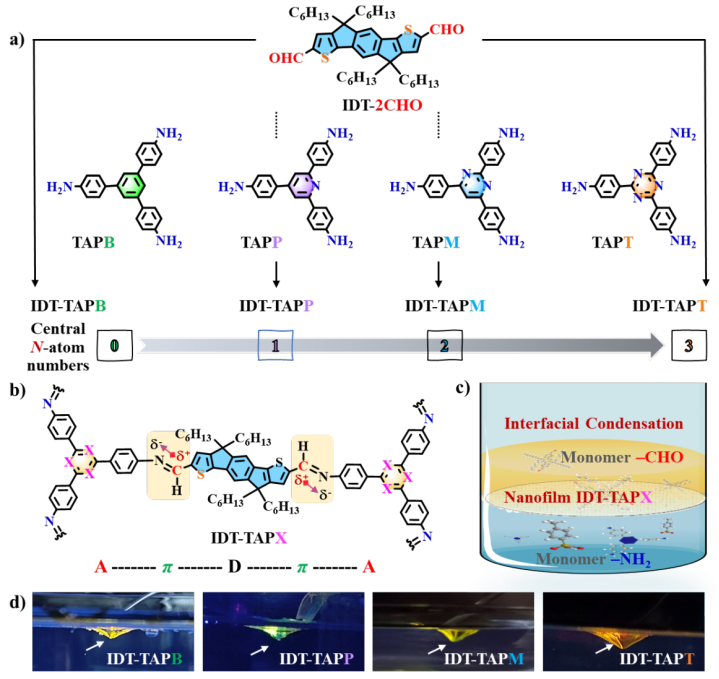
Figure 1. (a) Molecular structures of the two types of monomers used to construct the interfacial nanofilms and schematic diagrams of the four types of nanofilms obtained; (b) Analysis of the different D-π-A push-pull electronic strength characteristics in the molecular framework of the interfacial nanofilms; (c) Schematic diagram of the preparation of nanofilms based on the liquid-liquid interfacial condensation strategy; (d) Visualization of the four types of nanofilms floating on the water surface.

Figure 2. (a) Normalized UV-Vis absorption spectra and fluorescence emission spectra of the four types of nanofilms, with insets showing the UV-Vis and fluorescence visualization images of the films; (b) Theoretical calculations of the molecular framework of the nanofilms and energy level orbitals; (c) Electrostatic potential distribution map of the molecular framework of the nanofilms.
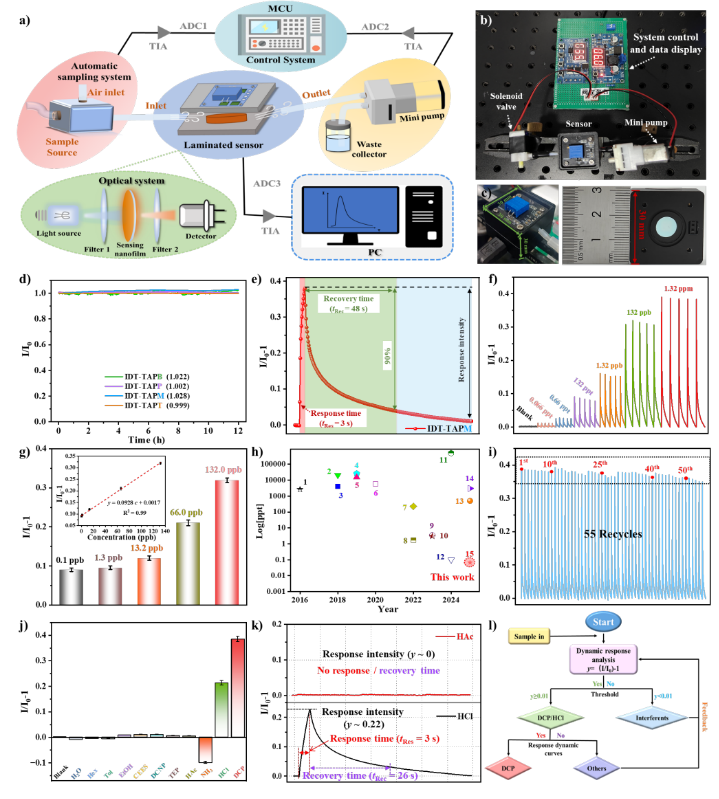
Figure 3. (a) Schematic diagram of the layered sensing device with independent intellectual property rights developed by the team; (b) Prototype diagram of the sensing platform; (c) Physical image of the small layered sensor; (d) Results of photochemical stability tests of the four types of nanofilms; (e) Response-recovery curve of the IDT-TAPM nanofilm to DCP; (f) Sensitivity tests of the IDT-TAPM nanofilm to different concentrations of DCP; (g) Relationship between the response intensity of the IDT-TAPM nanofilm and DCP concentration; (h) Comparison of the detection limit results of this work with reported DCP detection limits; (i) Reversibility and repeatability of the IDT-TAPM nanofilm response to DCP; (j) Response intensity of the IDT-TAPM nanofilm to DCP and potential interferents; (k) Kinetic curves of the IDT-TAPM nanofilm response to HAc and HCl; (l) Analytical flowchart and logical judgment diagram of the detection process of the sensing platform.
Paper Information
Precise Donor-π-Acceptor Strength Modulation in Interfacial Nanofilms Toward Ultrasensitive Fluorescence Detection
Jinghua Yu, Haixia Chang, Wendan Luo, Liping Ding,* Taihong Liu,* and Yu Fang
Advanced Optical Materials
DOI:10.1002/adom.202502848
Original Link
https://doi.org/10.1002/adom.202502848
Journal Introduction
Advanced Optical Materials is an international, interdisciplinary forum for peer-reviewed papers in materials science, focusing on all aspects of light-matter interactions. It is dedicated to groundbreaking discoveries and fundamental research in fields such as photonics, plasmonics, and metamaterials.