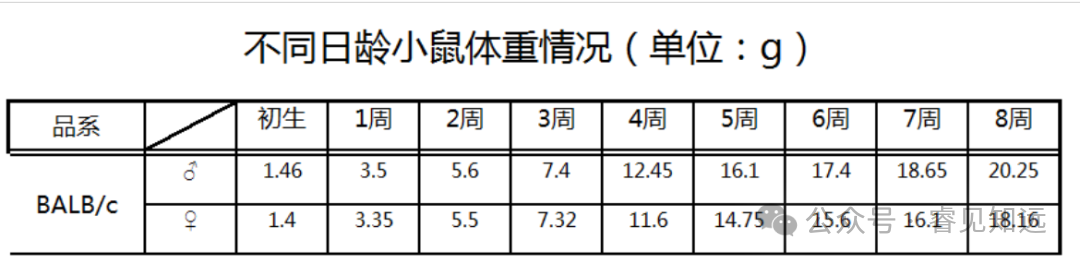
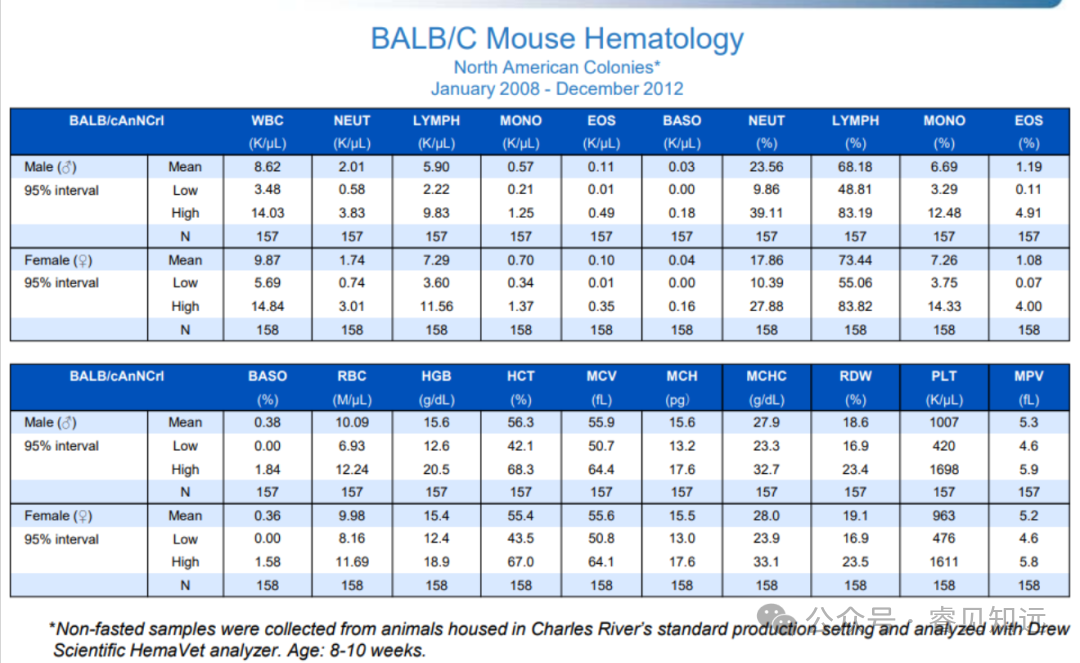
In 1913, H.J. Bagg from the National Cancer Institute in the United States bred the “Bagg albino” from a white original strain; in 1923, Mac Dowell conducted inbreeding; and in 1932, the 26th generation was obtained and named the BALB/c strain.The BALB/c mouse is difficult to distinguish from the “ICR” and “NIH” mice, all having a pair of ruby-like eyes and a coat of smooth, pure white fur. However, the genetic background of BALB/c mice is an inbred strain, bred from siblings, resulting in smaller individual differences, purer genetic traits, and overall better quality.BALB/c mice have a low incidence of breast cancer, but the likelihood of developing other cancers (such as lung cancer and kidney cancer) significantly increases with age. The incidence of breast tumors is approximately 10% to 20%. There is a certain number of occurrences of ovarian, adrenal, and lung tumors, as well as leukemia. The incidence of lung cancer is 26% in females and 29% in males. The incidence of leukemia is 12% in females and 10% in males. Compared to other inbred mouse strains, they have the highest blood pressure and exhibit spontaneous hypertension. Older mice show certain cardiac lesions, and both male and female mice often have arteriosclerosis. Almost all male mice at 20 months of age exhibit amyloidosis. They are sensitive to Salmonella typhimurium C5, moderately sensitive to the measles virus, prone to chronic pneumonia, and extremely sensitive to radiation. The ratio of reticuloendothelial organs (such as the liver and spleen) to body weight is quite large. They are commonly used in monoclonal antibody and immunology research. BALB/c mice have good reproductive performance, a long breeding period, generally no aggressive behavior, and are relatively easy to group rear. Average lifespan: some records show males live for 509 days and females for 561 days; others record males living for 648 days and females for 816 days. The average weight of 252-day-old males is 30 g and females is 28 g.

Characteristics
1. Long breeding cycle, good reproductive performance.
2. Low natural incidence of breast tumors, but sensitive to carcinogenic factors.
3. Extremely sensitive to radiation, prone to chronic pneumonia, exhibit spontaneous hypertension, and older mice have cardiac lesions, with both male and female mice showing arteriosclerosis.
4. Sensitive to Salmonella typhimurium, Leishmania, Rickettsia, and histamine factors.
Uses
1. Used in oncology, physiology, immunology, nuclear medicine research, and the preparation of monoclonal antibodies.
2. Used to establish experimental animal models for lung cancer, kidney cancer, etc.
3. Injection of mineral oil can rapidly induce plasmacytoma; this strain is widely used in hybridoma and monoclonal antibody production.
Common Laboratory Animal Mouse – ICR Mouse
Reference for Experimental Projects and Pricing
Table of Contents for Experimental Projects (Collection)
Experimental Animal/Cell Operation Techniques (Summary)
Experimental Animal Tissue Organ Section Staining (Summary)
Common Tissue Pathology Staining Analysis of Experimental Animals (Summary)
End~
We undertake model establishment for mode animals, cell culture model establishment, paraffin embedding sections, frozen embedding sections, various staining (HE, Masson, Oil Red O, etc.), IHC, IF, WB, PCR, in situ hybridization, bright field/fluorescence panoramic scanning, biochemical testing (manual biochemistry, ELISA, machine biochemistry), laser confocal (CLSM), small animal Micro CT, SEM (scanning electron microscopy), TEM (transmission electron microscopy), general pathology/super-micro pathology analysis, tissue chip production, and other experimental outsourcing!

For experimental consultation, business cooperation, and reprint authorization, please contact WeChat ID: AY54L5 (please add and indicate your purpose) or email: [email protected]